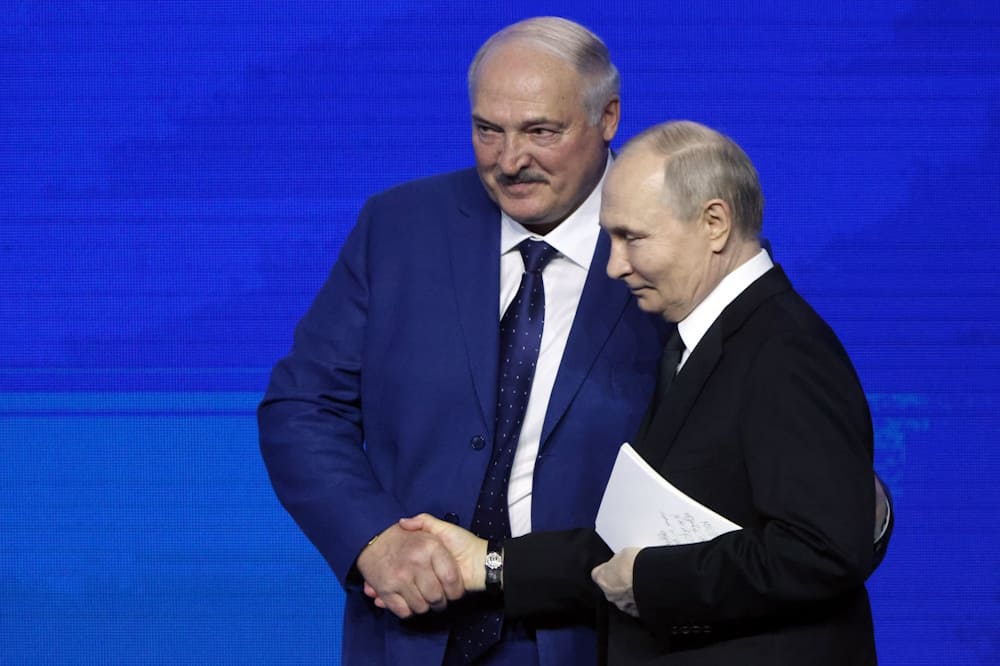
In recent months, a quiet but consequential debate has taken shape within the Belarusian democratic movement. Far from presenting a unified front, the opposition appears increasingly divided over a fundamental strategic question: how should they and how should the European Union deal with Alexander Lukashenko?
At the heart of the disagreement lies a dilemma that has haunted Belarusian politics since the failed uprising of 2020: whether to maintain strict isolation of the regime or to consider limited, pragmatic engagement. What was once an implicit tension has now surfaced more openly, revealing a movement still searching for a coherent strategy and, perhaps more importantly, for a shared reading of the country’s new political reality.
On one side stand those who argue that any form of engagement with Lukashenko, even narrowly defined or conditional, risks legitimizing authoritarian rule. For this camp, the moral clarity of isolation remains essential. Sanctions, diplomatic exclusion, and unwavering political pressure are seen not only as instruments of accountability but as symbolic recognition that the regime lacks democratic legitimacy. To deviate from this line, they warn, would reward repression, undermine political prisoners, and fracture the credibility of the opposition itself.
On the other side are voices advocating a more pragmatic approach. They do not deny the regime’s authoritarian nature, but question whether total isolation has achieved its intended results. Belarus, they argue, has become more deeply entrenched in Russia’s geopolitical orbit, economically and militarily. Continued exclusion from European channels may only accelerate that dependence. From this perspective, carefully calibrated engagement – whether humanitarian, technical, or diplomatic – could reduce Belarus’s international marginalization and potentially create openings for civil society in the long term.
The recent American shift toward limited re-engagement with Alyaksandr Lukashenko has intensified this internal dispute. By reportedly linking selective prisoner releases to high-level diplomatic contacts, Washington has opened what might be described as a humanitarian channel: concrete concessions in exchange for narrowly defined political rewards. For some within the Belarusian opposition, this appears to validate the argument that engagement, if carefully structured, can produce tangible results. If prisoners are freed, they ask, why should the European Union refuse to explore a similar path? Yet for Brussels, the equation is neither symmetrical nor purely humanitarian.
Before assessing what the EU should do, however, it is necessary to examine more closely what this divide within the opposition reveals. The disagreement is not merely tactical. The very fact that engagement remains a serious option in parts of the debate suggests an incomplete reckoning with how profoundly Belarus has changed since 2020. The question is no longer simply whether dialogue is morally acceptable or strategically wise. It is whether the political system that exists today retains the autonomy necessary for such engagement to produce meaningful results at all.
Since the mass protests of 2020, Lukashenko’s dependence on Moscow has shifted from structural to existential. What was once a carefully calibrated balancing act between East and West has collapsed into near-total reliance on the Kremlin. Politically isolated after the brutal crackdown on protesters, Lukashenko turned decisively to Vladimir Putin for survival. Financial support, security guarantees, intelligence cooperation, and diplomatic backing became the pillars sustaining his rule.
This dependence has reshaped state institutions. The Belarusian security apparatus – long the backbone of the regime – has deepened its integration with Russian structures. Intelligence coordination, counter-protest strategies, and repression technologies increasingly reflect Russian models and support. The media sphere has followed a similar trajectory: Russian state narratives dominate broadcasting, and pro-Kremlin messaging permeates both traditional and digital platforms. The informational sovereignty that once allowed Minsk limited maneuverability has eroded dramatically.
The 2022 constitutional referendum marked another decisive turning point. By removing Belarus’s neutral and non-nuclear status, it broke symbolically and strategically with the post-Soviet settlement and enabled the deployment of Russian nuclear weapons on Belarusian territory. For the first time since independence, the country became host to foreign nuclear armaments, further binding its security architecture to Moscow’s military strategy.
Military integration has intensified in parallel. Joint exercises between Belarusian and Russian forces have become frequent and large-scale, blurring the distinction between allied cooperation and operational merger. Russian troops have used Belarusian territory not only for drills but as a staging ground. In February 2022, they advanced toward Kyiv from Belarusian soil, making the country a logistical platform for Russia’s full-scale invasion of Ukraine. Even without a formal declaration of war, Belarus became directly implicated in the conflict.
Taken together, these developments fundamentally alter the context in which the opposition’s debate unfolds. If Belarus’s sovereignty is now deeply embedded within Russia’s military, security, and informational systems, what would engagement with Lukashenko actually achieve? Can a leader whose survival depends on the Kremlin independently recalibrate relations with the European Union? Or has the window for meaningful maneuver already narrowed to the point of near-closure?
The uncomfortable implication is that political change in Belarus may now be inseparable from broader geopolitical shifts – above all, from the trajectory of Russia’s war against Ukraine. A significant Russian setback could weaken Moscow’s leverage over Minsk and, by extension, shake Lukashenko’s position. Absent such developments, however, the structural pressures binding Belarus to Russia are unlikely to diminish. In this light, discussing engagement as if Belarus were still the semi-autonomous actor of the pre-2020 era risks underestimating the depth of transformation that has already occurred.
This brings the focus back to the European Union. Unlike the United States, the EU shares a border with Belarus and faces the direct consequences of its militarization. The transformation of Belarus–Russia relations fundamentally alters the strategic environment in which European policymakers must operate. For Brussels, engagement is not only a diplomatic gesture but a security calculation.
Those who argue that pressure alone is insufficient maintain that if dialogue can extract humanitarian concessions – such as the release of prisoners or limited easing of repression – it should not be dismissed outright. Yet this reasoning risks overlooking the structural logic of EU sanctions. European measures are not designed merely as bargaining chips for individual releases. They target electoral fraud, systemic repression, and Belarus’s role in enabling Russian aggression. Their purpose is to constrain the regime’s institutional and economic foundations, not to facilitate transactional exchanges.
Blurring these tracks could weaken both. Humanitarian negotiations and structural sanctions operate on different logics. Conflating them risks allowing the regime to convert limited concessions into broader legitimacy, without altering the underlying architecture of repression or its geopolitical alignment.
There is also the matter of precedent. The EU has already experimented with calibrated re-engagement. A decade ago, sanctions were imposed and later lifted; diplomatic channels reopened; economic contacts resumed. The expected liberalization did not follow. Instead, Lukashenko used the breathing space to stabilize his system, only to revert to repression when it suited him. Similar expectations that engagement would moderate Russia’s behavior proved equally misplaced. The pattern is difficult to ignore.
For Brussels, therefore, the stakes extend beyond immediate humanitarian gains. Renewed engagement with Minsk, especially in the absence of structural change, could signal not only to Belarus but also to Moscow that sustained repression and external aggression eventually lead back to normalized relations. In the current geopolitical climate, such a message would resonate far beyond Minsk.
Moreover, abandoning a principled sanctions regime would carry internal consequences for the EU itself. European institutions already face accusations of inconsistency in defending democratic standards. While double standards are frequently alleged, weakening pressure where it remains one of the few available tools would erode the union’s credibility. Upholding value-based policy is not merely a moral stance; it is central to maintaining coherence in external action and safeguarding democratic legitimacy within the EU.
The claim that pragmatism requires flexibility overlooks a central lesson of the past decade: sacrificing normative commitments in pursuit of short-term accommodation has not produced stability, moderation, or security. On the contrary, it has emboldened authoritarian regimes and narrowed Europe’s leverage. In this sense, the debate is not simply about tactics. It is about whether Europe and the Belarusian opposition itself fully recognize how much the ground beneath them has already shifted.