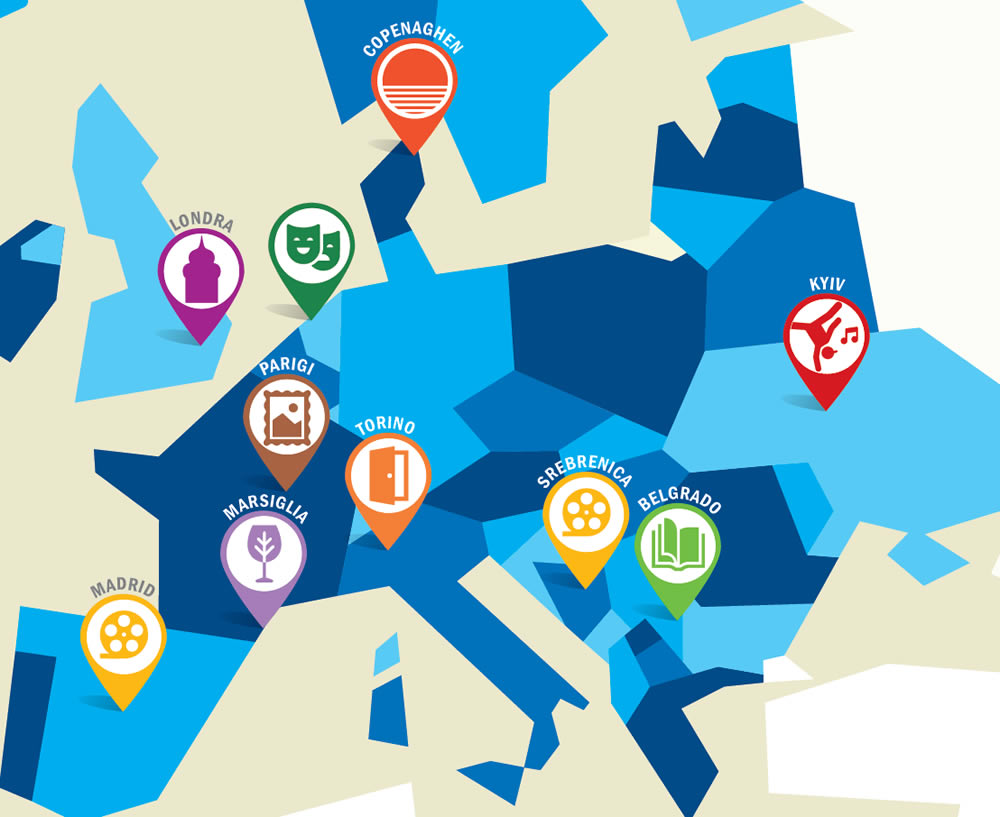
JUNE 14–15, 2025. BRUDNIY PES FESTIVAL / KYIV, UKRAINE
Music Sounds Louder Than War
The atmosphere at the Brudniy Pes Festival reflects the spirit of wartime Ukraine, responding to Russian aggression with irreverent mockery, biting irony, and incredible creative resilience. “Brudniy Pes” means “Dirty Dog,” or “a street dweller,” and since its first edition in 2022, the festival has been dedicated to street culture: hip-hop, street art, breakdance, but also drum’n’bass, electronic music, techno, and indie rock. This year’s edition, held June 14–15 at Keller Bar in Kyiv – one of the capital’s key underground venues – features five stages and ninety Ukrainian artists spanning six different genres. The festival supports youth, “the new faces of Ukrainian culture,” and testifies to the growth of the country’s independent music and arts scene, even during wartime. Alongside music, the festival nurtures a surreal, ironic world of visual art. This space of loss of control and transformation symbolizes Ukrainians’ boundless will to live and care for all victims of Russian aggression. The festival’s poster features Duffy, one of the dogs from Khvostati shelter, which rescues abandoned animals in wartime Ukraine. Brudniy Pes donates its proceeds to support the shelter.
JULY 14–17, 2025. SILVER FRAME FILM FESTIVAL / SREBRENICA, BOSNIA AND HERZEGOVINA
Bringing Life Back to Srebrenica
Walking through the streets of Srebrenica, one can still feel the weight of pain etched into the facades of buildings. The wounds of war and genocide remain open, reducing the town to a tragic symbol. That’s why the Silver Frame Film Festival, held this July, thirty years after the 1995 genocide, is so precious. Curated by director Ado Hasanovic, who grew up in Srebrenica, the festival seeks to restore life and culture to the town. “Long before it became the epicenter of one of Europe’s most horrifying massacres, Srebrenica was known as a spa thermal town in the former Yugoslavia, nestled in the Bosnian mountains and famous since ancient times for its silver mines – ‘srebro’ means silver”. The festival features high-quality films “as in Rome, Paris, or New York,” telling universal stories of hope, resilience, and human connection, to ensure Srebrenica also has access to such culture. The event is deeply tied to the territory, as Hasanovic tells Il Foglio: “The festival actively involves the local community, offering a platform for expression and even future opportunities. A competition and artist residency are dedicated to students from Western Balkan film schools. Open to all, regardless of religion or origin, the festival affirms cinema’s power to unite and build community.
JUNE 2025. CINE DORÉ / MADRID, SPAIN
The Quiet Charm of Arthouse Cinema
Sometimes there’s a very specific urge to walk into a cinema to watch an old film – and if that cinema is a historic institution in the city center, even better. This desire can be fulfilled at Madrid’s Cine Doré, an Art Nouveau building with floral motifs in the Antón Martín district, home of the Filmoteca Española. In addition to an international selection for the Filmadrid festival (June 10–15), June’s program offers several thematic retrospectives. Among them: a series on postwar Spanish romantic cinema and the clever tactics filmmakers used to circumvent the puritanical morals of the Franco regime; a retrospective on Anatole Litvak, a Jewish Ukrainian director who fled the Soviet Union for Germany, then Paris during the Nazi rise, and later Hollywood – when the antisemitic wave begins to rise – where he made the first openly anti-Nazi film, Confessions of a Nazi Spy; a Peruvian film festival; and Cambio de sexo, a 1977 film starring Lou Castel about a transgender teenager – all of which appeal to the reflective middle class seeking a cool matinée escape from the scorching Madrid sun.
MAY 10 – AUGUST 17, 2025. RISE OF THE SUNKEN SUN / COPENHAGEN, DENMARK
The Sun Sinks in a Sea Where It Never Sets
Converted container lofts, dives in the harbor, flat whites, skies cleared by social welfare, many bikes – Copenhagen is a utopia. In June, its endless days are filled with 3daysofdesign, the Copenhagen Photo Festival, and even a natural wine fair. Amid this radical chic setting is an effort to examine Denmark’s colonial relationship with Greenland, known by its native name, Kalaallit Nunaat. The Fotografisk Center hosts “Rise of the Sunken Sun” by Greenlandic artist and photographer Inuuteq Storch, first shown at the Danish Pavilion in Venice in 2024. The title references Greenland’s flag, where the Arctic sun sinks into the ice sea, and the exhibit addresses decolonialism and complex perspectives. Historic images by the first Kalaaleq photographer are juxtaposed with Storch’s intimate daily-life scenes. At Politikens Forhal, Storch also presents an installation exploring the JP/Politikens Hus photojournalism archive, reinterpreting Danish visual narratives of Kalaallit Nunaat. It’s a chance to see the world’s most contested island through the eyes of its people.
JUNE 13–22, 2025. OREOL FESTIVAL / TERSCHELLING, NETHERLANDS
Wind, Sand, and Theater in the North Sea
“Understand where you, with the wind in your ears and salt on your tongue”. That was Joop Mulder’s motto, and it captures the spirit of the Oreol Festival he founded – Europe’s largest site-specific performing arts festival. Every summer since 1981, the festival brings more than 50,000 people to Terschelling Island in the Wadden Sea nature reserve. The largest, and perhaps the strangest: installations among the dunes, gastronomic theater, collective performances in the forest or floating on a lake, and over 200 events including dance, music, street theater, circus, and literature. Equipped campsites, inclusive performances for people with disabilities, and total ecological commitment – it’s pure Northern Europe.
JUNE & JULY 2025. OPEN HOUSE EUROPE / TURIN, PORTO
Flâneurs in Other People’s Homes
For lovers of cities, architecture, and designed spaces, there’s a global free festival spanning all continents (except Antarctica): Open House, an international format born in London in 1992, now involving 58 cities. The idea is to open normally inaccessible places – homes, offices, public spaces, community hubs, villas, and historic buildings – to showcase the value of architecture, interior, or landscape design. It’s an event for those who love peeking into others’ homes and observing the evolution of cities – from small creative solutions to major urban projects. In Europe, upcoming dates include Porto (July 5–6), and before that, Turin (June 7–8). Here, the map includes homes and lofts of all styles, hidden gardens, skyscrapers, inhabitable forests, the eclectic Dancing Le Roi by Carlo Mollino, and even the (Art Nouveau) consulate of the Socialist Republic of Vietnam. Porto’s 10th edition, curated by the Casa da Arquitectura, celebrates architectural exploration with over 70 spaces across Porto, Maia, Matosinhos, and Vila Nova de Gaia. The spirit of Open House, like the city itself, is about everything – and above all, about people.
MAY 23 – JUNE 15, 2025. SHUBBAK FESTIVAL / LONDON, UNITED KINGDOM
London Opens a Window on Arab Cultures
London’s early summer hosts a cultural Arab spring: the Shubbak Festival, the major biennial of contemporary Arab culture. Theater, visual arts, readings, workshops, fashion and design events, and lots of music showcase the rich creativity of Arab cultures from South West Asia and North Africa. The 2025 edition focuses on the work of Palestinian and diasporic artists, whose works highlight the vitality of a people often portrayed solely as victims. Highlights include: Milk by Khasabi Theater Company, on the ineffable grief of mourning Palestinian mothers; Ahmed Masoud’s black comedy Application 39, imagining Gaza hosting the 2084 Olympics; a Barbican performance by DJ Sama AbdulHadi; the exhibition Rise, Habibi, inspired by poems of resistance by Arab and Muslim warriors, saints, princesses, and slaves from over a thousand years ago; Syrian Rhythms, a program imagining a rebuilt Syria; and For Sudan, honoring Sudanese culture and suffering while envisioning liberation. The program genuinely embodies the values in its manifesto: inclusion, accessibility, radical joy, integrity, freedom. “Shubbak” means “window” in Arabic – an invitation to open them in Europe.
JUNE 27–29, 2025. KROKODIL LITERARY FESTIVAL / BELGRADE, SERBIA
The Crocodile Festival That Fights and Resists
From June 27 to 29, the lawn of the Yugoslavia Museum Amphitheater in Belgrade hosts the Krokodil Literary Festival, the Western Balkans’ major literary event. Readings, interviews, panels, screenings, children’s workshops, and performances bring together Serbian and international guests (past names include Margaret Atwood, Irvine Welsh, Hanif Kureishi, Georgi Gospodinov, Dubravka Ugrešić, Hassan Blasim, Mathias Énard). Krokodil’s civic commitment goes beyond the festival: it is one of the few independent Serbian organizations that persistently fights – persecuted and targeted – for governmental accountability, fair elections, against violence, propaganda (they literally clean hate-filled nationalist graffiti off walls), disinformation, and historical revisionism. They denounce pro-Russian propaganda, support Ukraine by including Ukrainian artists in their residency program, and have opened Serbia’s first Ukrainian library with 600 volumes. Every year, they host an event to discuss Europe’s past and future. It is precisely where oppression and corruption threaten democracy that resistance blooms – 2and these are the voices we must engage to build Europe.
JUNE 20, 2025 – JANUARY 4, 2026. SAINT PHALLE, TINGUELY & HULTÉN / PARIS, FRANCE
Niki, Jean, and the Others at the Grand Palais
Moving and renovating are among life’s most stressful events. So, it’s fair to say that the massive renovation of Paris’s Centre Pompidou ranks among the French cultural world’s most stressful changes. The center is gradually closing its galleries until its full closure in September, when its “metamorphosis” begins (as stated on its website). Reopening is planned for 2030, but until then, its collections and programming will travel through Paris and the world via the “Constellations” spin-off program. Among these events is the exhibition Niki de Saint Phalle, Jean Tinguely, Pontus Hultén, opening June 20 at the Grand Palais in the 8th arrondissement. The show explores the work and dialogue between the artist couple and the Pompidou’s first director, a strong advocate and patron of Saint Phalle and Tinguely – starting with their Stravinsky Fountain sculptures outside the Centre. True to their provocative, utopian, and playful style, the exhibition is both historical and interactive. It celebrates rebellion through joy – like Saint Phalle’s oversized Nanas. Bonus track: from June 13–29, the Grand Palais Nave hosts the first retrospective of theater director Mohamed El Kathib, where the exhibit space comes alive each evening with performances, talks, and music.
JUNE 15–16, 2025. VIVENT LES VINS LIBRES / MARSEILLE, FRANCE
Natural Wines Throw a Party in Marseille
There’s an app called Raisin that maps every place where you can find natural wine and the producers behind it. Naturally, it’s French – and more useful than Google Maps. It also tracks sector events and fairs, like “Vivent les vins libres”, Marseille’s natural wine fair. Held June 15–16, the event unfolds across the city’s wine bars with pop-ups by over 30 French producers. Organized by natural winemakers themselves, the fair showcases a wide variety of wines from regions such as Jura, Loire, Alsace, Beaujolais, and Champagne, all united by a philosophy: wine is made in the vineyard. And perhaps best enjoyed with a Mediterranean sunset at the port.