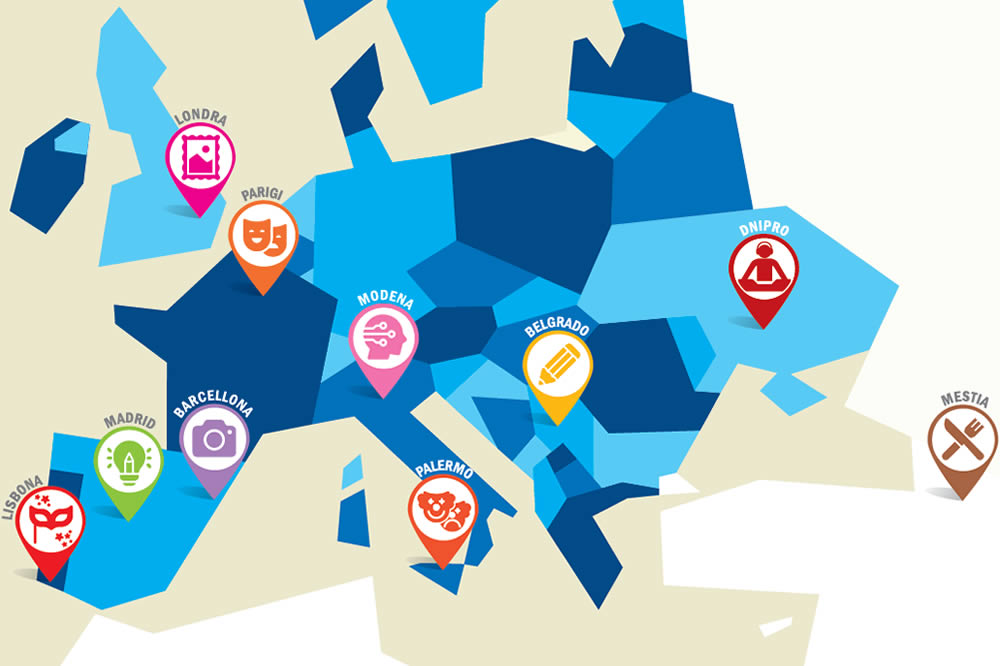
22 FEBRUARY 2026. A CONCERT OF CONTEMPORARY ELECTROACOUSTIC MUSIC. RE:VISION / DNIPRO, UKRAINE
Music against war and freezing cold
On January the 17th in Dnipro the minimum temperature was -15 degrees; in February, Ukraine will reach -30. The country, facing a brutal winter, is plagued by Russian attacks on energy infrastructure that leave homes and buildings without power, compounded by scheduled interruptions for repairs. Due to adverse weather conditions (and all these factors), the contemporary electroacoustic music concert scheduled for 17 January at the Dnipro Centre for Contemporary Culture has been postponed to 22 February – though it’s recommended to check until the last minute for any scheduled blackouts on Dtek Group channels, the country’s major private energy company. The event is part of a series dedicated to contemporary music that brings electronic and acoustic music to traditionally classical and academic spaces. Composer Alla Zagaikevych and the Kvero Ensemble from Kharkiv, made up of young avant-garde musicians directed by Volodymyr Bohatyriov, explore sound in space as a tool to deconstruct traditional listening. Sound is no longer an object to observe, but a constituent part of the environment, and the audience actively participates in the acoustic experience. Electric current aside, it’s extraordinary that Ukrainians, in their fifth year of invasion, still find the energy to experiment.
FROM 4 FEBRUARY. 4211 KM / PARIS, FRANCE
4,211 kilometres from Paris to Tehran
In one scene from the play “4.211 km,” a new father in Paris goes to register his daughter at the registry office. Returning to the maternity ward, he tells his partner Yalda that the clerk refused to add her surname too, Faharadi: it was too long. Yalda’s cry, feeling her daughter deprived of the inheritance of her own family history, echoes that of Mina while giving birth to Yalda herself in 1981. “4.211 km,” written and directed by Aïla Navidi and staged by the Compagnie du Nouveau Jour, is one of the most acclaimed plays (it won two Molière awards) of recent years, and has just returned to the stage at Studio Marigny in Paris. 4,211 km is also the distance between Paris and Tehran, the distance travelled by Yalda’s parents, Mina and Fereydon Fahradi, who after fighting the Shah’s regime in the seventies had to leave Iran with the rise of the Islamic regime. Yalda (Olivia Pavlou Graham) retraces their story, and thus her own: “I was born in Paris to Iranian parents, political refugees. Convinced until I was ten that France was a country of transition. Yet I grew up here and I love it. I am multiple.” The play traverses time and space: the tiny apartment in La Défense in the nineties where the family lives and welcomes the diaspora of political refugees – here they discuss, organize resistance, make music and celebrate – becomes an Iranian cell with the Revolutionary Guards. It’s a play about uprooting, identity and the never-abandoned desire to return to a free country.
6 FEBRUARY-8 MARCH. MADRID DESIGN FESTIVAL / MADRID, SPAIN
Design contains multitudes
Dezeen magazine once listed ten things wrong with design. It concluded by dismantling the idealism of the belief that “design can change the world,” disproved by the sector’s lack of capacity to design sustainably. “Rediseñar el mundo” (Redesigning the world), proof of this idealism, is precisely the theme of the Madrid Design Festival 2026, which for over a month offers exhibitions, installations, conferences, workshops, pop-up shows and showrooms on design cultures, from product to architecture, from interior design to craftsmanship and fashion. The festival, indeed, claims design’s role as a tool to transform processes, systems and lifestyles, integrating industry, craftsmanship, innovation, economy and everyday life. But design contains multitudes, so this year it also launches FORMA, a section entirely dedicated to collectible design – a market that increasingly resembles the art market. In the almost excessive ecosystem of over 300 events around the city (again Dezeen: there are too many objects, too many designers, too little diversity), the most expensive brands coexist with Guatemalan craftsmanship, exhibitions on Mediterranean knowledge and biodesign. The widespread presence throughout the city also aims to strengthen the productive and creative fabric and activate new urban economies.
25 FEBRUARY-10 MAY. BEATRIZ GONZÁLEZ / LONDON, UNITED KINGDOM
The art that can save pain from oblivion
Beatriz González is known as “la maestra,” and is considered Colombia’s greatest artist. In an interview she had been called an icon and she, then nearly ninety, had responded laughing: yes, an ancient icon. She died in January in Bogotá, shortly before the opening of a major retrospective dedicated to her at the Barbican in London. González knew how to recount and denounce violence, death and corruption in her country with satire, courage and tenderness, inventing a visual language capable of redrawing the aesthetic boundaries of taste and kitsch. Drawing from the imagery of Western art history – she was fascinated by how this canon had been absorbed by Colombian culture – she mixed religious icons with popular culture and vernacular painting. The exhibition traces over sixty years of her career, from the vast archive of stories cut from newspapers to which she gave new life in paintings, from painterly “interventions” on flea market furniture, to the colourful irony with which she portrayed the corruption and shallowness of the political class, to the dark testimony of violence in the country, from the disappeared to indigenous peoples, up to her most lyrical and recent works. For her, art had to bear witness to history, and the artist do what the news cannot: save pain from oblivion.
19 FEBRUARY. LA LETTERA, BY PAOLO NANI / PALERMO, ITALY
Variations of a clown, in everyday gestures
“La Lettera,” on stage since 1992, has been everywhere: in China, Greenland, Brazil, Japan, and of course in Italy, where it returns in February, over 1,800 performances for this small, perfect mechanism. It’s the most famous show by clown Paolo Nani, a classic of circus and theatre. Nani creates fifteen scenes, each a variation on a single theme. He interacts with the few objects contained in a suitcase, makes everyday gestures, and creates movements: he drinks, stands up, writes a letter. He tells the same story in different ways, with vulgarity, without hands, as in a western. He doesn’t say a single word. It’s a study, like Queneau’s “Exercises in Style.” It’s the preparation of a chemical formula in the laboratory: each component is measured out to the milligram with precision to obtain the solution. But with a secret ingredient, which contains the tragic and the comic: humanity.
13-17 FEBRUARY. ENTRUDO / LISBON, PORTUGAL
The burial of the cod at Lisbon’s Carnival
“If you can’t laugh when things go bad, laugh and put on a little carnival, else you’re dead or wanna be,” writes Stephen King in “Under the Dome.” Beyond saudade, the Portuguese don’t lack the ability to laugh, especially during one of their favourite celebrations: carnival, (meaning the entrance to Lent). Lisbon bustles with music, dances and colourful festivities and, naturally, masked parades. The official parades with allegorical floats are held at Parque das Nações, the neighbourhood redeveloped for the ’98 Expo, while in the historic centre the celebration takes on more spontaneous forms. The original Portuguese carnival, however, is half an hour from Lisbon, in Torres Vedras, and is considered somewhat the progenitor of Rio’s carnival: here the satirical and irreverent component is expressed with the cabeçudos, giant masks that mock public figures and parades that satirize society. In the fishing village of Sesimbra, however, one feels a kinship in spirit with Brazil. Samba circles and axé music (a syncopated and popular genre born in Bahia in the eighties; in Afro-Brazilian cultures axé is the energy that moves all things) will end on Ash Wednesday with the Enterro do Bacalhau: the burial of the cod.
12 FEBRUARY-30 MARCH. IN THE ABSENCE OF EVIDENCE BY PREDRAG KORAKSIC CORAX / BELGRADE, SERBIA
Drawing cartoons against repression
According to the report on civil rights worldwide published in December by the Civicus Monitor, civil rights in Serbia are no longer “obstructed,” but openly repressed. The head of the investigation, Ine Van Severen, maintains that the authorities have shifted “from limiting criticism to actively dismantling the right to speak, organize and protest.” President Vučić’s party now penetrates every aspect of public life; intimidation and police repression are increasing; dissent results in job loss, physical violence, judicial persecution and arbitrary arrests. Under these conditions, humour, a resource the Balkans overflow with, is a form of survival, and satire an archive of political violence. In February, the exhibition “In the Absence of Evidence” by Predrag Koraksic Corax opens in Belgrade at the M90 space, one of Serbia’s most corrosive political cartoonists, born in 1933 and raised in exile after his father’s murder at the hands of the Chetniks during the war. He began drawing in 1950 for the satirical magazine The Hedgehog, and publishes his cartoons in the independent daily Danas. The exhibition features cartoons from the nineties, about the war, the dissolution of Yugoslavia and Milošević’s regime, which describe the present with lucidity – politicians change names, but not habits.
20-22 FEBRUARY. LEARNING MORE FESTIVAL / MODENA, ITALY
The festival to learn how to learn
In 2021 Jeanette Winterson published “12 Bytes,” a collection of provocative and entertaining essays on artificial intelligence in which she reflects on humanity, art, religion and love (the inquiry continues in the recent “One Aladdin, Two Lamps”). She goes so far as to argue that AI, from being a tool, will become a form of life, not in carbon but in silicon. Without subscribing to this thesis, it’s enough to stop at the introduction, where she writes: we’re in bad shape, we need all the intelligence possible to take care of the world, “let’s not call it artificial intelligence, but let’s call it alternative intelligence. We need alternatives.” In Modena this second chance takes shape with the Learning More Festival, dedicated to the frontiers of learning and evolution in education in the digital universe and artificial intelligence. Curated by Donatella Solda and Damien Lanfrey and promoted by Fem – Future Education Modena, it offers lessons, workshops, in-depth sessions, interactive experiences with over 150 experts to reflect on the use of technology. Among the themes: the role of AI in educational processes, emotional relationships in the digital ecosystem, parenting, AI as a work tool (or colleague, Winterson would say), how learning is changing, narrative medicine. A rigorous but accessible festival to learn how to learn.
26 FEBRUARY-24 MAY. PÉREZ SIQUIER / BARCELONA, SPAIN
Photographing humour between peripheries and beaches
Photographer Pérez Siquier always lived in Almería, a small town on the southern Spanish coast. Yet he was one of the country’s most important photographers, capable of documenting over half a century of social and cultural transformations, with sensitivity and irony, while also witnessing the evolution of the photographic medium itself. Barcelona’s photography centre KBr (whose name recalls the potassium bromide used in analogue development) dedicates an exhibition to him that traces his work. Defined a peripheral photographer, Siquier began photographing in black and white, documenting the sub-proletariat of the La Chanca neighbourhood, to whom he restored dignity and lifestyle, also capturing the transformation of the urban fabric with the arrival of people from rural areas. He’s a pioneer because he was among the first to switch to colour photography, first still investigating La Chanca, and then moving, in the series “La Playa,” to the sun-drenched beaches that began to be invaded by mass tourism in the seventies. But he’s also a pioneer because he introduces a novel element to his neorealist formula: humour. The colours are vivid, the gaze intuitive and spontaneous, the images express the vitality of everyday human condition. He also played a central role in the modernization of photography in Spain, founding the magazine AFAL, giving space and visibility to a generation of photographers in a nation isolated and backward because of the civil war and dictatorship. A journey through twentieth-century Spain.
21-22 FEBRUARY. GEMO FEST / MESTIA, GEORGIA
The festival in the Caucasus mountains
For many Georgians, Svaneti is the country’s most beautiful region: the peaks of the Caucasus, the pastures, the towers of the Svan population that rise in the snowy valleys. Mestia, the only urban centre (fewer than ten thousand inhabitants in the entire municipality), is an important tourist destination for skiing and hiking. The first annual edition of Gemo Fest will be held here, a festival dedicated to Georgian gastronomy, with a focus on local cuisine, considered by many to be the best. Instead, to learn about the region’s recent history, there’s a fine film by Mariam Khatchvani, “Dede,” the only film screened several times a day at Mestia’s only cinema, cinema Dede, appropriately enough.