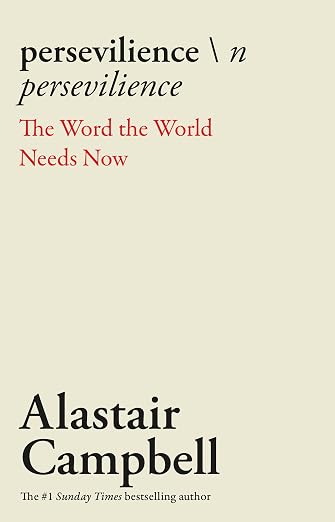
This all began when a word popped into my head, as I was writing about mental health. Persevilience. That’sthe word. The word went from my head, via my pen,onto a blank page. And now the word has become a book. Why? Because I think the word means something, and what it means matters.
Language evolves, you see. New words come along, and some of them endure; old words fade, and some of them die. Polycrisis is a good example of the former. It started life in French, as la polycrise, in a book co-written in 1993 by philosopher Edgar Morin and science and literary critic Anne Brigitte Kern, called Terre-Patrie. My first recollection of polycrise entering the political lexicon was 2016 – the year of Brexit and Donald Trump’s first election to the White House – in the mouth of then European Commission President Jean-Claude Juncker. Brexit and Trump – polycrisis indeed. Both trigger me still. Economic historian Adam Tooze popularized the word further; the World Economic Forum adopted it as the basis for debate and discussion on how governments and business leaders should address simultaneously the climate crisis, a deadly pandemic and the economic fallout from both. Its adoption into the dictionaries of the world followed as its usage became common, though it is not to be confused with ‘permacrisis’, which was Collins Dictionary’s Word ofthe Year for 2022.
 I have high hopes that persevilience may make a similar reverse journey,
Persevilience (noun): the ability of an individual, group or organization to turn any situation, setback or meaningful experience into a positive opportunity to grow, to advance and secure theirc ore interests and beliefs.
Persevilient (adjective): qualities pertaining to the pursuit and delivery of persevilience, whether by individuals, groups or organizations.
Persevilient (noun): a person, group or organization which displays qualities of persevilience.
You do not need to hold a master’s degree in the English language to work out that the main constituent parts of persevilience are perseverance and resilience (perhaps with a little bit of persistence and patience thrown in). But it is much more than a marriage of other words, important though the qualities of perseverance, resilience, persistence and patience may be. Let’s turn to the dictionary…
Perseverance (noun): the quality of continuing to try to achieve a particular aim despite difficulties.
Resilience (noun): the ability of people or things to recover quickly after something unpleasant, such as shock, injury, etc.; the ability of a substance to return to its original shape after it has been bent, stretched or pressed.
Persistence (noun): the fact of continuing to try to do something despite difficulties, especially when other people are against you and think thaty ou are being annoying or unreasonable.
Patience (noun): the ability to stay calm and accept a delay or something annoying without complaining; the ability to spend a lot of time doing something difficult that needs a lot of attention and effort
Persevilience takes in perseverance, resilience, patience and persistence, but builds them into some-thing bigger, better, more positive, more productive. Perseverance and resilience are words of drudge and struggle, whereas persevilience is all about hope and progress, and I plan to show you how.
Does Andy Burnham have it?
Burnham said on becoming Prime Minister that he felt this was Labour’s last chance to stave off the kind of right-wing populism that Nigel Farage represent. But perhaps his long-term survival is also necessary to prevent the notion taking hold that a country once admired for its political stability and maturity is becoming ungovernable. So he will need much more than perseverance and resilience, essential qualities though these are in Downing Street; he will need to be a Premier with persevilience. As a Labour supporter, let me try to find some reasons to be hopeful. First, he has been around a longtime, looks young for his age, has bundles of energy, still seems to love a challenge and really likes dealing with people. Strong ingredients for persevilience in politics. Second, he has grown considerably in stature. The way Burnham performed as Mayor in Manchester and delivered on the promise of a different way of doing politics, allied to better political and communications skills, was largely responsible for creating the sense of inevitability that he would replace Starmer. That is persevilience. It is brutal, if you are Keir Starmer, but Burnham’s persevilience simply overpowered Starmer’s resilience, no matter how hard he fought.
He also showed a ruthlessness I did not believe he had in those early years of us working together. I was wrong about that. I should add that in politics, whether we like it or not, a certain ruthlessness is required provided it is matched by empathy and emotional intelligence. It is quite something to oust a serving Prime Minister by creating and winning a by-election in someone else’s seat, then build a sense of inevitability about your very presence in Parliament leading to the PM’s resignation, yet ultimately have people saying that one of the reasons it happened is that you are a warmer and more personable chap than your predecessor, who on being ousted declared he would give you total support. No mean feat.
Burnham required persevilience too when Starmer had used his powers as Labour leader to block him from standing in an earlier by-election in Manchester’s Gorton and Denton constituency. Perseverance would have said, ‘Oh well, I’ll go back to being Mayor.’ Persevilience said, ‘Don’t take it lying down. Plot but do it in the open. Go through the same move again this time with a bespoke departure of a candidate. Wait for local elections which you know will weaken Starmer.’ The key question keeping Labour MPs awake was who could stop Reform UK? In a seat in which every wardhad gone to Reform in the local elections, Burnham answered it by winning the parliamentary by-election by more than nine thousand votes. Burnham has the same values as he always had, is arguing for the same things he always did. Yet in other ways he is not the same person – he’s tougher, sharper, more focused, more ruthless, still wearing his heart on his sleeve but always in control of his emotions. Whether he is a truly persevilient Prime Minister depends on how long he lasts, and what he does with that time in power. But as of now, as he settles into the job, the persevilience signs are good.
This is an adapted extract from the new essay by Alastair Campbell, “Persevilience”, published in the UK on 20 October. Campbell was one of the architects of Tony Blair’s New Labour movement and is now one of the country’s most influential commentators, thanks to his hugely successful podcast “The Rest Is Politics”.