

From Warsaw
Polish YouTube disrupts traditional television
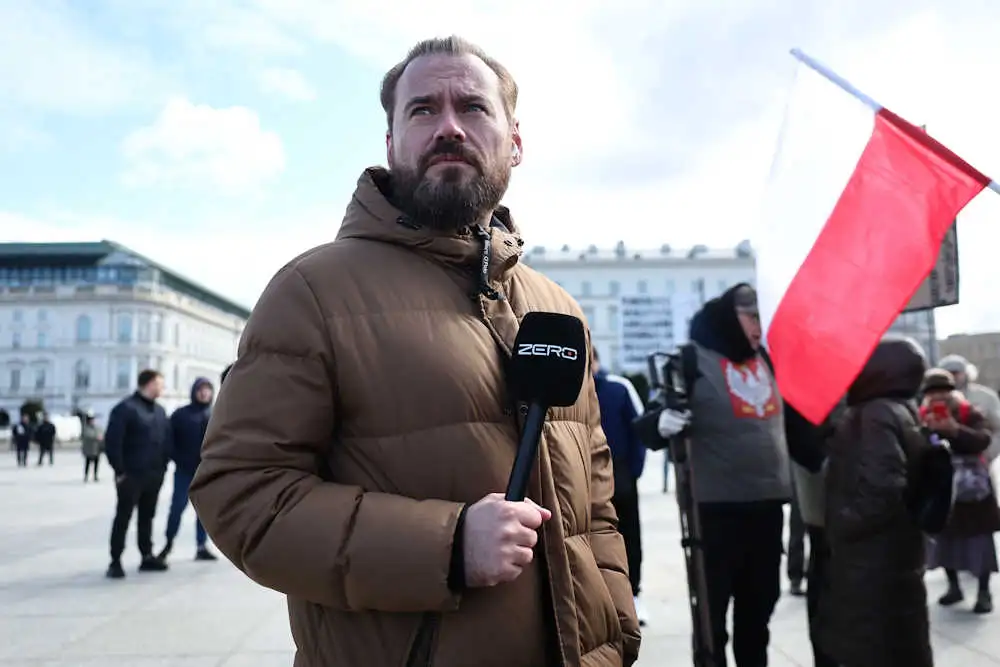
Before the second round of Poland’s presidential election in June, politicians began lining up at Kanał Zero. Members of the ruling Civic Platform, the liberal party led by Donald Tusk, concluded that the newcomer YouTube-based media outlet – launched in February 2024 – was the best place to try to win over conservative voters to their candidate, Rafał Trzaskowski.
A week before the vote, Foreign Minister Radosław Sikorski, an ally of Trzaskowski, gave his first interview to the channel. “I hope this isn’t just a cynical move, with everyone chasing an extra one percent right before the election and using every opportunity to appear in the media, only to go back to pretending Kanał Zero doesn’t exist once it’s over,” said Krzysztof Stanowski, the channel’s founder, at the start of the three-hour conversation.
Kanał Zero was quickly branded as critical of the ruling camp and sympathetic to the far-right Confederation Party, making most Civic Platform politicians wary of appearing there. “But during the campaign we realized that if we wanted to reclaim part of its electorate, we had to show up regularly,” explained a political strategist from Trzaskowski’s campaign. Speaking on condition of anonymity, the source added: “Sikorski was ideal for the task, as he enjoys credibility across the political spectrum.”
The election proved that Kanał Zero is a force to be reckoned with, impossible to ignore any longer. “It’s a phenomenon on a European scale. In a short time, Stanowski has built something that now rivals Poland’s biggest television stations,” said Paweł Prus, head of the Zamenhof Institute, a think tank focused on media in Central and Eastern Europe. He emphasized that no politician who cares about popularity or voters would turn down an invitation to Kanał Zero. In fact, some now prefer it to the state broadcaster TVP. “On Kanał Zero, they’ll get ten times more views for their appearance,” Prus noted in a conversation with Il Foglio Europeo.
The interview with Sikorski drew nearly 1.5 million views. Even more tuned in for the candidates themselves: 2.2 million for Trzaskowski and 2.3 million for Nawrocki. The rapid rise of Kanał Zero in just a year is illustrated by the viewership of the debate between the two, which was broadcast across multiple television channels: 2.2 million watched it on Kanał Zero, compared with 1.7 million on the public broadcaster TVP1 and 1.6 million on TVN24, the country’s largest private news station.
The project’s success is largely the result of Stanowski’s sharp reading of the media landscape. “He understood that in Poland there is a sizable segment of the public left unserved,” Prus said. These are people who want to follow current political and lifestyle events but, for various reasons, do not watch television daily. “They prefer to get their information from YouTube – and to do so on completely different terms,” Prus added.
Poland is hardly unique in this trend. A recent report from the British regulator Ofcom found that YouTube has become the second most-watched media service in the UK, trailing only the BBC. “YouTube is leading the charge in the streaming takeover of TV sets, with the platform now the first stop for younger viewers when they switch on,” the report noted, adding that viewers over 55 are now watching nearly twice as much YouTube content as they did two years ago. A good example of this shift is Piers Morgan, who in 2024 moved from traditional media to YouTube and is now working to expand his business.
Stanowski’s earlier projects also shaped Kanał Zero’s trajectory. In spring 2020, he and a group of journalists launched Kanał Sportowy on YouTube. The sports-focused channel was an immediate success, attracting more than half a million subscribers in its first year. But Stanowski soon realized that focusing only on sports limited the potential for growth. That led him to create a broader platform covering lifestyle, sports, politics, military issues, and international affairs.
He brought on journalists, many of whom had previously worked at TVP under the Law and Justice government, when the public media became highly politicized, and who were later dismissed after Civic Platform came to power. “This gave them a chance to return to the media, as it seemed no one else would hire them,” Prus commented. Others, such as Arleta Bojke, a former Moscow correspondent, are regarded as leading experts in their field.
Kanał Zero has also welcomed figures from outside the media world, including General Rajmund Andrzejczak, who served as Chief of the Polish General Staff until 2023, and rapper Tede. In September, immediately after completing his ten-year term, President Andrzej Duda joined the channel as well. In weekly episodes, he shares both memories from his time in the Presidential Palace alongside commentary on current events.
The channel does not shy away from controversy. Some programs have been accused of chasing views above all else. In January, Stanowski conducted a two-hour interview with Janusz Waluś – a Polish-South African far-right activist, terrorist, and the murderer of Chris Hani, the Black leader of the South African Communist Party. Many journalists found this deeply troubling, arguing that giving Waluś a platform risks normalizing extremist views. “By airing a program featuring Janusz Waluś, Kanał Zero not only gives a platform to a person responsible for one of the most symbolic crimes of the apartheid era, but also risks normalizing extremist views and actions,” argued Bart Staszewski, head of the Basta Foundation.
Such controversies have not dented the channel’s popularity, which surpassed 2 million subscribers in July. Kanał Zero insists it is only just beginning. Work is already underway on a news site that, according to unofficial sources, will employ many prominent journalists from Poland’s leading newsrooms.