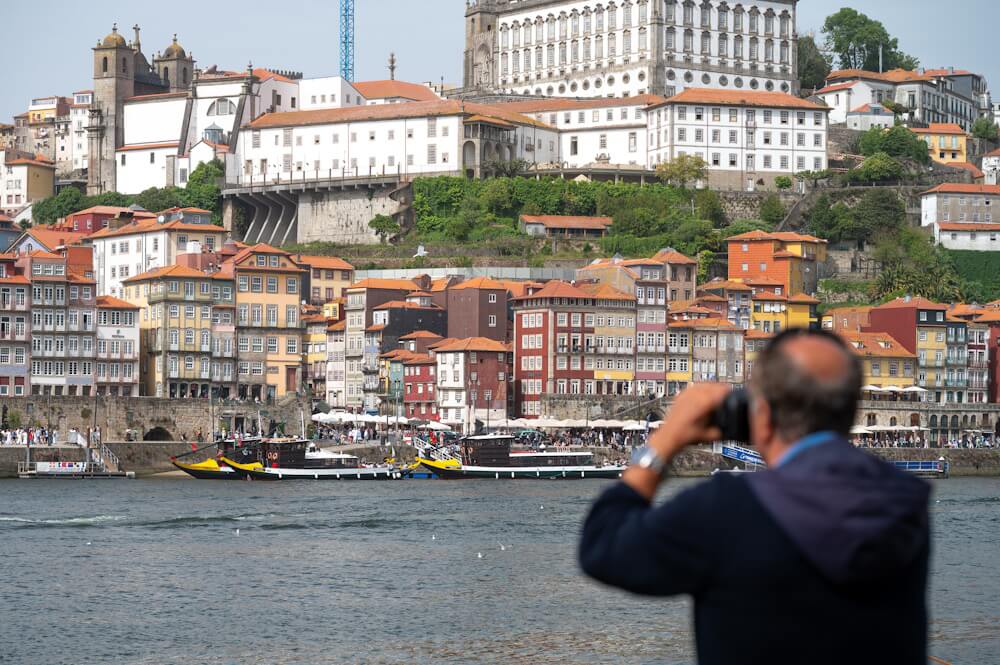
“This is what the traveler takes away from Porto, a mystery made of gloomy streets and earth-colored houses, all of it as captivating as, at dusk, the lights that gradually come on along the hillsides, a city joined to a river they call the Douro.” That’s how writer José Saramago described Porto’s discreet, mysterious charm in his 1990 Journey to Portugal. Today, more than thirty years later, Porto has become a well-known and crowded tourist destination. According to Portugal Global, Porto ranks fifth in the world for international tourists relative to population: around 7 million international visitors a year (fewer than 2 million until 2013) against roughly 250,000 residents — about 2,800 tourists a year for every 100 inhabitants, or 28 per resident. It’s a striking figure for illustrating the imbalance between the city’s size and its tourist volume, but it should be treated with caution: it compares an annual flow with a resident population and doesn’t measure how many people are actually present at any given time. Another telling figure is the growth in overnight stays: between 2019 and 2023, according to the European Commission, Porto saw overnight stays increase by around 60 percent, roughly 3 million additional nights. That places the city among the destinations at greatest risk of tourism density and imbalance. The Commission links concentrated urban tourism to potential effects on crowding, pollution, land and housing availability, cost of living, and pressure on natural resources. Particular attention is given to the role of short-term rental booking platforms. The Porto Metropolitan Area is among the twenty smaller European regions most visited by international travelers staying in short-term accommodation booked through Airbnb, Booking, Expedia and Tripadvisor. The Commission also spells out the link between the growth of short-term rentals and urban problems: fewer homes available for long-term leases, rising prices, overloaded services and infrastructure, possible displacement of resident communities, and changes to neighborhoods’ identity.
What explains such a tourism boom and the transformation of the city? There’s understandably no single cause, but a combination of factors that has built up over the past fifteen years. The first is low-cost European air travel. In 2009 Ryanair announced that Porto’s Francisco Sá Carneiro airport would become one of its hubs, unveiling an investment of more than 140 million dollars and a schedule of around 50 daily round-trip flights, including new routes to Basel, Eindhoven, Saint-Étienne and Tours, alongside a doubling of flights to Paris-Beauvais. The airline also said the move would support 1,500 local jobs. Over the years, routes from other low-cost carriers such as Easyjet, Transavia and Vueling have joined the Irish airline’s, along with intercontinental routes to Brazil, the United States and Africa. In 2025 the airport set a new record with 16.9 million passengers, a further 6 percent increase on the previous year. Since 2012, traffic has grown by as much as 166 percent. But the current situation is also tied to efforts by local authorities after the 2011 economic crisis to develop tourism by promoting the city’s Unesco heritage and building an image of an “authentic city,” cheaper than the capital Lisbon and an appealing destination for food and wine as well. The growth in listings on accommodation platforms has been striking too. According to the University of Porto, in 2011 there were only about a hundred Airbnb listings in Porto; by 2018 there were already 11,000(!), and today there are around 13,000. As in other cases, the role played by social media platforms, especially Instagram and TikTok, shouldn’t be overlooked. One of Porto’s most photographed and now-iconic sites says a lot about how tourism has changed, not just in scale. Every day, lines of visitors queue up to visit the Livraria Lello on Rua das Carmelitas — perhaps the only bookshop in the world where you pay an entry ticket just to get in (eight euros, deducted if you buy a book). Founded in 1869 and designed by engineer Francisco Xavier Esteves in a distinctive blend of Gothic and neo-Art Nouveau styles, it’s Portugal’s second-oldest bookshop. Numerous guidebooks, including Lonely Planet, describe it as one of the most beautiful bookshops in the world. But the current crush of tourists is tied to a rumor that the shop inspired British author J. K. Rowling’s description of the Hogwarts library in the famous Harry Potter saga. The rumor stems from the fact that Rowling did indeed live in Porto between 1991 and 1993, where she worked on what would become the Harry Potter novels. But the author has repeatedly denied drawing inspiration from that place. “I never visited this bookshop in Porto. I didn’t even know it existed! It’s beautiful and I would have loved to visit it, but it has nothing to do with Hogwarts,” she wrote in May 2020 on Twitter, replying to fans.
How are politicians, and local government in particular, handling this situation? In 2024 then-mayor Rui Moreira told Bloomberg that, with rental platforms having already saturated the historic center, they now represented an opportunity for growth and urban regeneration in less central areas such as Campanhã. The new mayor, Pedro Duarte, elected at the end of last year, takes a different view: in his inauguration speech he said, “A city excessively dependent on tourism and real estate risks becoming a hostage to its own success.” A success and a transformation that would have been unimaginable, yet perhaps something Saramago sensed in his own way, when he took his leave in front of a fountain near the Cathedral that was “dirty and stained.” “If one day the traveler returns to Porto and comes looking for this fountain and doesn’t find it, he will be greatly saddened. He will say then that a crime was committed in broad daylight, with the victim helped neither by the Cathedral up there, nor by the people of Barredo down below.”