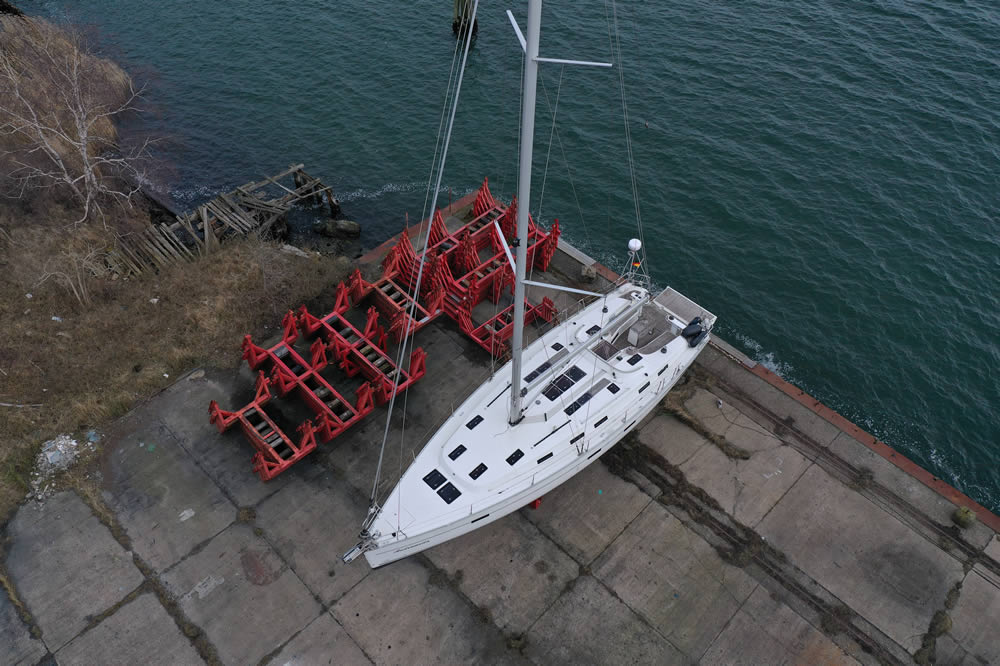
The waves were more than two metres high, tossing the sailing boat around like a walnut shell. The Baltic Sea turned the colour of ink around it. Below deck on the Bavaria C50 yacht, just 15m (50ft) long with five small cabins, a Ukrainian diving crew waited nervously.
The skipper had seen much worse and before the war he had sometimes enjoyed taking his clients into mild storms. But now he was concerned.
“This isn’t diving weather. Are you sure?” he yelled.
They were not. One by one the divers voted to abort their mission and return to port.
Then the lone woman among them, in her thirties, stood up. I’ll call her Freya. She had to shout over the wind. “Let me go alone, I’ll finish quickly,” she said. The men shifted uncomfortably. Her diving buddy raised his hand. He didn’t want to go but he was not going to let her risk it without him.
They climbed on deck and got ready with extra care, the floor shifting beneath their feet. The waves sprayed water into the cabin. Each diver carried well over 80kg of gear — for Freya, that was more than her own body weight. Underwater the load would disappear as if lifted by a magic hand, but above the surface it was a struggle to take a single step.
Freya’s buddy went into the water first and rigged the bomb, a makeshift device fashioned from a diver’s breathing tank, weighing another 40kg.
“This will be fun,” Freya called to him.
Then she plunged.
Freya — whose name, like those of her fellow saboteurs, has been withheld for security reasons — was born in Kyiv in the mid-1980s and raised mainly by her mother. She was a restless, energetic child. By the time she finished high school she spoke some English and Spanish, and she chose a university course that would allow her to travel.
Kyiv in the 2000s was a wild place, awash with new money generated by the robber-baron capitalism that sprung from the wreckage of Soviet communism. It fuelled a new type of nightlife and Freya charged headlong into it. Young, strikingly beautiful and wearing glittering dresses, she was a fixture of the capital’s nightclub scene. She occasionally worked as a model and once adorned the cover of an erotic magazine.
Around that time, when she was barely 20, she went diving for the first time off the Black Sea coast. It was love at first splash. Soon after she quit her day job and became a diving instructor. This financed trips to diving destinations: Egypt, Spain, Mexico, Thailand. She made friends the world over. Friends of hers to whom I have spoken say she was an embodiment of zhyttyeradisna, a Ukrainian word meaning “filled with love for life”.
This carefree existence was shattered when Russia invaded Ukraine in 2014. Freya was shocked by the stream of horrific images from the front line. One of her closest friends and diving partners from Crimea could no longer return home and became an activist and fundraiser for Ukraine’s troops. Freya, too, made efforts to fundraise.
When Russia’s full-scale invasion started on February 24, 2022, she was with other Ukrainians on a diving tour halfway around the world. They could have remained safely abroad but instead scrambled to return home.
Her ability to dive far beneath the ocean surface was no longer of use to anyone, so instead Freya and a few friends set up a charity to help victims of the Russian aggression.
Then, in April 2022, a shadowy special services unit contacted her through an acquaintance in the diver community. As it turned out, her specialist skills were needed after all.
Two maverick senior intelligence officers, whom I’ll call the General and the Colonel, had devised a plan to strike at the revenues that Russia used to finance the war. They worked with the CIA in Ukraine’s struggle against Moscow, and they privately sought counsel from individual US agents about their new plan.
Unable to find the expertise they required inside the military, they had decided to recruit expert civilian divers for the mission. The operation would be dangerous and potentially life-threatening, they told Freya.
“Where do I sign?” she asked.
The mission was audacious. The newly assembled crew was to attack the $20 billion Nord Stream Russian gas pipelines, more than 750 miles long, delivering gas to Europe along the seafloor. Their second target was TurkStream, a smaller pipeline connecting Russia with Turkey under the Black Sea that cost some $8 billion.
At the start of the war in 2022 Russia supplied nearly half of Europe’s gas imports and much of it travelled through these two pipeline systems.
Nord Stream is not one pipe but four: two strings of Nord Stream 1, the older pipeline, and two of Nord Stream 2, running for hundreds of miles under the Baltic from Russia to Germany. Each steel pipe is roughly 1.2m wide, encased in concrete and designed to carry Russian gas directly into Europe. The first starts in Vyborg, near the border with Finland, the second in nearby Ust-Luga, close to the Estonian border. Both land in Lubmin, Germany.
An old explosives engineer who was advising the saboteurs told them that punching even a small hole in a pressurised pipeline would unleash a reaction that would rip open the pipes, not unlike piercing a balloon. The engineer suggested they fill a diver’s breathing tank with a mix of octogen and hexogen, powerful but highly stable and easily handled explosives. A timer would be set. The goal was to direct the energy of the blast narrowly enough to crack the pipe, which would then be ruptured by the pressure.
The divers trained in an old granite quarry filled with water 80 miles west of Kyiv. Then they had to lie low for more than three months while the mission was repeatedly postponed.
In the early hours of September 26, Denmark scrambled fighter jets to investigate a mysterious disturbance in the Baltic Sea.
The first explosion came from the last of the eight devices the Andromeda divers had placed. At 2.03am Danish time, just south of Bornholm, the bomb positioned on the A string of Nord Stream 2 detonated. Its kinetic surge directed into the joint between two pipe segments, the blast created a stream of molten steel that acted like a supersonic blade, slicing the pipe with surgical precision — exactly as planned. That small incision, just as the old engineer had predicted, triggered a chain reaction of devastating violence.
The explosion severed the pipe entirely.
The mission took just weeks to prepare and cost only $250,000. It involved meticulous planning and ingenious engineering, as well as heavy drinking, chaos and rebellion. There was no plan B.
Nobody died, was injured or captured. But the Ukrainian operation had an effect that its planners and perpetrators never really contemplated: it crossed a red line in modern conflict. Critical infrastructure once considered off limits became fair game. It helped create a world of shadow warfare, where pipelines, deep-sea cables or tankers can be struck with relative impunity, introducing new uncertainty into the global order.
When the Trump administration started negotiations with Moscow last year over peace in Ukraine, Russia put forward a non-negotiable condition. The Nord Stream pipelines should be reopened as part of any peace deal. Subsequently a consortium of US entrepreneurs, as well as some people linked to the Trump administration, have mooted a deal to buy the Nord Stream 2 pipeline. That way the infrastructure wouldn’t be Russian any more. Putin himself agreed: sell the pipelines to the Americans and insulate the future gas trade from further sanctions.
I called the General to tell him about this plan. He listened attentively. “But my esteemed Bojan, don’t lose sleep over it,” he said. “By all means let them fix it. So we can blow it up again.”
© Bojan Pancevski 2026
Extracted from The Nord Stream Conspiracy, published by Hutchinson Heinemann. Adapted for Il Foglio Europeo.
Bojan Pancevski is the award-winning Chief European Political Correspondent of the Wall Street Journal, covering European and global affairs.