On the road to Lake Maggiore, in the province of Varese, the driver takes the curves confidently and happily tells the story of the area: “There used to be a subsistence economy here. If you were doing well, you had a few cows or goats, and could produce some cheese to sell. Then Ispra-1 and the JRC changed everything.” Ispra-1 was Italy’s and Europe’s first research nuclear reactor, operating from 1959 to 1973. From 1960 the facility came under European ownership, giving rise to the Joint (Nuclear) Research Centre, the JRC, which trained a generation of outstanding Italian and European scientists and technicians. The reactors were later shut down, then came Chernobyl and Italy’s nuclear program was dismantled, but the JRC remained. Today it is the Commission’s third-largest site and, with 200 buildings and 2,700 staff, one of the most advanced research campuses in Europe and the world. It produces the scientific evidence that underpins European policy.
This September, Ispra inaugurated the Security Research & Innovation Campus, a Commission initiative under the ProtectEU program, aimed at strengthening the Union’s strategic autonomy in the face of challenges we must confront pragmatically: the consequences of climate change, such as fires and floods, Russia’s invasion of Ukraine, hybrid attacks, cyberattacks, drones crossing borders, migration flows, disinformation and AI, threats to infrastructure, and energy dependence. The campus brings together the best scientific community working on security around six thematic areas: border management, crisis management, defense, internal security, nuclear security, and space-connectivity-quantum technologies, with the strategic goal of using research to strengthen European independence. The spirit of the campus, explains its director Bernard Magenhann, is to overcome the barriers of national research and work in cooperation as a Union, bringing together in one place scientists, investors, industry, construction infrastructure, companies and start-ups, alongside political science, in collaboration with agencies such as the European Space Agency or Europol. The aim is to function as a unified ecosystem rather than a fragmented one, an accelerator that turns ideas into operational solutions. For Magnus Brunner, European Commissioner for Home Affairs and Migration, the campus is above all the key to European sovereignty and independence. He says that building European solutions that make us more independent and confident in ourselves is not isolationism, but self-awareness and the ability to stand on our own feet — because if what European citizens need is designed and controlled elsewhere, it can be switched off at any moment, as we have learned from Putin and from the fraying relationship with Trump’s America. Brunner stresses that the JRC gives Europe scientific independence, knowledge and highly advanced facilities to carry out research and experimentation, building bridges with industry and policy and anticipating how technology will shape tomorrow’s world — from justice to security, from artificial intelligence to drones, from encrypted communication to information manipulation — and thus helping to design more resilient infrastructure, to protect us from earthquakes as much as from disinformation.
In practice, at the JRC sites in Ispra and elsewhere in Europe, researchers study migration flows in order to anticipate and prevent humanitarian disasters like Ceuta; they study how to decrypt messages sent by criminal networks; they train the professionals who track nuclear material attempting to cross borders; they monitor algorithms to check their compliance with European standards of security and transparency; and, with the future Quantum Communication Lab, they will guarantee secure telecommunications through quantum technology.
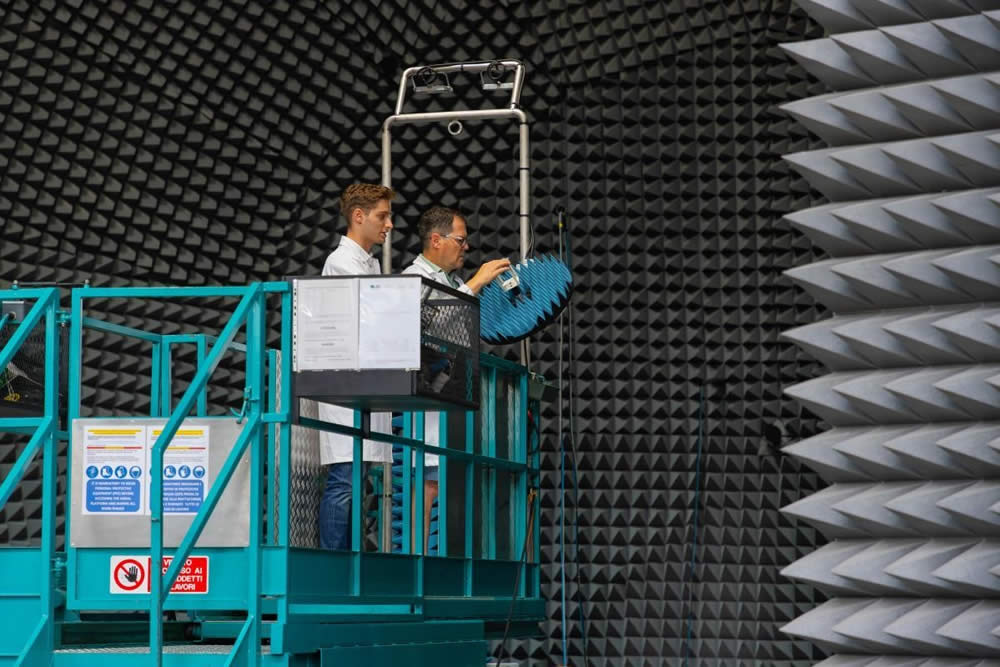
The laboratories are impressive. The European Crisis Management Laboratory simultaneously conducts research on crises caused by natural disasters (a Spielberg-style multi-screen display shows processed data on the flooding in Nepal), wars (the screen shows the front line in Ukraine), and humanitarian crises, gathering, synthesizing and making data intelligible for the Commission and for state bodies in very short timeframes, supporting decision-making processes. In another laboratory, a 200-metre-long Hopkinson bar (others around the world are usually about 10 metres long) tests how materials behave when subjected to extremely fast dynamic loads, such as the impact of a crash, a bullet or a missile. It’s like an extraordinarily sophisticated toy that simulates the impact of one mass striking another at a hundred kilometres an hour. In another laboratory, a hangar large enough to hold a four-storey building, the JRC uses a reaction wall to study the resilience of buildings. A full-scale prototype — of a building, a section of a bridge, a viaduct, a tunnel, even the arch of a church — is connected to pistons that simulate the shaking of an earthquake, right up to collapse. The materials to be tested are selected through open calls; more military-related research is likely to arrive, but the scientists insist that what interests them is the stress placed on the material, not the cause of that stress. The European Microwave Signature Laboratory, by contrast, looks like a soundproofed recording studio, but is in fact a state-of-the-art anechoic dome for testing microwaves and radio frequencies, supporting satellite navigation and communication (Galileo and GNSS) and the European radio spectrum. In plain terms: signals arrive inside the dome, which strips them of reflections, even under jamming or spoofing conditions — two electronic-interference techniques used to disrupt or deceive signals. It is part of TOSCA, the brand-new ecosystem, poetically named, that brings together six laboratories to make European communications secure and reliable, also supporting the IRIS² program, a constellation of European satellites due to launch in 2029. Europe has the laboratories, the infrastructure, the wealth, the energy, and the talented people, along with a body of public scientific knowledge (93 percent of JRC publications are public) needed to thrive; the opening of the campus is a step toward what it still lacks: confidence in itself, and a bit of glamour in telling its own story. Here, then, is a glamorous story: 27 different minds coming together to discover something new.