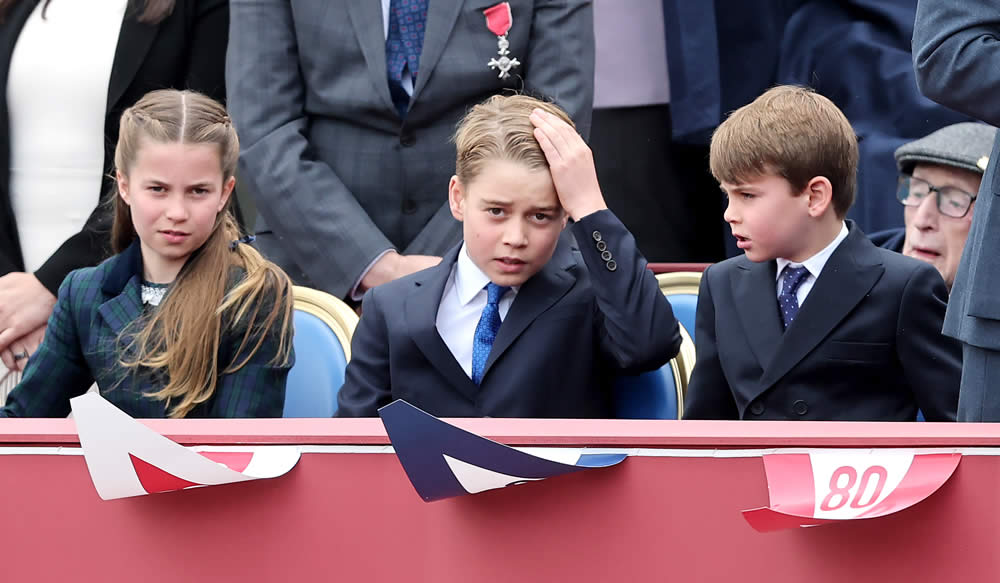
Prince George of Wales (George Alexander Louis), thirteen years old, now ready for secondary school and almost ready for the throne. He is second in line to the throne and will start at Eton in September. Son of William and Catherine, older brother to Charlotte and Louis, grandson of the King. That’s about all we know — the early days are long gone, back when, at two years old, that slightly blasé blond face went viral across the whole internet, already a meme (one of the first, as far as I recall), with the “peasants!” parody aimed at the onlookers of his photos — the country bumpkins, us. Once the photo game ended, everything ended. George sank back into the unknown, except for Wimbledon, the odd football match, and royal outings in a little jacket and tie. We know he was born on July 22, 2013. We know he keeps pushing a lock of hair off his forehead — he has the same hair his father had as a boy. We also know he has a slightly stern look about him, none of the easy charm his uncle has, say. But at thirteen, that could mean shy, bored, well-mannered, or nothing at all — simply: I’m thirteen. We genuinely have no idea who George is. And that’s a good thing — it may well be the most vital result William and Catherine have achieved as parents. He’s thirteen, that’s it. William was thirteen too when, in September 1995, he also started at Eton. A neat symmetry, an impeccable one, really — as if written by the Lord Chamberlain himself: same school, identical place in the line of succession, the same (perhaps) future laid out straight ahead, with no room to deviate. Except that the William who arrived at Eton in 1995 and the George of 2026 belong to two opposite kinds of adolescence: George is shielded by a family that has turned composure into an almost obsessive rule. Kate is the most grounded, down-to-earth figure the monarchy has — a self-control that, frankly, barely exists in nature. The mother of the future king is practically an alien species. William, by contrast, arrived at Eton just as his own family was falling apart — and not quietly. Diana was England’s saddest empress. In 1995, Charles and Diana were separated, but only in the way they were allowed to be — their unhappiness wasn’t fully their own; it had been handed over, almost by contract, to the newspapers and the entire public. The press sank its teeth in, specifically into Diana. Then, that same year, the Queen would pull the strings and push toward divorce. William was in his first stretch at Eton. That’s the period when all the legends took shape — Diana becoming Diana, Charles becoming Charles, and Camilla — and there wasn’t much attention left over for the son. The curious thing is that Eton itself — that great bastion of stiff, protocol-bound education — actually did him a favor. The kind of anonymity that was the only grace available to him in those years is something Tina Brown captures in “The Palace Papers,” describing Eton as a place so used to saturated privilege that even extreme privilege — that is, having, quite literally, a crown on your head one day — barely raised an eyebrow: “William’s schoolmates, used to a fair number of high-profile parents, were not intimidated by having the heir to the throne among them. Alongside the sons of Britain’s titled aristocracy were scholarship boys, heirs of foreign oligarchs and Gulf monarchies, and sons of self-made men who saw Eton College as the ultimate symbol of educational status.” Call it provincialism on an amplified scale: if everyone in there is somebody, then even the future king can simply be a thirteen-year-old. Yes, more or less. Because William had been born and raised anything but naive — he faced a problem unknown to his peers: he had to work out who he could trust, without the margin for error a boy his age is normally allowed. “Today you’re with me, tomorrow you’re talking behind my back” is the ordinary tragedy of growing up, one William was never permitted. Tina Brown identifies in the young William what would become his defining adult trait — what she calls the pre-emptive restriction of risk. “In line with William’s instinct for self-protection, his social circle was cautiously adventure-free, chosen from among those who were certain to keep his confidence.” The surnames of his trusted little companions were old and established: van Cutsem, van Straubenzee, Meade. Well-known families from that tiny circle, that ring of the British world where “family friend” means the families were friends before the friends themselves were even born. This was, perhaps, one of William’s earliest skills: cutting down the number of surprises. Diana, meanwhile, was doing exactly the opposite — she was always chasing the world’s astonishment; it had become her (highly refined) survival technique.
Diana also tried, as much as she could, to take the crown apart for her son. She was fixated on giving her children gusts of normal life, because she feared the palace produced dull human beings incapable of engaging with the world outside. Tina Brown writes that “until they went off to boarding school at Ludgrove, she drove them to and from nursery school herself. She let them go play at their friends’ houses. She tried to lighten the weight of her sons’ royal privilege by showing them how the other 99.9 percent lived.”
Brown quotes Ken Wharfe, Diana’s former bodyguard: “The Princess felt that preparing William, and to a lesser extent Harry, for their public roles was her main duty.” A splendid intention — and then things (badly) got out of hand: Diana’s problem became that the mother and the personal tragedy overlapped perfectly. And William took the full force of the shockwave — her anger, her loneliness, then the furious, almost blackmail-like relationship with the press, driven by the need — which she very much felt — to remain relevant by being loved by an enormous public. Thirty-one years later, there’s Kate, as a mother. It’s hard to imagine two people more different than Diana and Kate, even though the latter is often, oddly, compared to the former. Kate has never appeared as anything but Kate — a compendium of measured restraint, from her clothes to her clean, neutral accent, a perfect non-catalyst for the public’s morbid curiosity. Watching the early videos where — tired and worn — she talks about her cancer, her voice thin but steady, full of hope for everyone facing illness, it’s almost unsettling how consistently she maintains that same transparent, even-keeled form of personality. And we know as little about the private Kate as we do about George. Kate is present, but there has never been a display of motherhood, if I can put it that way. Hers is an ever-present but always measured tenderness. She’s the one who takes the photos of her children — not the photographers. And has that difference mattered for George? William’s adolescence was pure narrative material; George’s is, deliberately, painfully bare. Though, leaving aside one detail that is, in its own way, quite funny: all that effort poured into producing a normal teenager who will end up being anything but normal.