As I told a conference in Brescia, we used to laugh at Italy, as they churned from one Prime Minister to the next, one unstable government after another. We’re not laughing now. By “we,” I mean the United Kingdom, home to the so-called Mother of Parliaments, with its reputation for sensible, clever, pragmatic politics. The same United Kingdom which has now had six Prime Ministers within a decade – Cameron, May, Johnson, Truss, Sunak and Starmer – and despite Keir Starmer having led Labour to a landslide victory less than two years ago, we might be weeks away from getting our seventh.
Seven in a decade; that’s the period of time my old boss, Tony Blair, served as Prime Minister; Margaret Thatcher was in office even longer. Right now, Giorgia Meloni is looking a lot more like them, when it comes to longevity, than the more recent riders of the UK carousel.
So it is perhaps worth asking … did anything happen ten years ago that might explain the chaos and turbulence that have defined our politics? We do not need Sherlock Holmes to help find an answer. The Brexit referendum, June 23, 2016, called by David Cameron as an attempt to calm the divisions in his Conservative Party over the UK’s relationship with the European Union.
He was convinced he couldn’t lose. Big mistake. He was convinced he could get a great deal out of Europe to sell to the British people. Big mistake, and both Angela Merkel and Francois Hollande, then leading Germany and France, warned him to his face not to take the risk. He ploughed on. Call it the same arrogance that made every true-blooded Brit believe we could never be like Italy!
He lost, then resigned, and in came Theresa May to pick up the pieces. She had voted Remain. She overcompensated with platitudes like “Brexit means Brexit,” “it’ll be a red, white and blue Brexit,” but nothing could satisfy the various wings of her Party, nor calm the frenzied debate in the country, and before long, as the negotiations with Brussels ground on, Boris Johnson had brought her down.
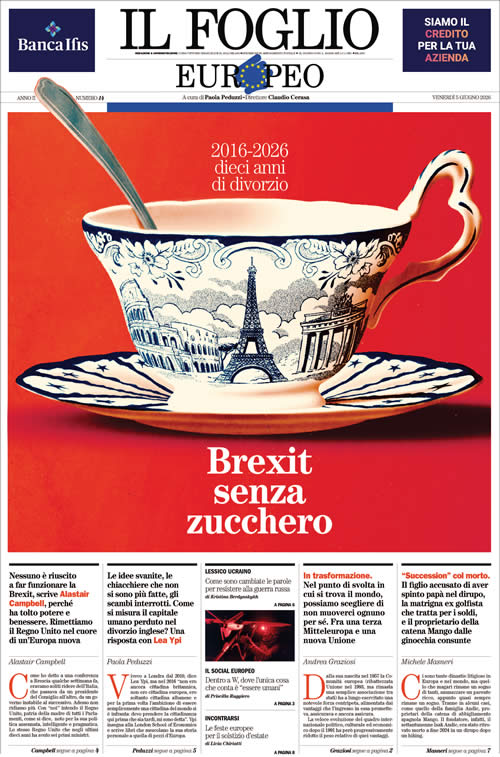
The man whose lies and false promises had helped get the vote over the line in the first place was now where he had dreamed of being since fighting with Cameron on the playing fields of Eton, 10, Downing Street. The lies continued, previous promises were dropped … “what do you mean, we said we would be able to stay in the single market and the customs union, no, no, no … it turns out we can’t have our cake and eat it, but never mind, I am going to ‘get Brexit done,’ and win an election by saying I will do so.”
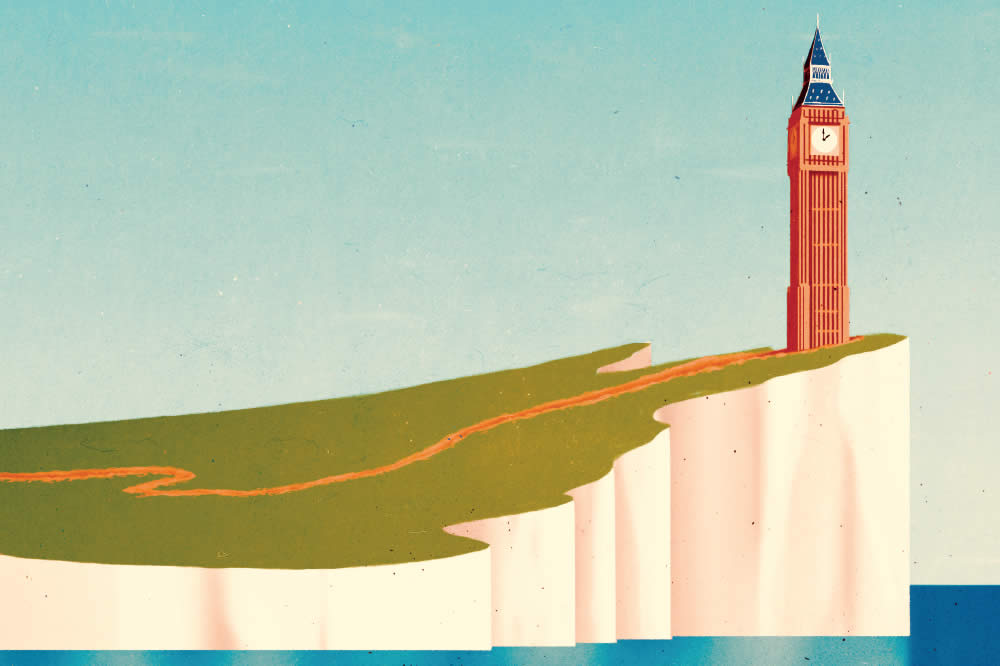
And he did, with the hardest Brexit of all inflicted on the British people. So where has it left us? Poorer, weaker, less respected in the world. Yet both Johnson, long since gone, and Brexit partner in crime Nigel Farage, now fancying himself as the eighth Prime Minister since we had that vote, both still pretending it has gone well. For Johnson, maybe it has, as he rakes in millions taking his comic shtick around the world.
As for Farage, it is quite incredible, and evidence of how unserious and unhinged our politics has become, that the author of a genuinely historic change which has made tens of millions of people poorer, has been able not merely to survive, but to prosper, personally with the millions flowing into his bank accounts, politically into a place where the prospect of Prime Minister Farage has to be taken seriously.
Johnson went because of a different set of lies, over his Covid partying, to be followed by the catastrophic Liz Truss, another Remainer now pretending to be a pro-Brexit fanatic, and whose economic fantasies led to further damage to the living standards of the British people, and the reputation of our politics. Rishi Sunak did his best to clear up her mess, but by now the Tory brand was so tarnished that it would have taken a combined leadership of Jesus Christ and Martin Luther King to prevent Labour leader Keir Starmer entering Downing Street.
His mantra was that he would “make Brexit work.” But how? They have negotiated diligently and without the screaming and shouting of the Tory era, but the changes made have not been a match for the tsunami of damage that Brexit has done.
The damage could not have come at a worse time. US President Donald Trump has imposed tariffs on our trade with the US, and through pique over UK refusal to be part of the Iran war has ended his unlikely bromance with Starmer. We have lost our influence on EU decision-making, and been frozen out of the European defence fund. Once the trusted bridge between the US and Europe, we are now struggling to mend fences with both.
The tragedy of course is that the UK had the best deal of any country in the EU – the opt-outs we wanted, and huge budget rebates; we were allowed to stay out of the Euro and Schengen zones. So even though – finally – a debate is stirring about possibly joining the EU again, we have to accept from the off that we will never be able to get what we had before. That alone underlines the madness of what we did.
As to the economic cost, there are all manner of competing analyses, but they all tell the same basic story … we have done lasting damage to our economic strength. The latest report by the National Bureau of Economic Research (NBER) assesses that Brexit has taken somewhere between 6-8% out of our economy. The same analysis argues that investment is 12-18% down, employment 3-4% weaker and productivity down by 3-4%, against what it would have been if we had stayed in.
Confront the Johnsons and the Farages and the dwindling band of Brexit true believers with these facts, and they resort to Trumpian cries of “fake news,” or in Farage’s case, he blusters that the Tories delivered the wrong kind of Brexit, and it would have been different if he had been in charge.
The Labour government must take its share of responsibility for allowing Farage to escape the enormous political damage that should have been his due (and which, incidentally, still can be, but only if Labour are prepared to confront the country with the reality that we made a truly terrible mistake, and a real determination to fix it.)
The facts are there to make the argument. The lost growth that Brexit has forced on the UK would have created extra tax receipts for the chancellor of £90bn a year. The country largely accepts that we need to spend more on defence. Meanwhile, the NHS remains high among voters’ concerns. Well, without Brexit, we could have afforded to double defence spending and increase health spending by 50% and not had to raise taxes by a single penny. That needs to be rammed down Farage’s throat.
And given we were promised that Brexit would put an end to red tape, so too does the number of customs declarations on goods moving between the UK and EU – now standing at 39.2 million a year, with our tax authorities calculating in 2019 that those forms alone would cost British business £7.5bn a year to fill in.
Following the local elections on May 7, which led to the current mood of challenge to Starmer’s leadership, two statements really stood out to me.
“I don’t think anyone in this country wants to re-open the Brexit debate.” The words of the government’s Culture Secretary Lisa Nandy.
And this, stunningly, from Nigel Farage … “Forget Brexit.”
When Lisa Nandy says that “I don’t think anyone in this country wants to re-open the Brexit debate,” she knows that is simply not true. Many people want exactly that. Polls show it. The desertion of Labour supporters to the Greens is partly about it. And I find it hard to believe that Lisa Nandy has not met the kind of people I meet all over the country, who tell me they won’t vote Labour again until the vague promise to “put Britain back at the heart of Europe” really means something.
One of the reasons we ended up with Brexit in the first place is that we were entering into a period of politics, here and elsewhere in the world, defined as the era of 3Ps … populism, polarisation, post-truth.
Johnson and Farage are the ultimate 3P politicians. Populism – exploiting legitimate grievance for their own political and personal ends; polarisation – a politics that thrives on division, seeks to drive tribes ever further apart rather than bring them together; and post-truth … facts don’t matter, truth is an inconvenient hindrance rather than a necessity in democratic debate, there is no shame in lying, even when you’re found out.
So when Farage urges us to “forget Brexit” … why would he want us to forget what was clearly his historic success? Whatever happened to his rejoicing at being introduced at events organised by MAGA as “Mr Brexit himself”, given these days he seems much happier to talk about anything but Brexit?
The answer is that he too knows it has not delivered the increased power and prosperity or the reduced red tape he promised it would, so he has moved on to other issues that lend themselves to his 3P arguments and tactics; and precisely because the main parties vacated the Brexit field for so long, he has been getting away with it.
The reason why Labour’s “Make Brexit Work” approach was doomed to fail is that it allowed the main authors of Brexit to escape the political calamity that should have been their due. Yes, Cameron and Johnson are gone. But Mr Brexit himself seems to have got away with it, sufficient for him to utter the words “forget Brexit,” and it doesn’t even merit a follow up question from journalists who once could talk of little else. That has to change, and the tenth anniversary of the referendum is as good a time as any to start reminding people of the damage Farage has already done.
I am convinced he can be beaten, and convinced too that the UK can be part of a very different European Union, hopefully with Ukraine, Western Balkan countries, and perhaps in some shape or form even Canada.
Those of us who believe that Brexit was a catastrophic error, a rare case of a country actively choosing its own decline, then refusing to accept or admit it, even as the evidence mounts … we must never tire of saying so, never tire of fighting for what we know to be right … for me, even if perhaps not in my lifetime, that means joining a European Union very different to the one we left. Sounds crazy? So did the Brexiteers, until they won.
Alastair Campbell was the spin doctor behind Tony Blair’s New Labour. Today, he co-hosts the United Kingdom’s most popular political podcast, The Rest Is Politics, alongside Rory Stewart.