

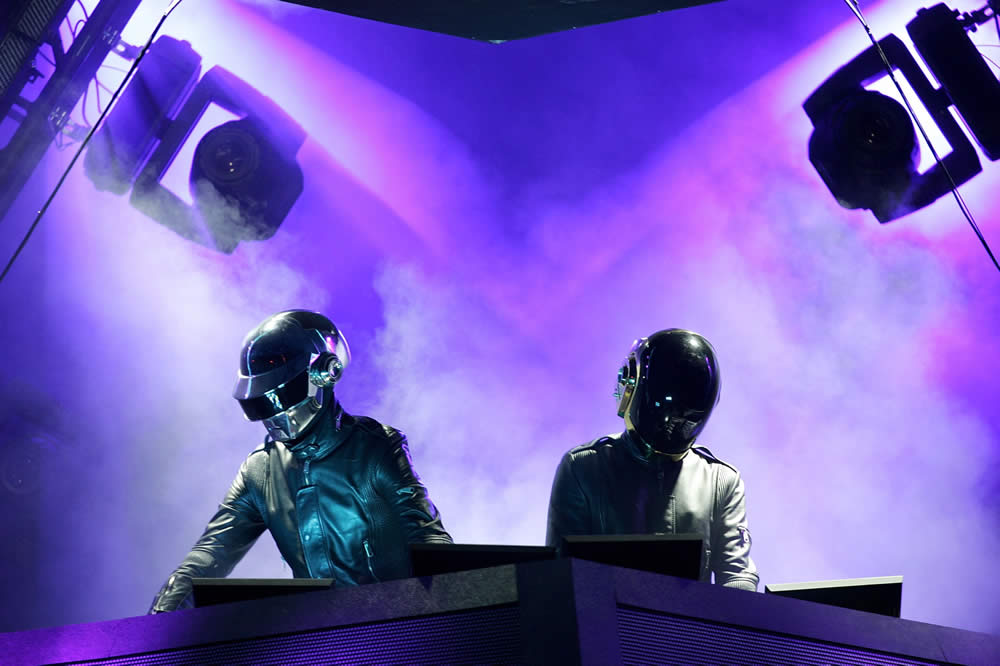
John Lennon used to say that French music is like English wine: drinking it – or rather, listening to it – is a problem. Until the fateful year 1995, three decades ago, French influence on the evolution of popular music had been circumscribed: it was exhausted by Johnny Hallyday and Françoise Hardy, a bit of yé-yé and the seasoned cohort of auteurs-compositeurs (Trenet, Bécaud, Aznavour, Ferré, Brassens, Moustaki), unless one went back to the great interpreters of existentialist Paris (Piaf, Gréco, Montand). Afterwards came just the postmodern transgressions of Serge Gainsbourg in the seventies and nothing more, except for Vanessa Paradis or the underground Magma. Then something happened that subverted the order of things. And now we find ourselves with Emmanuel Macron declaring his conviction that French electronic music has nothing less than German music, confirming his desire to propose it as a value sanctioned by UNESCO (in 2023 the appropriate commission included the Berlin techno scene in that country’s intangible cultural heritage). During a radio interview, Macron proudly explained that the French should be credited with the invention of electro-pop music, citing Daft Punk, David Guetta, Bob Sinclar, Laurent Garnier and Justice as initiators. The president abandoned himself to classic grandeur: “We’ll do like Berlin,” he announced, “I love Germany and I’m a convinced Europeanist. But we don’t take lessons from anyone and the importance of French Touch for dance culture must be recognized, even beyond French borders.” A competent assertion, which claims due prestige for a sound born by chance and with an unlikely promoter: Parisian paparazzo Jean-Claude Lagrèze who, in the early nineties, conceived the dance evenings at Le Palace, without suspecting he had sown the seed of a musical universe in which, little by little, would bloom the rarefied and hedonistic atmospheres of Air and St. Germain, the futuristic spatiality of Daft Punk, the tormented hits of Bob Sinclair, while, at the console of the venue on rue du Faubourg-Montmartre, Laurent Garnier, Guillaume la Tortue and David Guetta made the golden youth of the Ville Lumière dance.
On these days the celebratory issue of Les Inrockuptibles, the most authoritative monthly magazine from across the Alps dedicated to pop culture, celebrates the glorious thirty years of French Touch, since from 1995 to 2025 this sound hasn’t stopped unleashing dances around the world. The global explosion of Daft Punk’s “Homework” (1997) and the universal consecration of Air’s “Moon Safari” (1998) were the philosopher’s stone of French house music. “Daft Punk made us understand that we could sell a universe, not just a song. It was a revolution. Since then we’ve all adapted our music to the spirit of Daft Punk,” recounts Nicolas Godin, fifty percent of the Air duo. “Seeing Air triumph on BBC’s Top of the Pops was a victory for us musicians from across the Alps,” recalls Thomas Mars, singer of Phoenix. In a few years the scenarios changed for French music, consumed and imitated throughout the world, although French Touch didn’t convey extra-musical messages and never generated a derivative culture, as happened with hip-hop. Pure sound, conceived by young white bourgeois and easy to create: it was enough to find the right funk sampling, filter it, add a beat and invent a slogan within everyone’s reach, and the result was an electronic and evocative dance sound, sexy and with a high visual coefficient, with dense atmospheres and evocations of pleasure or, again, an “abstract musical science,” as it was described at the time (recommended reading: “BoomBass,” the story of French Touch written by Hubert Blanc-Francard, published by Léo Scheer in 2021, and “Electrorama” by Tsugi, Marabout editions, 2020).
“It’s a question of approach and aesthetic universe,” maintains Thomas Bangalter, mastermind of Daft Punk: “We used electronic music as a vector to develop something global.” The international triumph of the albums he signed with Guy-Manuel de Homem-Christo ended up captivating both the rock fringe and rave fans, giving French Touch the status of a musical, aesthetic and also economic revolution: “Before, prejudices reigned. Then everything became simple. No wholesaler refused a French record anymore. Finally attention was paid to what was happening in our scene.”
The genres that influenced the birth of French Touch (or French house, if you will) are Eurodisco and Space Disco proposed by artists very popular in France like Cerrone and Sheila B. Devotion. From that came the processed sounds, the use of vocoder and filters, the taste for melody and science fiction references. All this combined with the second strong influence: American P-funk from the eighties, which had its best exponents in George Clinton and Bootsy Collins. The peak of popular success for French Touch would arrive between 2000 and 2001, with the positive vibrations and “feel-good” nature of productions by Bob Sinclar, Étienne de Crécy, Modjo and David Guetta. From there proliferated a generation of musicians and producers who preferred keyboards and samplers to classic rock instruments, supported in their research by a constellation of visionary graphic artists and video directors like Alexandre Courtès, Geneviève Gauckler, Michel Gondry. Yet, with the passage of time, things would begin to crumble and even French Touch would become a reproduction of itself: some identify its decline with the dissolution of Daft Punk, announced publicly on February 22, 2021. Others hypothesize that when Madonna made an album (“Confessions on a Dance Floor”) vampirizing French Touch, the effect was to empty the national identity of this sound. Yet, just last summer, the Paris Olympic Games ceremonies were literally centered on the celebration of French Touch before the world, with performances by Phoenix, Air and Kavinsky and the sound design of the closing event entrusted to the cream of French DJs. And now here’s Macron launching it all into the history of culture, while French Touch is experiencing a new cosmopolitan spring, thanks to third-generation artists like Duck Sauce, Martin Solveig and Phil Weeks. The sensation is that the French can’t do without this sound. And that the rest of Europe continues to envy that graceful manifestation of joie de vivre that never stops seeming, at the same time, unconscious and fascinating.
