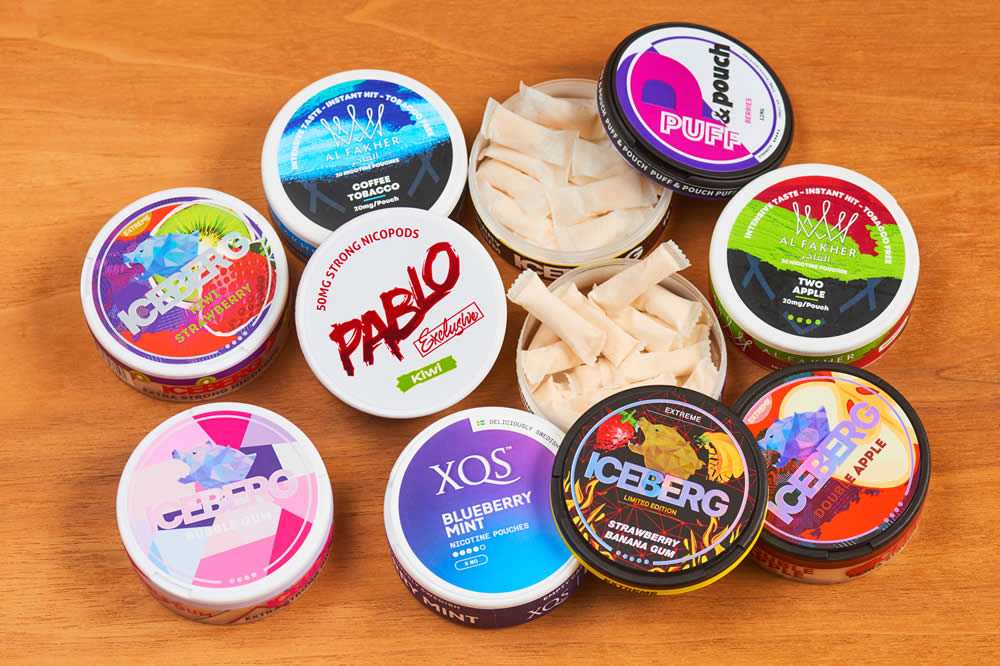
Finance student Lilian Clair was drinking beer in a bar in the French city of Lyon when one of his friends took out a tin of what looked like mini teabags filled with white powder.
Never more than a casual smoker, Clair, 22, was about to experience the tobacco industry’s latest sales weapon: the nicotine pouch, or white snus. These sachets, containing no tobacco but up to five times the amount of a cigarette, flavourings and other ingredients, have conquered America.
Now they have arrived in Europe, hooking growing numbers of young people and dividing lawmakers over whether they should be considered a useful alternative to tobacco, or the thin edge of a wedge designed to get young people smoking.
“You had one or two of us who discussed it,” Clair said. “Then there were others who were interested. And the curious ones, let’s say, who wanted to try.”
Clair was one of the latter. After he lodged a sachet between his top lip and his gum, the effect came on quickly. “The first time, you feel like your head is spinning. I didn’t keep it there for long, maybe two minutes, five minutes,” he said. “But if you kept it for a long time, it could make you vomit easily. I have two friends who tried it and they threw up afterwards.”
In Sweden, people have put sachets of tobacco on their gums since the 16th century. In the last five years, the tobacco industry has begun aggressively marketing this new form of pouch, filled with plant fibre, nicotine powder, flavourings and other ingredients, as an aid to quitting smoking.
Part of several companies’ self-declared goal to become predominantly smoke-free businesses, the gambit may have saved the industry.
British American Tobacco (BAT) sold 1.1bn of its Velo pouches in the United States in the first half of last year. Two years after some expressed doubts about the company’s future when it wrote down the value of some of its cigarette brands, it hit a record share price last January.
Pouches, or lip pillows, upper deckers or cushies, are suddenly ubiquitous in America. Social media is awash with “Zynfluencers”, a new breed of content creators often sent free samples by Philip Morris International, whose pouch brand is called Zyn. Tucker Carlson, the right-wing television commentator, owns a pouch brand and calls nicotine “a life-enhancing, God-given chemical”. Advocates champion the nicotine buzz of pouches as energy-giving and focusing: children have been known to take them before school.
The tobacco giants are now targeting Europe. A study by the Alliance Against Tobacco, in France, found 229 influencers had promoted nicotine pouches, as well as vapes, on French-language social media between 2019 and 2024, reaching 24 million people. BAT invited the drag queen Catherine Pine O’Noir to promote Velo at the Cannes Film Festival. Online sellers advertise them freely: the videos of Walid Chinwii, from France, who calls himself Mr Snus, have been viewed on TikTok four million times, and include a clip of him opening up a tin at the foot of the Eiffel Tower.
A new image of cool is taking root among Europe’s young people, fewer of whom smoke. After trying a pouch, Clair moved to Hungary as part of the Erasmus university exchange scheme, where he said many in the expatriate community used them, particularly his Dutch friends. He estimates that 15% of his friends have tried them, and 5% use them habitually. Clair said none of his generation wanted to be the “guy who smokes like a fireman and whose mouth smells when you kiss him”.
“People who use this thing are not necessarily smokers,” he said. “The guys who consume them are sporty. They don’t want to kill their lungs. They keep their cardio for running, for football, for everything. And also, because when you have a party, where you drink alcohol, having that as well, it adds a bit of madness to the party.”
The health effects are still unclear. Since they do not contain tobacco – like e-cigarettes, another product the tobacco giants and other manufacturers now sell in their hundreds of millions – they are not as destructive as cigarettes. But studies have found in them arsenic, lead and formaldehyde, all dangerous toxins. Gums are thought to recede from excessive use. At the same time, the nicotine levels make them highly addictive and could cause cardiovascular problems.
The Netherlands and Belgium have banned pouches. France has moved to follow suit. Spain’s government wants to ban all but the pouches with the least amount of nicotine. Other countries, including Italy, tax them and ban them for under-18s.
Brussels is unlikely to implement a Europe-wide ban, or even a tax, because so many countries object, including on free trade grounds.
“It’s part of our way of life, and the government will not tolerate Brussels persecuting Swedish snus consumers,” trade minister Benjamin Dousa told a Swedish newspaper last year, after the country helped block a French and Spanish-drafted law to reduce legal levels of nicotine in pouches. Many of the producers owned by big tobacco are in Sweden.
The tobacco giants say banning tobacco-free products pushes smokers back to cigarettes and encourages black markets in vapes and pouches.
Look at Sweden, they say, where only 5.3% of people smoke. Is it a coincidence it is the country of the snus?
The experience of disposable vapes – or e-cigarettes – shows the risk of bans: several European countries have banned them, yet teenagers buy them over Snapchat and in convenience shops at will, paying about 10 euros for 9,000 puffs, the equivalent in nicotine of 36 packs of traditional cigarettes.
François Torpart, of the French National Committee Against Smoking, which calls for a ban on pouches, said this might not happen in their case because the market in Europe is less established. Their strength, their marketing to young people and their marketing to be consumed “all the time”, he said, shows that “they are entry products to nicotine addiction, not exit products”.
After a couple of tries Clair decided pouches were not the answer to cool after all. “It was fun to try…” he said. “But there’s nothing cool about it.”
Richard Assheton is a freelance journalist. He's a contributor to The Times, The Sunday Times, and The Guardian. He lives in Marseille.