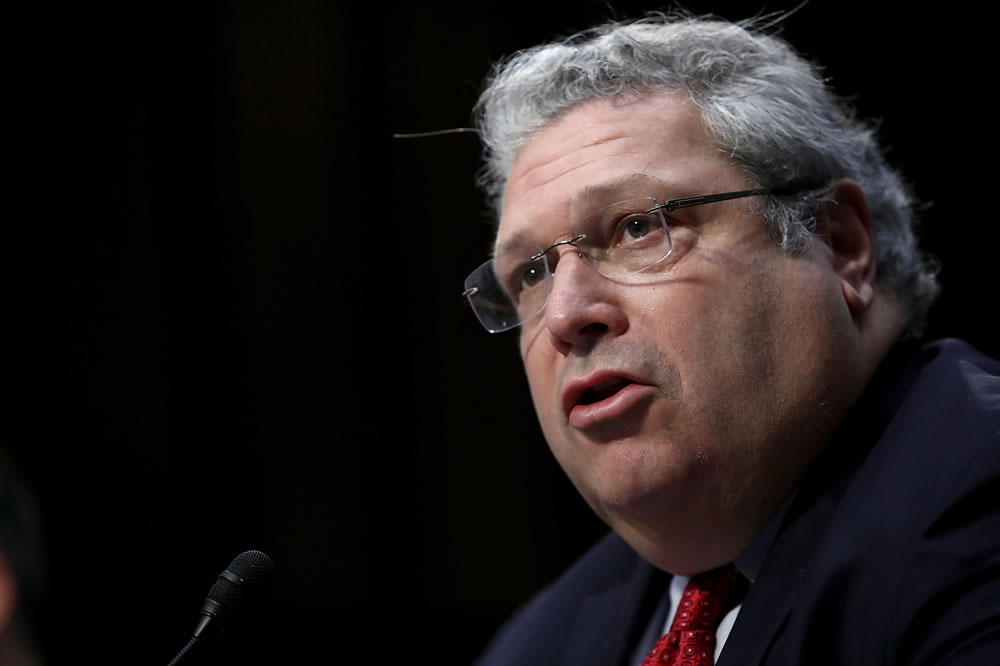
For Robert Kagan, senior fellow at the Brookings Institution and one of the leading intellectuals of American global leadership, the war in the Middle East is a strategic mistake. “The United States has achieved remarkable results on the battlefield against Iran,” he tells us, “but the overall strategic picture is negative for Washington.” The central argument of Kagan’s thinking is that this war is absorbing American power in a theater of secondary importance, dangerously diverting it from higher priorities.
Robert Kagan worked on the policy planning staff of the State Department under George Shultz, served as an adviser on John McCain’s presidential campaign, and is the husband of Victoria Nuland, who spent many years handling European Affairs at the State Department. He is one of the most authoritative voices on the transatlantic relationship, and is well known in Europe for this reason. “The United States has never considered the Middle East and the Persian Gulf primary interests,” he explains. “The primary interests have always been Europe and East Asia. Iran does not have the capability to strike American territory, and the foreign policy of the Trump Administration should be focused on national security: I don’t see how Iran threatens those interests.” This conflict, then, is driven by Israeli priorities — “it has been conducted essentially in Israel’s interest.” Kagan’s argument carries real force, especially in light of Trump’s supposed doctrine of Western Hemisphere primacy, and certainly the Islamic Republic’s firepower poses no threat to Kansas. But American power since 1945, as Kagan himself acknowledges, has always been organized around something larger: an Iran on the nuclear threshold, with a network of allied terrorist groups stretching from the Mediterranean to the Red Sea, with intercontinental missile ambitions and a strategy of choking one of the planet’s most critical energy corridors, represented — from the Administration’s perspective — a challenge to non-proliferation and to the energy security of every American ally. The war may be primarily in Israel’s interest, but that does not mean it serves only Israel’s interest.
Kagan also believes it is important to consider the signals sent to America’s principal adversaries — signals that, he argues, benefit no one in Washington. “The Chinese have noticed that to fight this war the United States stripped the western Pacific of significant forces. The naval expeditionary units Washington sent to the Persian Gulf had a precise mission in East Asia: to respond to a potential Chinese attack on Taiwan,” he observes. “Any future mission involving China, in any Taiwan scenario, will require American ships to traverse heavily contested waters, exposed to enemy fire far more sophisticated and far more abundant than anything Iran could muster. After all, we are talking about a weakened, decimated Iran that is nonetheless capable of inflicting significant damage in the region. What lesson have the Chinese drawn from that?” And yet a different reading is also possible: for two decades American power appeared restrained — with the withdrawals from Iraq and Afghanistan, with the incremental approach to Ukraine and support that never came close to meeting the actual demands of that defense. Whatever the costs of the campaign against Iran, the strikes demonstrated that the United States is still willing to use force decisively. Kagan is unconvinced: the costs to Washington, he argues, have outweighed the benefits. And another actor that stands to gain from this campaign, alongside China, is Russia. “Do you believe Vladimir Putin is more afraid of the United States today than he was yesterday? The war has helped Russia and hurt Ukraine,” he says. “It delivered tens of billions of dollars in oil revenues to Putin at a moment when the Russian economy was under severe pressure. At the same time, it has drawn down Ukraine’s already relatively limited stocks of Patriot interceptors and other air defense systems it needs to protect itself.”
Another geopolitical casualty of this war, for Kagan, is the transatlantic relationship. In Of Paradise and Power: America and Europe in the New World Order, his celebrated 2003 essay, Kagan argued that Americans and Europeans inhabit different worlds: Americans live in a Hobbesian order in which military force remains central, Europeans in a Kantian one shaped by law and diplomacy, made possible by the American security umbrella. Mars and Venus — two visions often in tension, but the underlying order existed and held. “That system rested on an almost miraculous level of trust on the part of America’s allies — on the certainty that the United States would always stand by them and would never use its power to take advantage of them. It was a great compact, and that compact has been discredited,” he says. “The war has both revealed and deepened the chasm that has opened between the United States and Europe. It is clear that in planning it, the Americans had given no thought to the repercussions for the European continent. They certainly did not consult the Europeans — not even Giorgia Meloni, Trump’s close friend.” Kagan believes something momentous is happening that many people, especially in the United States, have failed to grasp: “The American people have voted for Donald Trump twice, and the Democratic Party is certainly not the party of Dean Acheson and Harry Truman. I see no one pointing out that among the serious things now unfolding is the fact that we are essentially abandoning our security relationship with Europe. It is by no means certain that we can simply go back to how things were, as if nothing had happened.”
Europeans now face a choice: “They can allow Russia to reestablish its position, along the lines of the Cold War or the tsarist empire, or they can resist.” But rearmament carries its own dangers. Any serious European military buildup will inevitably be led by Germany, and Kagan hears the echo of those anxieties that had given rise to a postwar order designed precisely to contain them. “We Americans take the permanence of European harmony for granted, but the reality is more complicated. There has always been a certain suspicion of excessive German power.” If the Atlantic framework dissolves, the German question returns — and with it the specter of an arms race on the continent. “If the AfD wins in Germany, if the right wins in France, if the right wins in the United Kingdom, we will be confronted with nationalist movements, not pan-European ones. There will be genuine centrifugal forces pushing Europe toward fragmentation.”
American engagement had begun to erode before Trump. Washington allowed allies to free-ride on its security guarantees without contributing adequately to defense for thirty years, watched Europe make itself dependent on Russian gas and oil, and stood by as Iran built an empire of proxies. The result is an order that has hollowed out from within. “Trump has demonstrated that the United States still commands enormous power, if it chooses to exercise it — but the question is: exercise it in the name of what?” Kagan believes the answer has been clear for eighty years: exercise it as the leader of an order built on alliances, from NATO to East Asia. “It was not the ideal solution — it had its costs, its risks, its stakes. But in the real world, I think it was a good solution.” The war against Iran offers no definitive answers; it remains unclear whether things will improve for the United States, for the Western community, and above all for the Iranian people. If the regime survives — weakened but intact — the war may come to resemble other Middle Eastern conflicts, with temporary shifts in regional balances. If instead it leads to internal change in Iran, it could prove a turning point. “There are no ultimate solutions,” Kagan concludes. “There are only better or worse situations.”
Ani Chkhikvadze is a Washington-based journalist covering US foreign policy, European security and international affairs. She’s originally from Georgia.