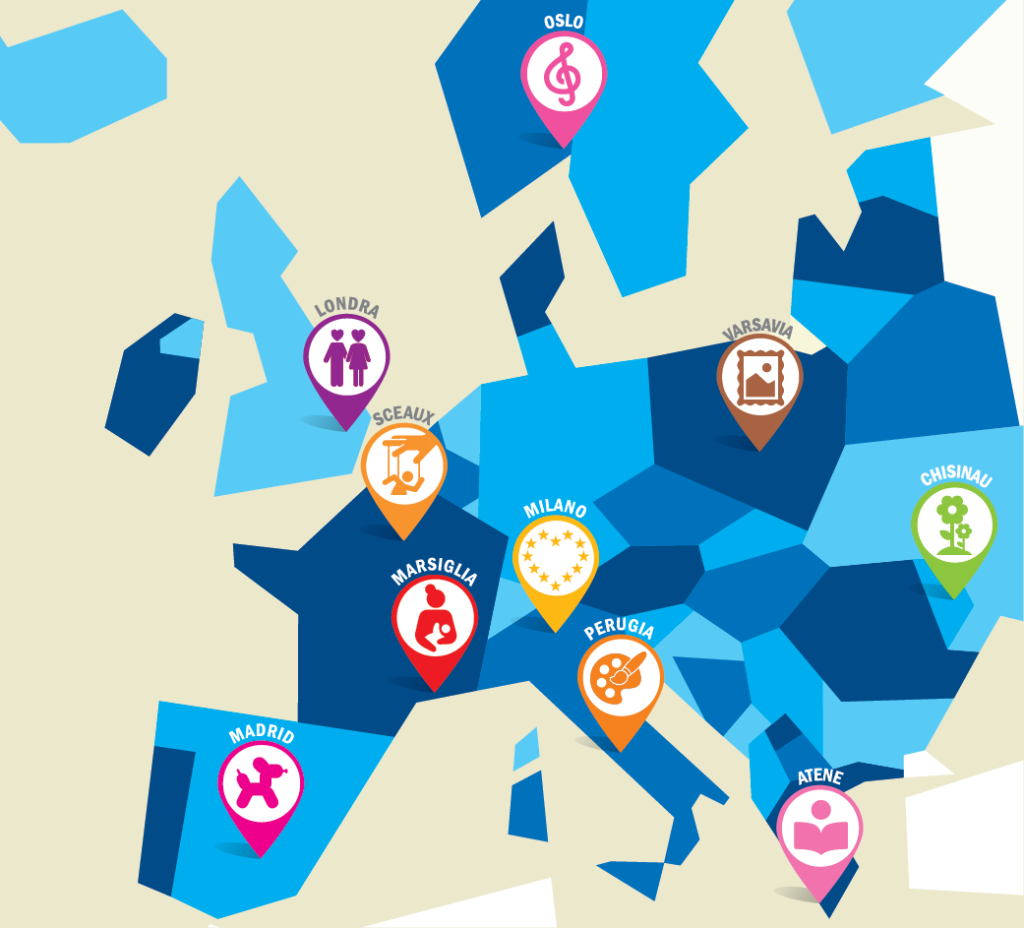
28-29 March. Mons la girafe / Sceaux, France
The giraffe from the Kharkiv zoo
On January 1st, the Feldman Ecopark in Kharkiv was bombed. Two lions were injured and all the birds in an aviary died. The Feldman had also been among the first targets at the start of the Russian invasion of Ukraine, and many animals had died. This tragedy moved author Oleg Mykhaylov and director Oksana Dmitrieva so deeply that they decided to create a puppet show about it, together with the V.A. Afanasyev Puppet Theatre Academy of Kharkiv. This is how the show “Mons La Girafe” was born, staged at the end of March at the Les Gémeaux theatre in Sceaux, in Île-de-France. Through the eyes of a child, we follow the life of a giraffe from the Kharkiv zoo during the Second World War, and its friendship with its veterinarian. It is a lyrical fable about war and the loneliness it causes, where pain does not harden into hatred, but rather into tenderness. The puppets are made of wood and metal, a tangible symbol of Kharkiv’s destroyed buildings, and the story makes room for humour, lightness and hope. A few days ago, a dwarf horse named Lyutik was born at the Feldman – the first of the spring baby boom. They write: “It means that this harsh and long winter is over and we will be fine. The birth of a red horse in the year of the red horse is surely a good sign.”
18 March–31 August. Bonnes Mères / Marseille, France
The good mothers of the Mediterranean
The Basilica of Notre-Dame de la Garde, which watches over Marseille, is affectionately nicknamed by the people of Marseille the “Bonne Mère”, the good mother. “Bonnes Mères”, in the plural, is the new exhibition at the Mucem, the Museum of European and Mediterranean Civilisations, dedicated to representations of the figure of the mother. The exhibition explores motherhood as a universal experience, between myth and everyday life, at the crossroads of cultures that make up the Mediterranean basin. It tells of the plurality and diversity of experiences within this universal condition – motherhood as a social construct, a political challenge, and a subject of artistic inquiry, from antiquity to the present day. The first section, archaeological and philological, is dedicated to traditional representations and the archetype of the mother, how it has been instrumentalised and reinterpreted – the divine feminine, the virgin mother, the motherland, symbols both represented and questioned, as in Louise Bourgeois’s fertile but headless Sphinx. The second part enters the physicality of women’s bodies and their invisibilised experiences: menstruation, childbirth, breastfeeding, postpartum depression, and terminations of pregnancy. Mental load, inequalities, but also joy and creative strength all come to the fore. The exhibition overturns the idea of motherhood as private confinement and presents it as a space of emancipation in public life as well. To free the mother is to free life itself – it is not tautological to recall, as Adrienne Rich wrote, that every human being is born of a woman.
14 March–14 June. Giotto and Saint Francis / Perugia, Italy
The gentle revolution of Western painting
“Observing the life and nature of Francis of Assisi, one cannot help but think that this man must have had a very gentle mother,” writes Herman Hesse in “Francis of Assisi.” Whether or not that is true, standing before the Madonnas with Child by Giotto or Pietro Lorenzetti – soon to be on display in the exhibition “Giotto and Saint Francis. A Revolution in Fourteenth-Century Umbria”, curated by Veruska Picchiarelli and Emanuele Zappasodi at the Galleria Nazionale dell’Umbria – one senses that this gentleness nonetheless flowed from the saint’s life, permeating the world and the painting of Giotto. Opened on the occasion of the eight-hundredth anniversary of the saint’s death, the exhibition explores the encounter between Francis and the genius of Giotto: a meeting that, between the late thirteenth and early fourteenth centuries, revolutionised Western painting. The exhibition retraces what took place around the Basilica of San Francesco in Assisi, where Giotto and masters such as Simone Martini and Pietro Lorenzetti were called to work, creating a new visual language that, moving beyond the formal stylisation of Byzantine art, introduced a physicality capable of capturing and rendering reality, in a space inhabited by figures endowed with physical presence and emotional intensity.
20 March–28 June. Maria Jarema Cracked Modernism / Warsaw, Poland
A fractured identity and the allure of freedom
A retrospective dedicated to Maria Jarema, one of the most important Polish artists of the twentieth century, titled “Maria Jarema Cracked Modernism”, is on display at the Museum of Modern Art in Warsaw, curated by Éric de Chassey and Natalia Sielewicz. A painter and sculptor, she was among the founders of the First Kraków Group, decisive for the modernist generation, and worked at her brother Józef’s avant-garde theatre Cricot as a set designer, costume designer, and actress. She was a central figure, a “cultural magnet” of the artistic scene between the two world wars, during the occupation, and in the postwar period – in 1957 she co-founded with Tadeusz Kantor the Second Kraków Group, a forerunner of the Polish avant-garde under communism. Her friend and art historian Helena Blum wrote of her in 1958: “In every discussion or conversation, Maria’s voice was important and decisive. She did not impose her opinion, but became authoritative through intelligence and charm.” Working within the context of modernism and post-Cubist abstraction, with influences from Surrealism and Expressionism, her works explore light, form, and movement. She always asserted her artistic and inner freedom, refusing to submit to Socialist Realism, and instead experimented with the monotype technique to explore identity as a totality and at the same time as a cracked and fragmented subject – hence the exhibition’s title.
27-29 March. Athens International Literature Festival / Athens, Greece
The polis’s new literary festival
In less than ten years, Greece has gone from a severe crisis and the risk of being forced out of the European Union to leading the Eurozone economically. Athens now seeks to position itself not only as a reference point for economic development but also as a cultural hub, and so it inaugurates the first edition of the AILF, the Athens International Literature Festival, with many international guests, at Technopolis City, a former industrial site now repurposed as a cultural venue. In the city, rapid growth often corresponds to an equally rapid growth in inequality and social divide (gentrified neighbourhoods no longer accessible, and peripheral areas lacking infrastructure and services): the hope is that this new event will help make Athens a centre of literary ferment on the international stage, but above all become a space dedicated to its citizens.
13-22 March. Oslo International Church Music Festival / Oslo, Norway
In Oslo, sacred music goes pop
Perhaps one of the moments when we most strongly sense the presence of something we might call divine is while listening to or playing music. Music has, after all, accompanied the whole of human history as a bridge between the immanent and the transcendent, and has always played a central role in the rituals of every religion. Today, sacred music – particularly in Western societies – is no longer as widely embraced, and the Oslo International Church Music Festival, held in Norway in March, is committed to developing and spreading the heritage of sacred music. The wide-ranging programme will be hosted by the city’s main churches, with particular attention given to intercultural and interfaith dialogue, including concerts featuring music from outside the Western church tradition – such as musicians from the Cathedral Mosque of Córdoba, or the Georgian choir of the Monastery of the Thirteen Holy Assyrian Fathers, who will explore Assyrian and Orthodox traditions and sing hymns and prayers in Aramaic. Among the many events, French artist Camille Bordet and Iranian musician Mostafa Taleb will create a rich and vibrant soundscape of Persian melodies woven into traditional European music, drawing on sacred and secular texts from Persia and medieval Europe through to present-day France.
1-10 March. Mărțișor / Chișinău, Moldova
The Moldovan spring festival
On March 1st, for the Mărțișor festival, Moldovan President Maia Sandu published a video recounting its legend: the sun is imprisoned by a dragon and the world freezes in a bitter winter. The hero arrives – Mărțișor, a young man who bravely confronts the dragon and defeats him. His red blood melts the white snow, the sun is freed and brings spring. Different versions of the legend exist, but all share the colour red, a symbol of life, and white, a symbol of purity and winter. Mărțișor marks the arrival of spring on March 1st and is celebrated throughout the month; in Chișinău there are events at least until the 10th. The symbol consists of white and red braided wool cords, with a bow and a charm, which are pinned to a jacket, hung on a door, or given as gifts. It is a pagan festival, rooted in the folklore of Moldova, Romania, Bulgaria, North Macedonia, and parts of Greece and Albania, suppressed during communism and rediscovered after its fall. It is a wish for fertility, rebirth, hope and solidarity, teaching that after every struggle and sacrifice there is always a new beginning. Some representatives of Moldovan tourism spoke to Il Foglio about these very themes: Moldova has been building itself for thirty years in small but, for Moldovans, immense steps, thanks to their sacrifices – including those of the diaspora.
4-8 March. ARCOmadrid / Madrid, Spain
The future of the art market in Madrid
In January, Spanish art galleries went on strike to demand that the government reduce VAT on contemporary artworks and align it with European directives, already adopted by countries such as Italy, France and Germany. In Spain the rate reaches up to 22 percent (in Italy it stands at 5), and according to the galleries’ association, the government’s inaction is damaging the competitiveness of the entire sector, both nationally and internationally. The protest was backed by Maribel López, director of ARCOmadrid, the country’s largest contemporary art fair, who reiterated the need to recognise the sector’s economic and employment significance. On March 4th the fair opened its 45th edition, enhancing its role in cultural dissemination beyond its commercial function, and strengthening the presence of museums and foundations. Some 211 galleries from 30 countries will participate, and a third of the international attendees will come from Latin America, confirming ARCOmadrid as the main gateway for Latin American art in Europe. There is also a thematic exhibition, “ARCO2045: The Future, for Now”, curated by Magali Arriola and José Luis Blondet, which uses déjà vu as a strategy for imagining the future and draws inspiration from David Lynch’s paradoxical optimism in his weather forecast videos on YouTube.
18 March-6 June. Romeo and Juliet / London, United Kingdom
Two young people at a party — the rest is tragedy
“POV: Romeo and Juliet meet at a party.” This is the TikTok launch of the new production of “Romeo and Juliet” directed by Robert Icke, running from March 18th at the Harold Pinter Theatre in London. Another promotional post: “In Verona, in the height of summer, two young people meet at a party. The rest is tragedy.” Pop aesthetic, font, and register – and two young, strikingly beautiful leads. Romeo is played by Noah Jupe, whom we have already seen perform Shakespeare, specifically Hamlet, in Chloé Zhao’s “Hamnet.” Juliet will be played by Sadie Sink, Max from “Stranger Things” – and who knows, perhaps this debut, both Shakespearean and in the West End, will finally free her from our association of her with Kate Bush’s “Running Up That Hill.” Sink also comes from Broadway, having performed in “Annie” for much of her childhood, and has just received a Tony nomination for “John Proctor is the Villain.” Icke, a director with a gift for breathing fresh life into great classics (whether great classics actually need fresh life we leave for the audience to decide), has said that he was not looking for someone to play Juliet, but rather that after meeting Sink he asked himself what he could create for her. The production seems more interested in the fragility of chance and the coincidences of the two lovers’ meeting than in the tragedy of the story – and it is certainly interested in building a very glamorous, very social media-friendly universe of communication: in a shoot for British Vogue, the Gen Z couple of lovers shares a plate of tomato pasta at an Italian restaurant in the West End, dressed in Prada and Céline.
12 March. L’Europa non cade dal cielo / Milan, Italy
A sentimental history of the European Union
The EU’s current popularity can be measured in memes about the Union comfortably returning on a Monday for the Security College with the war that broke out in the Middle East on the Saturday: we really do need to fall in love with Europe again. There is a show for that – “L’Europa non cade dal cielo” (“Europe Doesn’t Fall from the Sky”), directed by Alessandro Argnani, written by Laura Orlandini, and performed by Camilla Berardi and Massimo Giordani. It is an epic and sentimental account of the history of this supranational project, born from the rubble of war to guarantee peace and prosperity, growth and solidarity: the founding ideals, the contradictions, the imagery, the music, the ideas, and the people on the move.