Nigel Farage has resigned as a UK Member of Parliament following allegations he had accepted undeclared political donations. This triggered a by-election for his parliamentary seat. As a limelight-loving showman facing criminal investigation, Farage said he would resign but then contest the election, “let the people decide,” he said. This is what he called a ‘People vs Establishment’ contest.
By winning a local vote Farage wants to silence accusations of corruption that have slowed Reform’s momentum in recent months. Ever since The Guardian newspaper showed he accepted £5mn from a British cryptocurrency billionaire Christopher Harborne. It was the largest donation to an individual in UK political history. Murky details of other, undeclared ‘private’ donations have since come to light, related to cryptocurrency sources and convicted fraudsters. Farage did not declare the donations, he says, because at the time he was just a simple, private citizen, widely considered to be the most influential political figure of his generation – a humble broadcast journalist and co-founder of Reform UK. Curiously, just days after receiving the Harborne’s donation in April 2024, Farage declared his very public and political intention to be a Member of Parliament and party leader. He claims the two events were a coincidence.
As the UK’s economic crisis continues, public revelations about Farage’s private finances are viewed with weary anger. Opponents label his resignation and by-election campaign a distracting farce, a stunt. Farage expected the ‘establishment’ to be obedient, to play along. But then the other major UK political parties refused to participate, leaving Farage to contest his ‘People vs Establishment’ election with a parody character called Count Binface, who dresses in a black cape and wears a large mask shaped like a bin.
Reform UK’s nationalist cocktail of free-market extremism, climate denial, and anti-immigration is being offered as the antidote to the mundane, janitorial politics personified by Keir Starmer and the Labour government. Reform have topped most electoral surveys for over a year, and their popularity has grown despite criticism, name-calling and ridicule. During local elections in May Reform won over 1400 seats. In the face of such trends the British resort to a carnival tradition of whacky satire and silliness, one that aims to undo the spectacle of legitimacy and common sense.
Another controversial strategy splashed over the heads of the far-right and had a big influence on how right-wing populism reaches the streets. This was ‘milkshaking’ – the bizarre and consequential protest trend that first struck British politics in 2019. That year, the verb “to milkshake” – the act of dousing public figures with a dairy drink – entered the Collins Dictionary. But milkshakes were not for every public figure. They flew for a previously untouchable class of political personality – the populist far right.
Targets of milkshaking included the street-fighting fraudster currently known as Tommy Robinson – milkshaked on consecutive days. Afterwards he claimed that “No amount of punches, milkshakes, attacks, is going to stop me.” But the electorate gave him just 2.2% of the vote in the 2019 European Parliament elections. The same month, Carl Benjamin, a contrarian YouTuber best known for publishing repellent rape jokes, was hit multiple times in different picturesque rural towns. The press enjoyed printing the pictures.
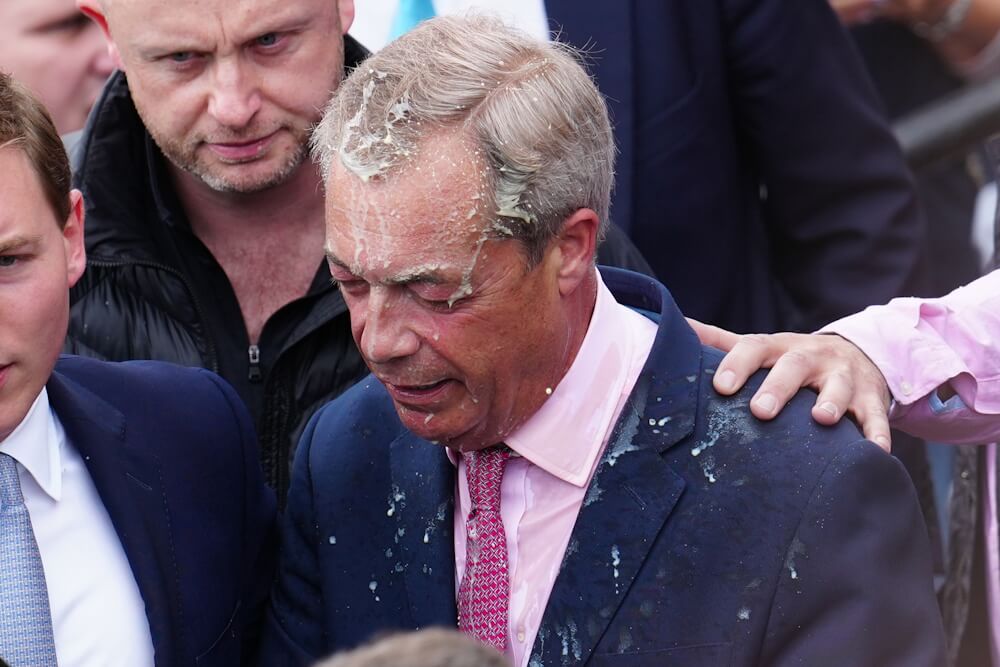
Attempts to ban the sale of milkshakes could not protect Nigel Farage, who was struck by a banana-and-salted-caramel flavour milkshake in the city of Newcastle. Afterwards he said he was surprised at “the sheer level of hatred” people felt towards him, and complained that “normal campaigning is becoming very difficult.” Days later, Farage met with a crowd of protestors holding milkshakes, like rebellious peasants, lofting milky pitchforks and frothed torches at the castle’s gates. England’s sweet riot. Farage refused to leave his bus.
The emotional aesthetics of milkshaking is tightly interwoven with modern social media – fast, funny, memeable, and chaotic – and ready to douse the energy of internet blowhards and braggarts into a comic sadness. The angry man, who inspires political violence in other angry men, can be humbled in seconds; made to look a clown and his noisy politics of loss and revenge ages like milk.
Costume candidates rarely change political culture. They have been part of English elections since the 1960s. But the milkshaking trend made a powerful contribution to the ‘People v Establishment’ by-election we are seeing in 2026. On his first day campaigning in the 2024 UK General Election, Farage was milkshaked by a 25-year-old OnlyFans content creator. After the incident Farage responded with a confusing mix of anguish and defiance, describing the incident as “terrifying” while joking on social media, holding a milkshake. Right-wing populists dream of being everywhere. They also remain wedded to old-fashioned vestments of party power and masculine glory, flag-waving, honorifics, blue suits, the needy-want of Barbour-wearing respectability. “I’m going to make one promise to you and the tens of thousands watching this live online and the media …” said Farage after being milkshaked in 2024, “I will not surrender to the mob. I will not stop campaigning.” To produce content, to capture attention online and in person, Farage flies throughout the UK in a helicopter, usually in the company of four security staff and as many as 12 security guards at larger events. Being a divisive firebrand is expensive, and this is where the donations matter. Harborne, who witnessed Farage get milkshaked in 2019, said his £5mn donation to Farage was motivated “to support Nigel’s security not just now, but for the rest of his life.” One bizarre legacy of throwing milkshakes at the far-right has been to reinvigorate the older tactic of ‘permanent campaigning’ first described by political scientists in the 1980s, a kind of Helicopter Populism that aims to put one person in front of as many cameras as possible. And when the campaign is Nigel Farage – his personal character, image, and myth – milkshaking threatens to expose a political movement whose early success is based on a fragile personality cult.
Ths paradox of Helicopter Populism is that it removes political figures from the people they say they know better than anyone else. They look more elite, aloof, and scarcely in touch with the world they say is in dire decline. Another novelty candidate. It is interesting that the people who promise to protect and avenge the masses are also the people who trade the sweet touch of common folk for comfort and luxury. This is the Faustian bargain that shadows every power-hungry man. It is his weakness as a self-appointed tribune of the people. The dream of permanent campaigning is a smooth-talking fantasy, forged in the clouds, and out of range of flying milkshakes. Democracy needs testing in the streets. And at the ballot box.