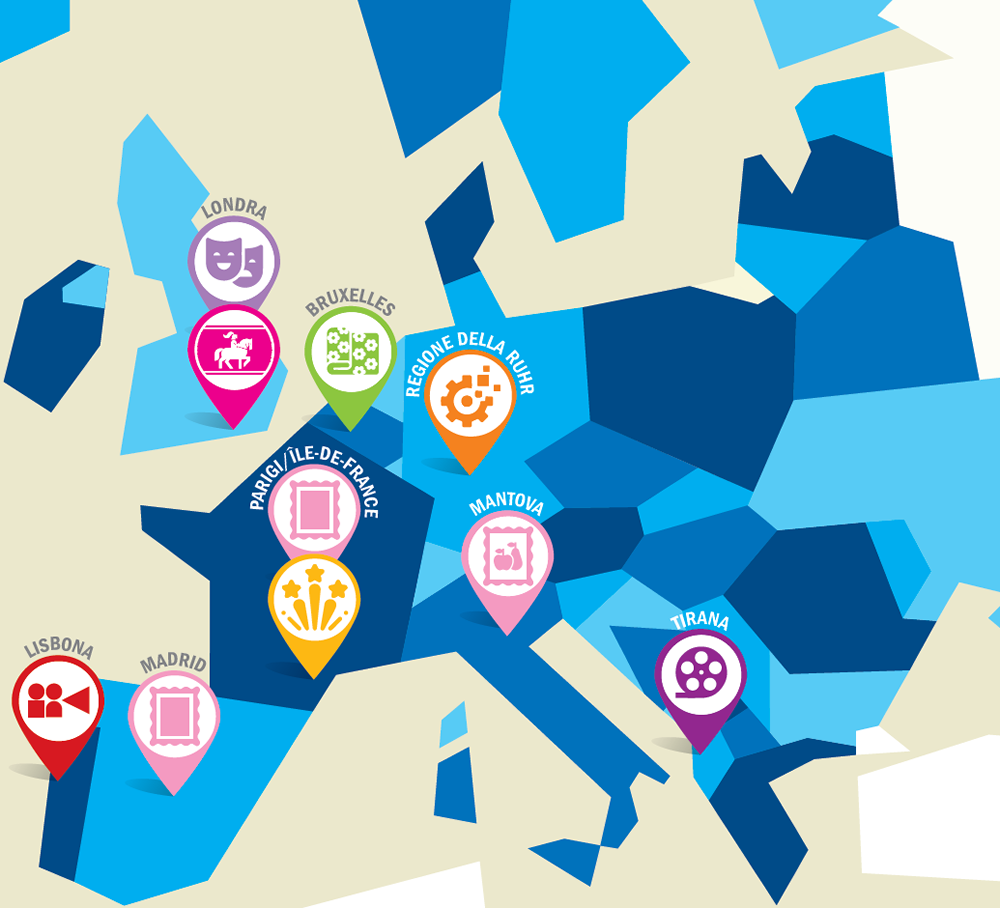
SEPTEMBER 18-26. QUEER LISBOA / LISBON, PORTUGAL
The film festival with a queer flavor
While Futuro Nazionale, the far right Italian party, in its election platform, declares its intention to ban “genderist/homosexualist” programs, TV scenes, and ads from 6 a.m. to 11 p.m., Lisbon’s Queer International Film Festival is launching a new section, “Queer Families,” aimed at children and families, with two Brazilian films: “Feito Pipa,” by Allan Deberton, about a boy who loves soccer, and “Papaya,” Priscilla Kellen’s animated film about a papaya seed who wants to fly away rather than put down roots alongside the other seeds. The festival, turning 30 this year, brings the most interesting independent queer cinema to Lisbon and revives forgotten titles, including “Pink Narcissus” (1971) by gay-photography master James Bidgood, “High Art” (1998), Lisa Cholodenko’s tormented lesbian love story, and Frank Ripploh’s very explicit autobiographical comedy “Taxi to the Toilet” (1980), set in West Berlin. Among the most anticipated films of the season is “Maspalomas,” by the Basque collective Moriarti, the story of a retiree felled by a stroke and forced to leave his queer-friendly, party-loving refuge in the Canary Islands to move into a nursing home in San Sebastián, where he reunites with his daughter. In short, a rich assortment of queer flavors for every patron and her plus-one.
SEPTEMBER 10, 2026-JULY 11, 2027. THE BAYEUX TAPESTRY / LONDON, UNITED KINGDOM
A most delicate soft-power operation
When the nuns of Canterbury (probably) embroidered the Bayeux Tapestry, they had no idea what story of soft power the piece would go on to tell today. The tapestry — which is in fact an embroidered cloth — dates back to the 11th century and depicts the Norman conquest of England by William the Conqueror, culminating in the victory at Hastings in 1066. It’s considered the founding moment of the English monarchy and the most prized artifact in English art, though it has always been kept in Normandy. Napoleon displayed it at the Louvre while preparing his invasion of England (which never happened), even commissioning a musical to go with it to rouse his troops; the Nazis were obsessed with the idea that it told the story of an Aryan conquest of Europe. After the war, there was talk of bringing it to England for Elizabeth II’s coronation, but she was wary of the risks involved in transporting it. King Charles took a different view, and pushed Macron — who was, for his part, determined to bring it to London despite firm opposition from art historians — to turn it into a symbol of post-Brexit reconciliation. The work was transported under the Channel overnight in an ultra-secure truck paid for by the British; tickets have sold out, and the “tapestry of reconciliation” is setting a precedent for wrapping the UK and the EU’s tattered relationship in ever more of these gestures: in 2027 Greece will hold the EU presidency, and there is already a push in London to return the Parthenon Marbles, making general amends for the mistakes of both past and present.
26 SEPTEMBER 2016–10 JANUARY 2027. INVENTING NATURE. LEONARDO, ARCIMBOLDO, CARAVAGGIO / MANTUA, ITALY
The wonder of finding nature as part of ourselves
According to the vision of various spiritual masters, the earth too has its own path of growth and evolution, and today we stand on the threshold of a new era. It is widely held that Italy is being ferried into this new phase by the ardent love that, above all between the Middle Ages and the Renaissance, poets, artists and thinkers bestowed upon it, transfiguring it into unattainable masterpieces. Leonardo, Arcimboldo, the Carracci, and Caravaggio, who all contributed to this heritage, are brought together in the exhibition “Inventing Nature” at Palazzo Te, which explores the relationship between nature, art and culture at the sixteenth-century court. At that time, nature was perceived by man as something other than himself, a marvelous phenomenon (inventare comes from invenio, to come upon, to find — there is a feeling of wonder in it) to be investigated and conquered through science, art and technology. Across seven thematic sections, the exhibition tells the story of the different visions of nature that inhabited Renaissance culture, marked by this separation — one we have since overcome, thanks in part to our growing knowledge of Eastern cultures. And indeed, as Stefano Baia Curioni, director of the Fondazione Palazzo Te, suggests, it is “necessary to trace the origin of this vision in order to arrive today at its overcoming.”
SEPTEMBER 21-DECEMBER 12. THE STANDARD OF LIVING / LONDON, UNITED KINGDOM
An economist’s love affairs
John Maynard Keynes makes his West End debut in “The Standard of Living,” written by James Graham and directed by Nicholas Hytner. Rory Kinnear (“The Diplomat”) plays the economist, Royal Ballet star Natalia Osipova plays his wife, the Russian dancer Lydia Lopokova, and Thomas Flynn plays the painter Duncan Grant, the great love of Keynes’s life. The show traces and reimagines the British economist’s life: his lively mind — the proposal to reform capitalism, his design of the postwar international financial system, his case for state intervention in the economy, for bold public spending in times of austerity, his insight that markets are governed to a great degree by human psychology — alongside his vibrant cultural life within Virginia Woolf and Vanessa Bell’s Bloomsbury Group. As the United Kingdom sinks into social chaos, the character wrestles with what it means to live a good life. Economics and money are only ever a means, never an end, for living better and, as he put it, “enjoying life” — and it’s in this love of beauty that a distinctly European spirit shows through (not unlike the spirit that animated Jean Monnet). For a deeper dive into Keynes’s thinking on the good life, there’s Robert and Edward Skidelsky’s essay “How Much Is Enough? Money and the Good Life.”
THROUGH SEPTEMBER 23. CARMEN LAFFÓN. VARIACIONES / MADRID, SPAIN
The rarefied atmosphere of Laffón’s cupboards The work of Carmen Laffón (1934-2021) instantly conjures a sense of calm and stillness. The Seville-born painter’s retrospective, “Carmen Laffón. Variaciones,” is on view through September at Madrid’s Museo Nacional Thyssen-Bornemisza. Her work — paintings, charcoal drawings, and sculptures — grew out of observing reality: she began with figurative realism, and in her subjects, almost always the same ones, whether domestic scenes or landscapes, she tracks the shifting light that touches them. Cupboards, baskets of laundry, still lifes, but also whitewashed walls, salt flats, and nature reserves conjure a rarefied, almost abstract atmosphere, conveying a sense of intimacy and silence. No overwrought intellectualizing — just the quiet beauty of simple things, and the mystery of color.
SEPTEMBER 10-DECEMBER 6. TEA TOWELS AND SERVIETTES BY MICHAEL LIN / BRUSSELS, BELGIUM
Taiwan’s floral fabrics that bring back home Between the 1950s and the 1980s, brightly colored floral-print fabrics, with chrysanthemums, roses, and peonies, were popular in Taiwanese homes — known as “bedsheet fabric,” since they were typically used to make wedding-night bedsheets. Industrial production of the fabric had been a Japanese idea: from the 1920s onward, Japan (which held Taiwan as a colony until 1945) had built up a thriving textile industry on the island, capitalizing on traditional local motifs. When production and taste for the fabric later faded, artists and designers starting in the 1990s began reinterpreting these patterns. Among them is Michael Lin, a Taiwanese artist active between Taipei, Brussels, and Shanghai, known above all for his large-scale works drawing on traditional textile patterns, and his monumental paintings — practically installations in their own right — that reshape the meaning of a space. For Lin, it’s essential that the patterns remain recognizable, capable of evoking nostalgia and homely, familiar memories. In September, he unveils a giant site-specific installation at La Loge in Brussels. The work itself is still under wraps, but Lin often invites visitors to step inside it, to linger, even to rest there — perhaps to summon memories of home all the more vividly.
AUGUST 20-SEPTEMBER 20. RUHRTRIENNALE / RUHR REGION, GERMANY
The festival in Europe’s largest former industrial zone In this age of tailor-made tourism, industrial-archaeology enthusiasts can walk the genre’s own Disneyland, the Route of Industrial Culture, linking the most important industrial landmarks of the Ruhr — for 150 years the mining and steelmaking heart of both Germany and Europe. Virtually every decommissioned plant has been repurposed. Former blast furnaces, turbines, kilns, gasometers, and power stations are now tourist, sports, or cultural venues, and for one month a year they host a performing-arts festival, the Ruhrtriennale, in its final year under the direction of Ivo van Hove (tomorrow marks the last performance of his production “Rebel Rebel”). Pulitzer Prize-winning composer Caroline Shaw, co-producer of Rosalía’s album “Lux,” makes her debut with “Siddhartha”: director Lisaboa Houbrechts, who took the classic trip to India to find herself, revisits Hesse’s novel, with singer-songwriter Meskerem Mees in the lead role. Also on the bill: Senegalese choreographer Germaine Acogny, 82, considered the godmother of contemporary African dance, presents “As We Are,” in which she portrays Josephine Baker. Acogny’s piece is staged in dialogue with “Bantu,” choreographed by Gregory Maqoma and performed by the Vuyani Dance Theatre and dancers from the École des Sables. Rounding out the program: Bulgarian choirs, two forgotten composers of sacred music, and Caribbean theater productions for younger audiences.
SEPTEMBER 11-DECEMBER. FESTIVAL D’AUTOMNE / ÎLE-DE-FRANCE, FRANCE
The Parisian rentrée, in music, song, and children For 55 years, the Festival d’Automne — a multidisciplinary festival spread across the Île-de-France — has marked the start of the Parisian season and also hosts artists in residence. This year, New York-based, Zimbabwean-born choreographer nora chipaumire will be at the Ménagerie de Verre, presenting a different piece in each of her three weeks of residency, including the musical performance “Les Femmes Africaines (Sisters, Wives, Mothers, Artists) — Music from Women’s Hearts and Hands,” in which she is joined by five women from the Senegalese village of Toubab Dialaw. It’s a tribute to the labor, musicality, sound, and creativity of African women who make music by playing their own bodies and everyday objects — plates, containers, spoons. Exiled Russian activists Elina Kulikova and Dima Efremov, who campaign for the release of political prisoners, will bring their “Trilogie de la guerre,” a theatrical and musical work (its first act, “Un Champ brûlé,” has already toured Europe, including a stop in Italy last spring) that condemns the Russian invasion of Ukraine and explores what it means to belong to a country at war. Moroccan choreographer Bouchra Ouizguen, this year’s featured artist with a dedicated program, will debut “Nahl” — Arabic for “bee” — a piece featuring children as its protagonists, with all their free, vital energy.
SEPTEMBER 21-27. TIRANA INTERNATIONAL FILM FESTIVAL / TIRANA, ALBANIA
Auteur cinema inside the dictator’s former pyramid Elsa, Natasha, and Fatma Paja, of the Trivet art collective, have for 97 days now been putting up flamingo posters to announce daily protests in Tirana against Edi Rama and Albania’s unchecked construction boom, particularly in the protected coastal area of Zvernec. What began as an environmentalist movement but has since broadened — the slogan is “Albania Is Not for Sale” — has stirred up a kind of opposition culture, aimed above all at the political class’s corruption. For years, Rama has wanted to turn Tirana into an international design hub, whatever the environmental and social cost, and indeed the world’s leading architecture firms now have active projects in the country, mostly skyscrapers. The prime minister is fixated on architecture — he once told Dezeen that an architecture event mattered more than a political summit, and as mayor he had many of the city’s gray socialist-era buildings painted in bright colors. The most famous building in this city, which is filling up with famous buildings, is the Pyramid, the former mausoleum of Enver Hoxha, now a multi-purpose center returned to the people of Tirana and one of the venues for the Tirana International Film Festival. Amid the festival’s wide selection, attention has landed on the Balkan short-film section: worth noting are “Antigona,” by Ibër Deari, the story of a bus driver in rural North Macedonia; “Primo Sangue,” by Antonio La Camera, about an Arbëreshë mother in a town in Calabria; and “Searching for Poetry,” by Lorin Terezi, in which a former political prisoner rediscovers two notebooks of poems hidden away during the communist era.
SEPTEMBER 23, 2026-JANUARY 17, 2027. CEZANNE ET NOUS / PARIS, FRANCE
To each their own, contradictory Cézanne For those still stubbornly trying to stretch out summer by any means necessary, one option is to immerse yourself in a subject that has long starred in Western art: bathers, male and female alike. Paul Cézanne’s in particular — later taken up by many artists, from Matisse to Picasso — can be seen in the exhibition “Cézanne et nous,” opening at the Musée de l’Orangerie. The show traces the fervent, ongoing dialogue between Cézanne and the art that followed him, right up to today, dismantling the idea of a straightforward, linear legacy and instead showing how the master of Aix has represented, and continues to represent, a many-sided, plural, and contradictory source — all the richer precisely because of it. To each their own Cézanne.