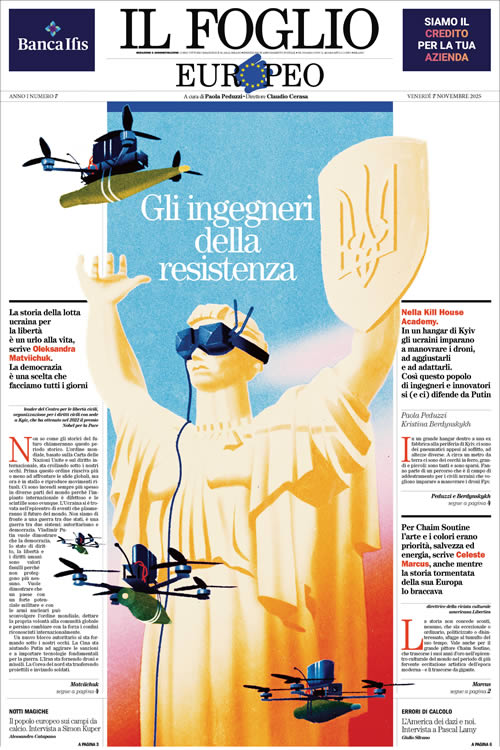
 I don’t know how historians in the future will call this historical period. The world order, based on the UN Charter and international law, is collapsing before our eyes. It did cope more or less with global challenges before, but now it is stalling and reproducing ritualistic movements. Fires occur more and more frequently in different parts of the world because the international wiring is faulty and sparks are everywhere.
Ukraine has found itself at the epicenter of events that will shape the world’s future. It is not just a war between two states; it is a war between two systems: authoritarianism and democracy. Putin seeks to prove that democracy, the rule of law, freedom, and human rights are fake values because they no longer protect anyone. He wants to convince that a country with a strong military potential and nuclear weapons can disrupt the world order, dictate its will to the global community, and even forcible change internationally recognized borders.
A new authoritarian bloc is forming before our eyes. China is helping Putin circumvent sanctions and import technologies critical for warfare. Iran is supplying drones and missiles. North Korea is transferring artillery shells and sending soldiers. These regimes, having seized power in their respective countries, all of them have something in common. They have the same idea of what a human being is. They see people as objects to be controlled and deny them their rights and freedoms. Despite their shortcomings, democracies place people, their rights, and freedoms at the center of their policies. There is no way to negotiate this. The very existence of a free world endangers the power of dictators.
Modern authoritarian regimes do not share a common ideology. However, they promote common narratives. They argue that dictatorship means stability and security while democracy means weakness and inefficiency. They combat humanistic ideas, such as human rights, independent courts, and freedom of the press. They erode trust between people and destroy our connection with reality. Russia refers to the war as a “special military operation,” justifies attacks on residential buildings, schools, hospitals, and playgrounds as the “protection of Russian-speaking people,” and portrays the abduction of Ukrainian children and their trafficking to Russia as their “rescue.”
On top of that, we live in a world where new technologies are rapidly developing. People spend more and more time in virtual space, polluted with fakes and disinformation. As a result, they lose the ability to distinguish between truth and lies. Now, the residents of a small community no longer have a shared sense of reality. Without a shared sense of reality, people are unable to act together. Without common action, how can we protect our democracy?
Putin launched a full-scale invasion not in order to occupy some more part of Ukrainian lands. Putin did it in order to occupy and destroy the whole of Ukraine and move further. He sees Ukraine as a bridge to Europe. His logic is historical. He dreams about his legacy. Russia is an empire. An empire has a center, but no borders. Therefore, people in other European countries are safe only because Ukrainians do not let the Russian army move further.
My experience dealing with the consequences of mass violence and oppression has led me to a simple conclusion: the collapse of the world order was preceded by an ethical crisis. We began interpreting the slogan “never again” differently.
For Ukrainians, “never again” literally means this. We will not tolerate evil, even if it is many times greater than our capacity. We will resist evil, saying ‘never again’ to concentration camps, to occupation, to the destruction of entire nations, to murder and torture. We will fight for the slightest chance for our children to have the freedom to live without fear of violence and to shape their future. For Ukrainians, “never again” is not just a word. They have proved it on the battlefield.
However, for many people in the European Union, “never again” means that we will never again pay a high price for our freedom. Even when our lives are at stake, we are no longer willing to risk them. There are reasons for it. The coming generations inherited democracy from their grandparents. They began to take security for granted. They became consumers of democracy. They understand freedom as a choice between different cheeses in the supermarket. But we can’t attain democracy once and forever. We made our choice every day.
Yes, democracy is not perfect. Many people are disappointed with it because a large number of problems, including social inequality, remain unresolved. But authoritarian regimes don’t solve these problems either. People simply don’t have the right to complain. We were so confident that democracy was the final answer, so we stopped promoting it. No one explains to people that we have to perform two tasks in parallel – to protect our democracy and to perfect our democracy. Because we have no alternative. The alternative to our imperfect democracy is the hell of the restored Soviet Gulag.
We are not mere observers in this world. It is not enough to understand that in many parts of the world, the space for freedom is shrinking to the size of a prison cell. It is naive to believe that you just need to wait long enough until things settle down. It is unworthy to evade responsibility; we are not hostages of circumstances but participants in this historical process. We cannot leave problems as an inheritance for our children. Even when we have nothing left, we always have our own words and our position. Eventually, that is not so little.
And despite everything, the story of our struggle is a life-affirming story, because these are dramatic times that raise hope. And hope is not the confidence that everything will be fine. It is more of a profound understanding that all our efforts have meaning.