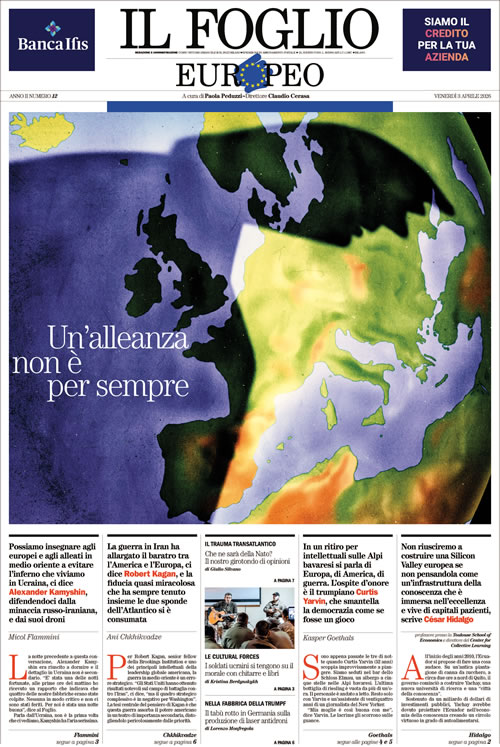
For Donald Trump, NATO, without the United States, is nothing more than a ‘paper tiger’. The American president, frustrated by Europe’s refusal to back him in the war against the Iranian regime, threatens to ‘remember’ this snub. Yet, at the same time, he insists that NATO is useless, anyway. As for the defense of Ukraine, however, Trump claims to have done more than enough, and that he needs to recoup the investment that has also depleted his arsenals. Consequently, NATO’s European partners should take charge, under the PURL program. American weapons to be supplied to Kyiv are now subject to payment. The free, values-based solidarity within the Alliance has already broken down, and there is the fear that even these purchases may be called into question. We asked some experts: what NATO’s role is today, and what purpose the Atlantic Alliance serves. And furthermore: are these wars – the one in Ukraine and the one in Iran – ‘our’ wars? Are those the wars of Western democracies?
Ian Bremmer, American political scientist, is the president and founder of the Eurasia Group. His last book is The Power of Crisis: How Three Threats–And Our Response–Will Change The World
- What’s the point of Nato, today?
As it ever was, the point of Nato is providing collective security for its members. the nature of the threats are changing, and they are increasingly asymmetric rather than conventional, and from a growing number of state and non-state actors. Also, the reliability of the United States, by far the most militarily powerful member, has decreased… diminishing the strength and utility of the alliance even as most of its members increase their military capabilities.
- Are the wars in Iran and Ukraine our – as western democracies – wars as well?
Ukraine clearly is “our war”. Ukraine was invited to join Nato, even though without a clear pathway to membership, also sits in Europe and Russia’s invasion poses a direct threat to alliance members, primarily but not exclusively front line states. Iran is less so “our war”. The decision to decapitate the leadership and try to bring about regime change was a unilateral decision by the United States (and Israel) and not a matter of collective defense for other Nato members. But Iran’s export of terror, ballistic missile and nuclear programs do pose direct threats to Nato members, so the broader issue of containing that threat is a matter for Nato as a whole.
Claude-France Arnould, is Senior Fellow for Defence at the Brussels Institute for Geopolitics. Arnould was also Executive Director of the European Defence Agency and France’s Ambassador to Belgium.
“After two decades of existential doubt and extraterritorial operations such as Afghanistan, NATO should now be as relevant and strong as it was during the Cold War. Conflict is back in Europe, triggered by Russia. Yet the Alliance is today under rhetorical attack from its central pillar – the US – and faced with an American disengagement the scope and duration of which is still unclear. Painfully, Europeans understand that they must rearm and rely on themselves. For many of them it is a traumatic moment. Yet the Americans’ call for Europeans to be security providers, rather than security ‘customers’, is far from new. It will not vanish. Europeans’ capacity to act independently is therefore the safest contribution to the Atlantic Alliance – and our life insurance, should we find ourselves truly alone.”
“The war in Ukraine is our challenge as a European war, and because we committed ourselves to support Ukraine. As such, both our security and our credibility are at stake. The war in Iran was triggered by the US and Israel without any consultation with the Europeans, without any legal basis, and with a total absence of visibility regarding the objectives. Yet this war impacts us. Our economy and the security of our energy supplies are endangered. An EU member – Cyprus – as well our allies in the region have been directly hit. We owe them our support. But Europeans rightly stood firm in the face of blackmail from the US President demanding that Europeans protect the Strait of Hormuz without any clear and agreed strategy in the region.”
–––––
Steven Erlanger is chief diplomatic correspondent in Europe of the New York Times
NATO exists, as it always has, to deter Russia from renewed imperial fantasies. It is more important today than at any point since 1989.
The war in Ukraine is certainly “our” war, including the United States, no matter what Trump and Rubio say. The war in Iran has sucked in Europe, almost inevitably, with the use of American bases in Europe and the surging price of energy and its impact on the more important conflict for Europe, beating back the Russians in Ukraine.
Elisabeth Braw, Security expert and senior fellow with the Atlantic Council’s Transatlantic Security Initiative. Here articles appear on the Guardian, the Times and Politico.
Nato is made up of 32 countries that have planned to support one another in case any of the members are attacked by hostile states. It’s a treaty that exists for the purpose of defending the member states. If Trump wants Nato to help in Iran, Nato it would have been a different organization. We have to remember that article 5 was activated only on 9/11, when all the Nato countries came together in support of the United States. We have to remind that to Trump.
European countries support already support Ukraine. They are doing it financially and morally and politically. It’s an honorable thing that the European countries have being doing for four years. And let’s not forget that they could have quit at any given point – but they didn’t’. They should be applauded for their loyalty, sticking with Ukraine for four years
On the contrary, Iran is not a European war. Of course, many European countries are collateral victims, but they were not involved in the decision to attack or on the planning of the military operation.
Unfortunately, the attack on Iran has severe implications for Europe, and European countries are also paying the price. We should also remind that to Trump.