The TORV Kyiv project was made possible through generous sponsorship of Novo Nordisk, Carlsberg Ukraine, GAU Fonden, Bosch, Negrich Workshop, DSV Global.
In Kyiv’s historic Podil district, on 11,000 m² of blistering post-Soviet asphalt, an unexpected story has unfolded. Piece by piece, we built what is likely the world’s largest tactical urbanism project.
This isn’t a tidy European capital or a West Coast design lab. It’s a city under siege. Regular waves of drones and missiles hit civilian infrastructure. Here, tactical urbanism is tested under fire. This is not about polished renderings gathering dust. It’s about urgency. Plywood and sweat. Volunteers painting and building after sleepless nights. Reclaiming public space not someday, but now.
Placemaking isn’t a luxury. It’s a lifeline. A bench in the right spot is public health. A patch of shade is social justice. A welcoming square that is alive with movement, rest, and ritual is how a city remembers who it is, especially a city living through invasion. So that’s what we’re doing: trading vacancy for volume, turning passive asphalt into active possibility. And the canvas is immense. Eleven thousand square meters of neglect.
Not just any old square
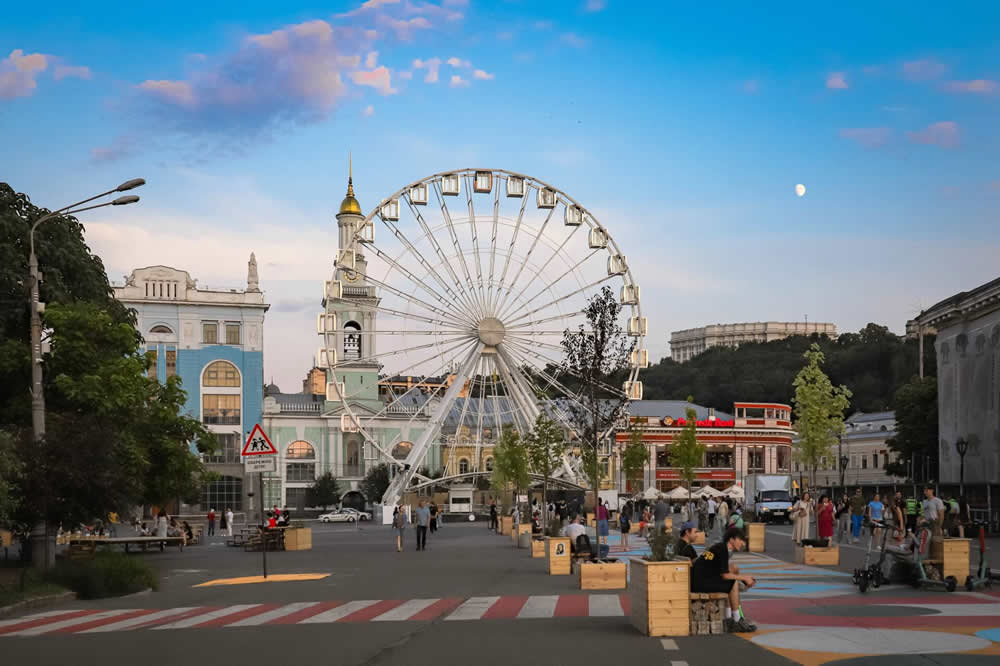
This isn’t a random patch of leftover city. It’s Kontraktova Square, the historic heart of Kyiv’s lower city. Podil is where Kyiv was born. Already in the 6th century there was a market on this spot, streets and buildings and trade. For a millennium, it powered Kyiv’s economy, where goods and ideas moved between Scandinavia and Byzantium, Asia and the Atlantic. Then the late-Soviet era paved the heart over, and since independence it has baked in the sun.
This is Kyiv’s Place de la République, Times Square, Zocalo, but it was emptied of life. Something needed to change here, of all places. I didn’t want monuments. I wanted the conditions for life. In a warzone, human-scale design is a vote for normality. A quiet rebellion against despair.
 Tactical urbanism
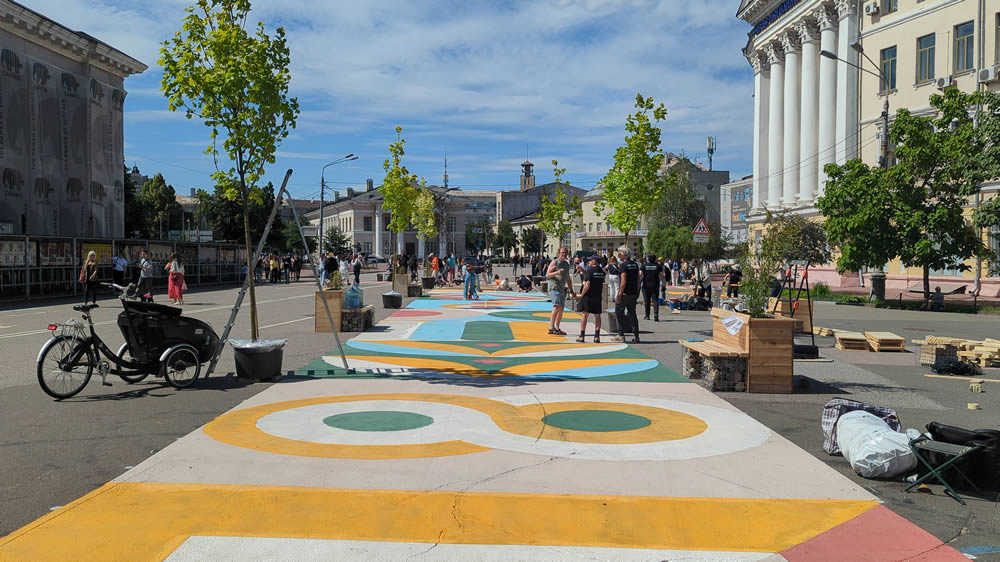
The only viable approach on a site this large, in a context this urgent, was tactical urbanism: speed, simplicity, scale. Low-cost, temporary interventions like paint, benches, planters and pop-ups, to test and transform space in real time. Prototype, observe, adapt, repeat. Treat the city as a living system, not a fixed object. In Ukraine, where uncertainty is constant, this isn’t trendy. It’s essential.
TORV Kyiv was conceived as a live experiment, not a finished product. Function over perfection. Feedback and flexibility over finality. Eight months of planning began in September 2024 and in a normal situation, I would need a team of ten people employed full time for six months but we were only three: me, a coordinator, and a first-time architect. We were backed by tireless volunteers, of course, but this project would require a massive effort. We mapped, observed, talked. We ran workshops with residents, students, and business owners. Skepticism softened to curiosity. People asked for benches, shade, ping-pong, pétanque, chess. Low-impact activity and dignified rest. So we listened.
Building the square
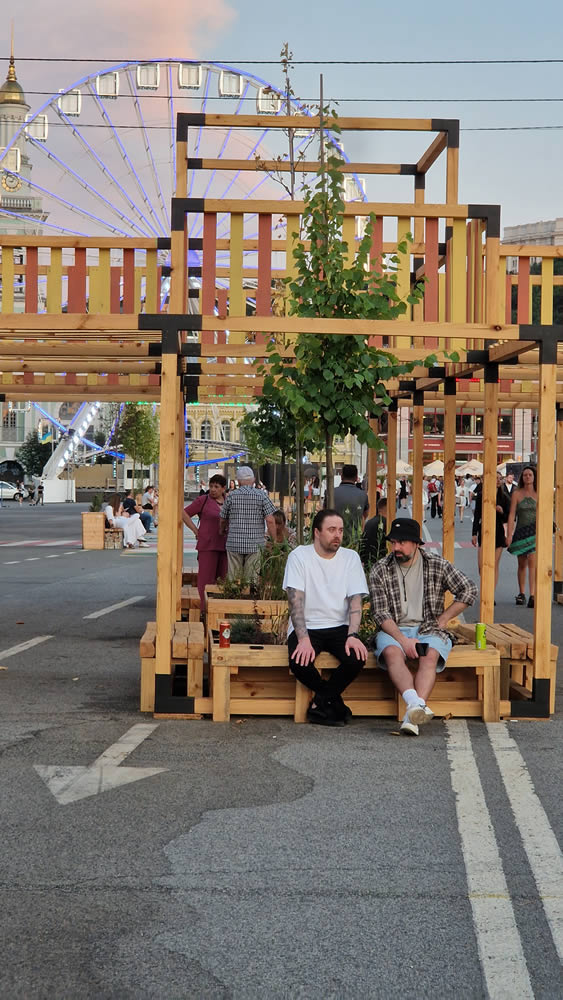
Designing something human on 11,000 square meters of asphalt meant thinking fast, building smart, and staying light on our feet. We worked with what we had – paint, wood, scaffolding, trees in pots – and designed everything to be modular, movable, and easy to assemble by volunteers. No digging, no foundations, no waiting for permits to catch up. Just ideas made physical, piece by piece.
The process was improvised but deliberate. Each element had to serve multiple lives: benches that double as planters, shade that travels, materials that can be reused elsewhere when the project ends. We tested, watched, and adjusted. When something didn’t work, we changed it. When people used things in new ways, we learned from them.
Colour broke the monotony of grey, geometry carved space out of chaos, and structure gave shape to community. The square’s transformation wasn’t about decoration—it was about proof. Proof that a public space can be reborn quickly, cheaply, and beautifully, even under the weight of war. That simple, flexible design can cool heat, invite movement, and restore a sense of belonging.
From asphalt to atmosphere
Then the shift started happening, as soon benches and shade were installed. Kids climbed, students lounged, parents gathered. The haters went quiet in the face of lived evidence. The climbing wall rose, ping-pong tables rarely sat empty, and the green, shaded hubs filled with citizens. Movement returned. Conversation followed. The Danish-Ukrainian design language is simple, elegant, and above all, used.
What made it remarkable wasn’t our quickly doodled sketches in lieu of blueprints. It was that this came together in a war, with three people leading a passionate army of volunteers, battling post-soviet bureaucracy, and stubborning believing that it was important. Every small win – each permit signed, each planter built, each volunteer who returned – pushed it forward. Bit by bit, it became real.
And we pulled it off, opening in July, 2025. Against all the odds. Now people don’t just use the space – they care for it. They gather with friends and neighbours. Pick up trash. Let their kids loose. TORV Kyiv is no longer ours. It belongs to the city. Connection led to care. In a city under stress, care is resilience.
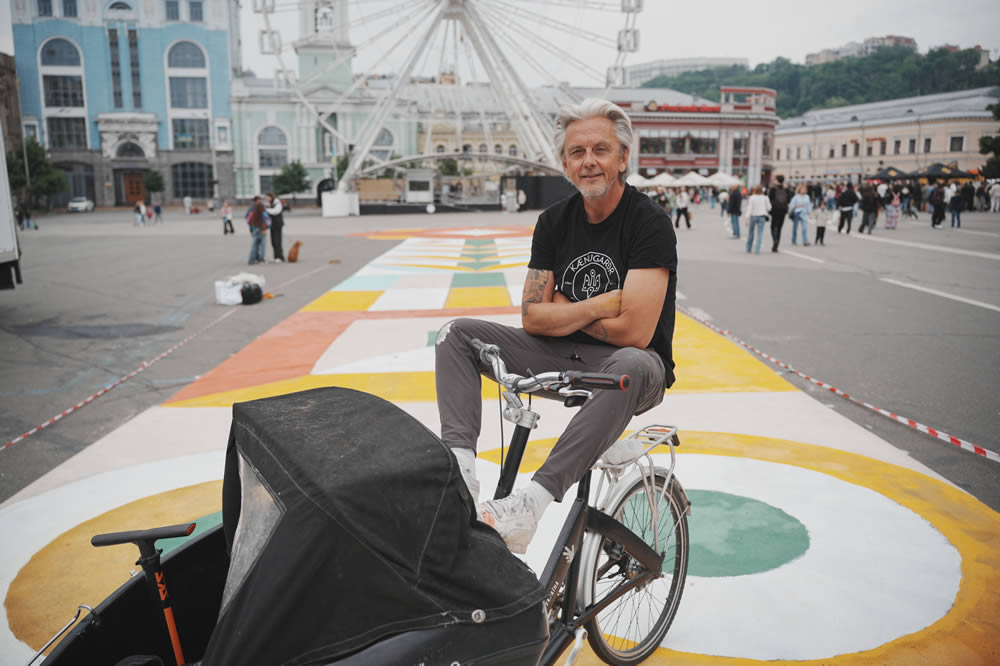
TORV Kyiv isn’t finished. It’s a field test in the open air, built to observe, learn, and adjust. Desire lines are etching themselves into the paint. The project will be uninstalled in September 2026. When the plywood is gone, what remains should be the most important thing: a public that knows something better is possible, and is ready to demand a permanent solution.
New York City did a similar intervention on Times Square in 2008. Closing the streets to cars, putting out temporary chairs and tables. It was a success and they made it permanent years later. They had 10,000 m2 but we have 11,000. The difference? We did it in a war zone, exclusively with volunteers, completely exhausted after relentless nights of missiles and drones hammering the city. We did it with air raid sirens echoing off of the surrounding buildings.
Working with urbanism in a war zone has taught me so much. I know now that urbanism is much more than just a valuable tool for making cities better. It is a medicine that can soothe and even heal. It is a superpower that can bloom and blossom in the rubble of war.
Urbanism is the resistance against military invasion, disaster and crisis and certainly against the worsening climate crisis. Placemaking is the music of hope in any city in the world. The melody is just sweeter in a war zone.