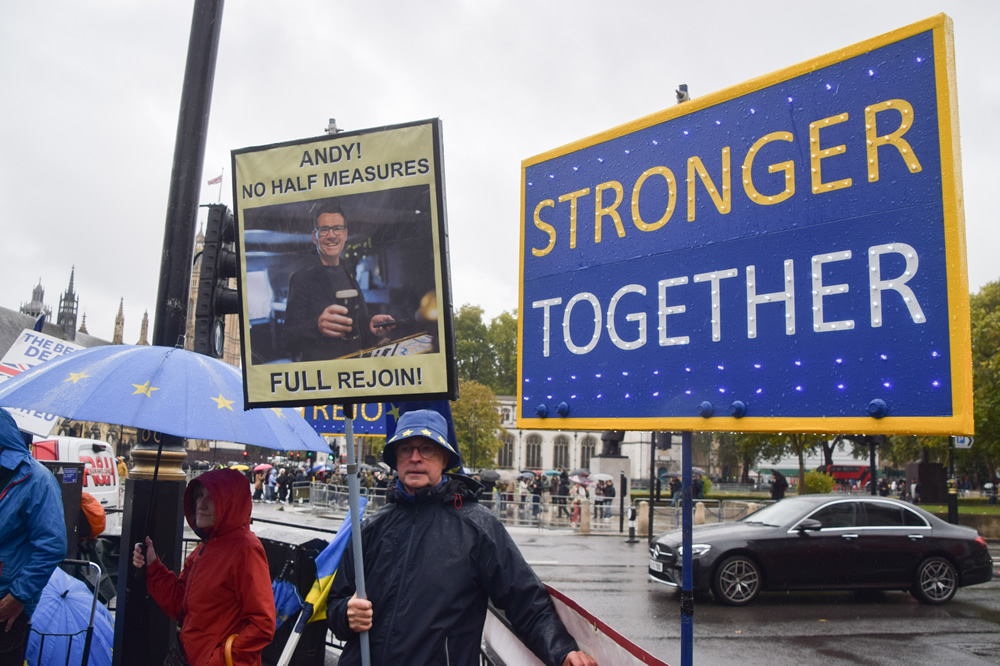
Andy Burnham’s decision to launch a public debate in the United Kingdom about its relationship with the European Union, and even admitting “rejoining”, is a politically courageous gesture which we should welcome on our side of the channel. Reversing long years of total lack of trust after the breakup and prolonging the “defrost” operated by his predecessor Keir Starmer, the new British Prime Minister may be about to open a promising new chapter.
To deliver an ambitious new “deal” is, however, more complex than one may think. “Million euro questions” remain on the table: how far can the UK and the EU go in resetting their links? All the way up to the full return of Britain to the European Union? If so, would public opinions on both sides support it, knowing that referenda may be needed on either side of the channel? If return is not the endgame, what would be the boundaries of a closer than present relationship?
In my just published book “Il Divorzio delle Nazioni” (Guerini e Associati, 2026) I dedicate two chapters to my experience in London as the first EU Ambassador to the United Kingdom after Brexit (2020-2022) and to an assessment of EU/UK relations before and after the breakup . Significantly, the chapter dealing with the latter issue is overall titled “Rompere è difficile” and includes a chapter claiming “C’è vita dopo la Brexit”. The true is unavoidable: the EU and the UK went through a traumatic, litigated divorce after a close and intimate relationship of almost 50 years. The divorce left deep wounds, both inside the Kingdom and between London and continental capitals ,which are yet far from fully healing. But, at the same time, it is clearly in the interest of both sides to refuse to be forever bound by the 2016 referendum and the resulting “Withdrawal” and “Trade and Cooperation”(TCA) treaties that regulate our relations since 2020/2021. Breaking up was and is hard but there is still life after Brexit and it deserves our attention, political will and creativity.
I believe there are two main forces driving this hopeful rapprochement: the international security context and the economic costs of Brexit. Additionally, one should not ignore the negative impact on British, Italian and other EU young citizens who have been prevented from benefitting from youth exchanges, job opportunities and fair access to universities on both sides of the channel. We should not allow ourselves to inflict more pain on the “Brexit generation”.
It is today clear to everyone that the combined effect of Putin’s Russia aggression in Ukraine, and the threat it represents to other European countries, and Trump’s America disinvestment in Europe ( including in the UK) requires solid cooperation on foreign policy and defence and security matters between the EU and the UK. First and foremost within NATO, obviously, but also beyond it, both bilaterally and in the framework of the new defence and security momentum inside the EU. This should be, in my opinion, the main driver of the new stage of cross-channel relations. My concern is that it might be taken hostage by the difficulties in finding common ground on the other track of discussions: regulatory, trade and overall economic matters.
It is equally clear that the economic impact of Brexit is overall negative, particularly for the UK, but also for all the EU Member States. In times of growing economic and technological competition from China and disturbing signs of trade assertiveness and overall unreliability from the US, having a dysfunctional economic relationship is detrimental to British and European economies. Brexit has become, even more than in the past, an obvious economic own goal. My concern is that the discussion of the terms of the economic resetting might , in turn, be taken hostage by the memories of the harsh and tense previous negotiations on the Withdrawal and TCA treaties.
How to move forward in a sustainable and mutually beneficial way? How to build a new consensus , first of all inside a divided UK and then among EU countries and, ultimately, within our public opinions? The path forward is narrow and the obstacles dire but I believe we should dedicate time and energy to reset the relationship in a creative way, doing our best to protect ourselves from the ghosts of the past. And ultimately put behind us what I call in my book “the mother of all divorces”.
João Vale de Almeida was EU Ambassador the US, UN and UK. He’s author of “Il Divorzio delle Nazioni” (Guerini e Associati, 2026).