Germany wants to say no to Palantir. The German domestic intelligence agency, the BfV, is reported to have chosen the ArgonOS software from the French company ChapsVision for the analysis of structured and unstructured data, preferring it to that of the American giant. Back in December, the president of the BfV, Sinan Selen, had already stated that he wanted a European solution. Palantir’s CEO and co-founder, Alex Karp, reacted angrily in an interview with Bild: “Palantir components are used on every serious battlefield in the world”. Some German state police forces already use Palantir, but on the military front too, Vice Admiral Thomas Daum, inspector of the Bundeswehr’s Cyber Troops, is currently excluding the American software from the project for the new German military cloud. In Germany, the Palantir issue is part of an increasingly tense debate on the transatlantic axis, which has been put to the test by Trumpism. The case is merely the most visible symptom of a broader issue concerning the model of military artificial intelligence that Europe wishes to, or is capable of, developing.
“Why should a European country use Palantir? Do its digital workflows truly reflect the way Europe wants to fight?” asks Heiko Borchert, co-director of the Defense AI Observatory (a research centre hosted by the Helmut Schmidt University in Hamburg) and an expert in artificial intelligence applied to defence. “In some European countries, there is a growing awareness that American software manufacturers, under the current Trump administration, pose a security risk,” says Borchert. This concern cuts across London, Paris and Berlin.
NATO, however, sees no alternatives; numerous member states of the Atlantic Alliance now rely predominantly on Palantir, because effectiveness and speed take precedence. Admiral Pierre Vandier, the Alliance’s Commander for Transformation, told Politico: “As far as I know, there is no real competitor to Palantir today.”
The problem, according to Borchert, goes far beyond the Palantir issue alone. “Through armaments cooperation, AI is entering the European armed forces anyway as a component of foreign weapon systems. Italy and Germany are buying F-35s equipped with American AI. If this AI were validated and verified using different criteria from those applied to solutions developed in Europe, it would create an imbalance, giving the exporter a structural advantage.”
For Borchert, the point is not to find a European clone of Palantir or similar companies, but to change the paradigm. “We keep copying American business models, convinced that we can succeed as imitators,” he says. “The digital solutions from Google, Amazon and Facebook are hungry for data: users share information in exchange for a service. But in war, the enemy does not give you its data voluntarily. The defence sector is rich in data but poor in information.” Today’s military AI, the so-called second wave, “is based on the analysis of enormous quantities of data: satellite imagery, radar signals, communications data,” explains Borchert, “but more data does not automatically generate useful information: we have to invest more and more to separate irrelevant data from meaningful data, and in the meantime we are still focusing on collection.” The third wave, the one on which the researcher and his team are also working, “works differently: it models decision-making processes mathematically and conceptually. It learns to make decisions under conditions of uncertainty. Data still matters, but in a different sense: not as raw material to be accumulated, but as the result of millions of simulations, from which reliable patterns emerge”. With a defence budget of over 900 billion dollars, such as that of the United States, “it hardly occurs to you to seek resource-efficient solutions,” Borchert points out, “but conditions in Europe are different, and so Europe must think differently: not chasing after those who believe they can decide faster, but developing solutions that produce better decisions.”
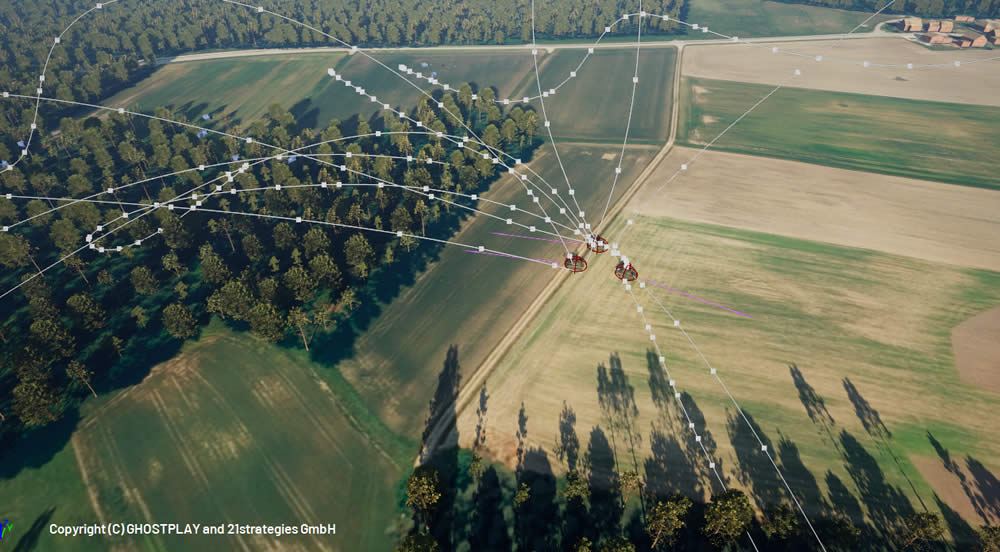
That this is not merely theory, according to Borchert, is demonstrated by GhostPlay, a Bundeswehr project. “In GhostPlay, we use artificial intelligence to develop military tactics, partly deliberately without human input,” he explains: “We construct a virtual battlefield, the Defence Metaverse, and pit an AI simulating the enemy against our defence systems.” A conclusion emerging from nearly two million simulations would run counter to the current debate: “AI can develop tactics that achieve the same effect with far fewer resources.”
Borchert gives a concrete example. “In our simulations, a swarm of small drones—for example, commercially available systems like the Switchblade—attacks a ground-based air defence post. With conventional tactics, 20–30 drones were needed to breach the defences. Our most advanced algorithm has reduced that number to four.” How? “The AI has learnt to exploit the terrain, vary its speed, change flight paths, and hide behind hills, so that the radar constantly loses track of it. And then the decisive move: the swarm members coordinate. Two or three carry out a diversionary manoeuvre. When the anti-aircraft defences focus on them, the others attack from its blind spot.” Of course, Borchert continues, “one might argue that in reality it won’t all work quite so well. Agreed. But even if the advantage were halved in practice, it would still be enormous. This is not an argument against mass in itself. In certain military contexts, mass will remain necessary; masses of soldiers will be needed to hold a front line. But it is an argument for looking not only at efficiency, but above all at effectiveness.”
The defensive metaverse itself has produced another result. “I don’t mean to say we’re predicting war; that would be wrong,” Borchert clarifies, “but in our Metaverse we see patterns that haven’t yet appeared in reality and that the enemy could plausibly adopt. This allows us to discover our own weaknesses before the adversary does.” A concrete example? “Kateryna Bondar of the CSIS think tank in Washington recently described the Russian V2U drone system, in which members of the swarm coordinate for collective success. We had observed precisely this behaviour in our simulations two years in advance.”