Berlin
Saved from neglect, from real estate developers, and from the fury of the flames, two historic buildings from Thomas Mann’s roughly twelve years of exile in Los Angeles are now in the hands of the German state and used as centers for transatlantic cultural exchange. The Thomas Mann House, the residence where the Nobel Prize-winning writer lived with his family during his American exile. And Villa Aurora, home of the Jewish writer and Mann friend Lion Feuchtwanger — at the time the most widely read German-language author in the world — who also fled Nazi Germany and took refuge in California. Both villas are located in Pacific Palisades, today a residential district that was then on the outskirts of Los Angeles. They now host cultural programs between the United States and Germany aimed at preserving the memory of European exile in America and encouraging reflection on present-day social, cultural, and political issues. They are funded by the German Foreign Ministry and Ministry of Culture, along with a handful of sponsors.
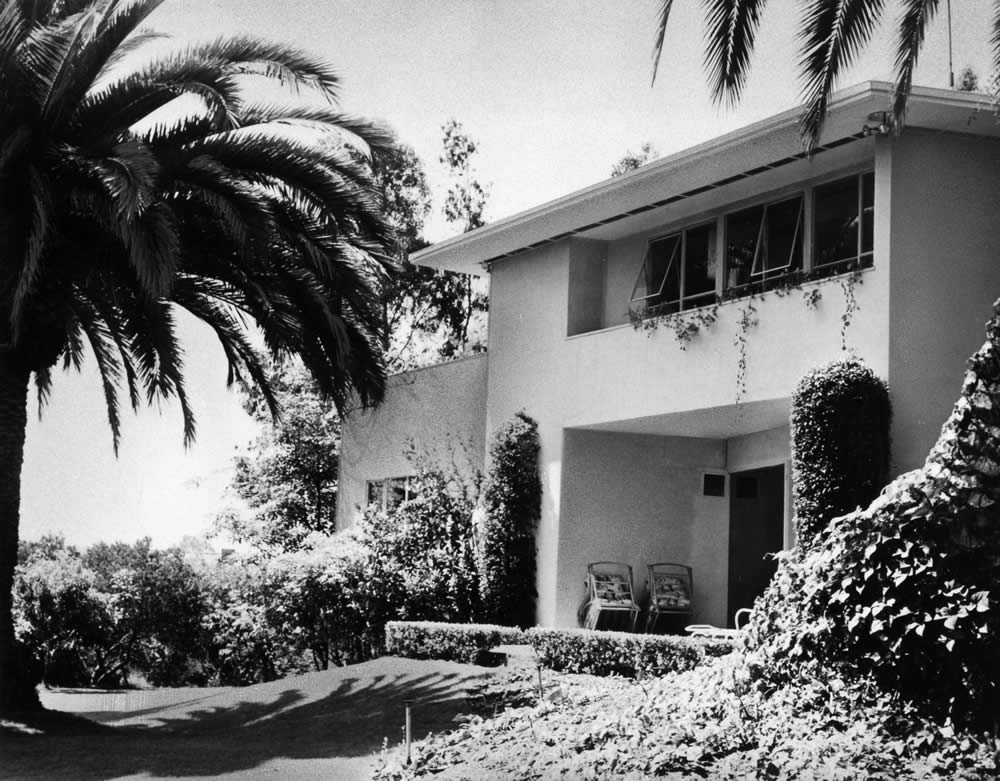
The Thomas Mann House is located at 1550 San Remo Drive, Pacific Palisades, CA 90272. It was purchased by the German state in 2016. For its construction, Mann had commissioned the German-Jewish American architect Julius Ralph Davidson. Villa Aurora, at 520 Paseo Miramar, Pacific Palisades, CA 90272, was not acquired directly by the state but, starting in the early 1990s, by a circle of friends who rescued it from disrepair and turned it into an artists’ residence. Today it functions along the lines of Villa Massimo in Rome: a place for residencies and exchange, a kind of think tank for German scholars and artists, as well as foreign ones based in Germany.
Thomas Mann had recognized the danger of the looming National Socialist barbarity early on, and his exile from Nazi Germany began on February 11, 1933, just days after Hitler came to power (January 30). That day, Mann left his home in Munich for a lecture tour around Europe, and when Hitler assumed full powers in March, he decided to leave the country with his wife, Katia — first to Switzerland (1933-1938), then to the United States. In 1936, the 1929 Nobel laureate in Literature was stripped of his German citizenship. In America — first in Princeton, then, from April 1941, in Los Angeles — he stayed until 1952, when, amid the McCarthyist wave that struck many European intellectuals suspected of Bolshevism, he returned to Switzerland, where he died in 1955. He set foot in Germany again in 1949, sixteen years after leaving.
The devastating fires that struck Los Angeles in January 2025 also threatened the two institutions tied to Thomas Mann’s memory, though both were spared outright destruction. The Thomas Mann House, after months of inspections, technical checks, cleaning, and restoration work, was able to reopen in June 2025, in time for the writer’s 150th anniversary. Villa Aurora, where the flames came within three meters of the house, was hit harder and has only just reopened: a reopening ceremony took place on August 30, with cultural programs, fellows, and visitors resuming gradually from there. The restoration work, funded by the Foreign Ministry, involved repairing smoke-pollution damage inside the building (including asbestos and lithium contamination), toxicology testing, structural and slope-stability checks, and measures to clear fire damage from the garden.
Both houses also serve as museums, with guided tours of the rooms and exhibitions, but they also hold “a productive value as places of exile, on themes tied to the present and future — liberal society, democracy, minority rights, identity, and antisemitism: all themes rooted in the place itself and linked to exile,” explained CEO Jakob Scherer in conversation. The interiors of Villa Aurora still feature the original furnishings chosen by Marta Feuchtwanger, the writer’s wife, who had kept a salon and hosted guests even back in Munich. Both houses can be visited, but they also host fellows — candidates admitted to stay at the villas on fellowships. Capacity is limited to five or six people at Villa Aurora and four or five at the Thomas Mann House. Since these are former private homes, the amenities are residential rather than hotel-like: there is, for instance, a single shared kitchen, so guests live in a kind of commune, interacting and exchanging ideas with one another. As with Villa Massimo in Rome, only German citizens or foreign nationals residing in Germany are admitted. “Villa Aurora is a symbol of flight, of exile, and of democracy — it makes the value of freedom in art and politics emotionally tangible,” Scherer notes. Thomas Mann, a literary giant revered by his peers, had become a symbol of resistance to Nazism, and his house on San Remo Drive in Pacific Palisades was a crossroads for émigré intellectuals, the “who’s who” of the European intelligentsia. It was nicknamed “Weimar on the Pacific,” in memory of the brief, democratic Weimar Republic swept away by Nazism in 1933.
During the Second World War, Los Angeles — thanks in part to Hollywood’s film industry — became, even more than New York and the East Coast, the leading magnet for artists and intellectuals, Jewish and non-Jewish alike, who had fled persecution under the Nazi regime in Germany and Austria. In his house, which Mann had nicknamed “Seven Palms” after the palm trees still found there today, he wrote several of his masterpieces — including, in its entirety, “Doctor Faustus” — and hosted some of the greatest writers, philosophers, artists, and musicians of the twentieth century, from Bertolt Brecht to Igor Stravinsky, from Artur Rubinstein to Albert Einstein, and many more. It was in this house that he recorded his famous 55 anti-Nazi broadcasts to the German people (“Deutsche Hörer!”, 1940-1945), which were sent to the BBC and transmitted into Germany to encourage German resistance. The writer addressed his fellow countrymen, denouncing Nazi crimes and the Holocaust, and rose to become a champion of humanism and a symbol of the “other Germany.”