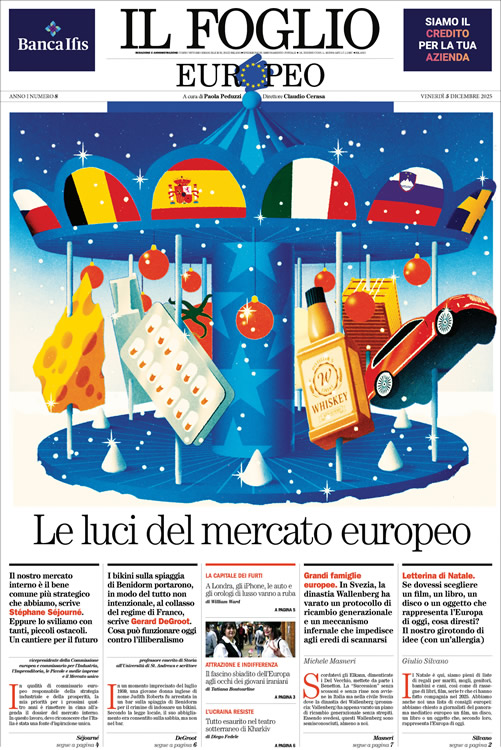
Christmas is coming, and we are surrounded by lists of possible presents for husbands, wives, parents, kids and dogs, just as we are with reviews of books, films and Tv shows that were loved in 2025. We also have a list, a list of European tips: we asked media personalities of the European landscape to propose a film, a music album, a book, or an object that for them represents the Europe of today.
Lux by Rosalía
I’ve been playing Rosalía’s incredible, genre-bending album LUX on repeat. The lead single ‘Berghain’ features the Catalan pop superstar singing with an Icelandic one (Björk) about a Berlin nightclub, with majestic backing from the London Symphony Orchestra. What could be more European than that? Musically, this album is also a mish-mash of continental influences, from baroque to flamenco. And then there’s the fact that she sings in 14 languages, leading some to quip that it’s the musical version of a European Commission press conference. If only European Commission press conferences could be this much fun.
Katy Lee
author of the podcast The Europeans
The euro note
A faceless currency with imaginary bridges and buildings, abstract, harkening to no sense of national pride, the design of bureaucrats fearful of offending anyone and seeking a soft, harmless consensus, the euro notes are both a symbol of flawed European integration and of excessive European caution. The euro also represents an older hubris, that Europe’s currency, even without a single market and all the opt-outs, would rival the U.S. dollar in value and as a reserve currency. The coins at least have some national symbols on the back, but no one much uses them anymore. And the metallic combinations give me, at least, a skin allergy.
Steven Erlanger
chief diplomatic correspondent in Europe of the New York Times
“Slow Horses”, “Kairos”, Matcha latte
For pop culture: the Apple TV series “Slow Horses”, based on novels by Mick Herron —a spy thriller tragicomedy that is also a sophisticated analysis of geopolitics and state capture in a post-Brexit, post-Cold War Britain and the unintended consequences of the 2011 invasion of Libya. The withering expressions of Kristin Scott Thomas, as deputy (and then head) of MI5, as she contends with an incompetent narcissistic of a boss, are priceless. For high culture: Jenny Erpenbeck’s novel “Kairos”, about a love affair and the long-term emotional reverberations fall of the Berlin Wall. For a cultural phenomenon: the matcha latte —ubiquitous now across Europe, as cities from Lisbon to Athens to Barcelona to Paris become overrun with a mix of tourists and digital nomads bringing their Bobo ways to the old world. (“Kairos” is published by Granta/New Directions).
Rachel Donadio
Contributing writer to The Atlantic and ex Rome bureau chief del New York Times
“Prophet Song” by Paul Lynch
“Prophet Song”, by the Irish writer Paul Lynch, won the Booker Prize in 2023 and vividly describes the plight of refugees in a country sliding towards totalitarianism. The Booker judges said it ‘captures the social and political anxieties of our current moment.’ I found it to be immensely powerful and moving, especially as it could be seen to apply to any number of countries in Europe. (The book is published by Oneworld).
Robin Lustig
BBC longtime journalist, from London
A semiconductor from Nexperia
To me, ‘Nexperia-gate’ symbolizes Europe’s naive approach to China. The Netherlands, home to ASML among others, is a leader in the semiconductor industry. However, this multi-billion-dollar industry has become a pawn in the trade war between the United States and China. The small country of the Netherlands finds itself caught between these two superpowers due to political interventions. Where is the ‘superpower’ that is the European Union in all of this? The consequences are dire. What happened after the intervention at Nexperia, originally a Dutch company? The communist government of China, through its co-ownership of the parent company Wintech, managed to disrupt the German automotive industry with a mere push of a button. We are talking about relatively simple semiconductors here—not high-tech ones. How is it possible that German industry, despite all the warnings, remains so dependent on the Chinese state-owned economy?
Alexander Bakker
Brussels Correspondent of De Telegraaf
“The Nazi Mind: Twelve Warnings from History” by Laurence Rees
The political, psychological, neuropsychological, and behavioral mechanisms that enabled the Nazis to win and then made the Holocaust acceptable are being used today by populists to gain power. At a time when liberal democracies are in decline, this brilliant book (and I have read many books on this period) tells the story of Nazism from 1920 to 1945 through twelve chapters that provide keys to understanding the rise of populism and how to fight it: conspiracy theories, the separation of the people into “them” (Jews, Muslims) and “us,” the cult of the leader, the corruption of youth, the questioning of human rights, fear, etc. If there is only one book to read this year, it is this one by the British historian. (“The Nazi Mind” is published by Penguin Books).
Jean Quatremer
Brussels correspondent of Libération