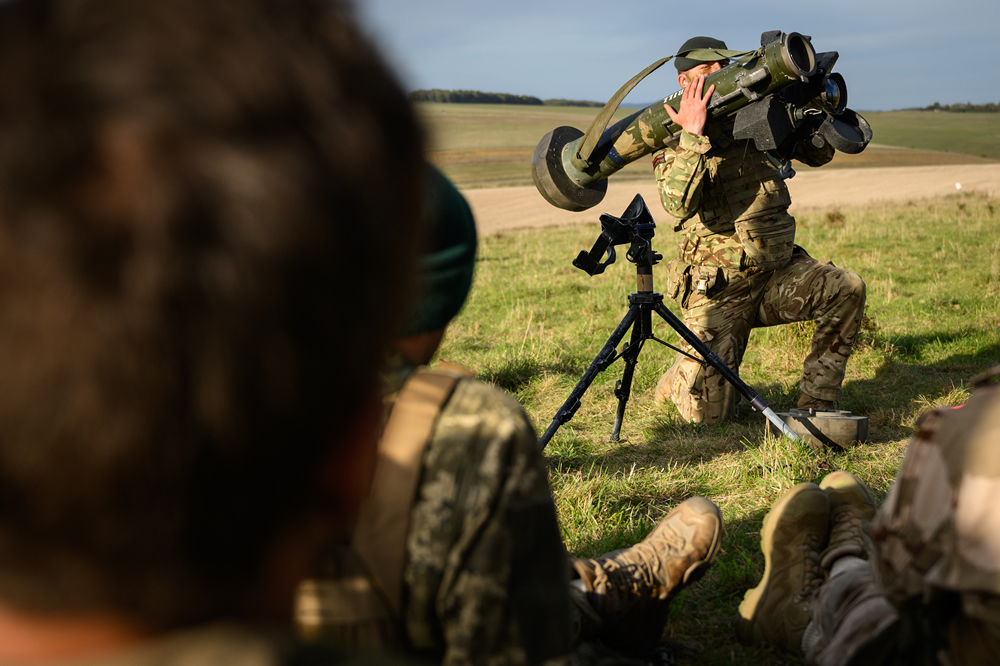
As Russia massed troops around Ukraine’s borders in 2022, Britain began delivering anti-tank weapons to Kyiv. The initial package included 2,000 NLAWs, giving Ukrainian soldiers means to fight the armoured columns that would invade weeks later.
The UK was the first country to aid the Ukrainians while others including the Washington hesitated. But was the decision coordinated with the White House? Ben Wallace, Britain’s defense secretary at the time, in a conversation with Il Foglio, describes it as a British initiative followed by a check with the Americans.
“When we decided and asked the prime minister for permission to lethally arm Ukraine in advance, I think, we just asked the Americans if they were OK with that. And that was it,” he says. “These were self-defense weapons, 300 meter range anti-tank weapons. They weren’t even as long range as javelin, right? So we put that in and it was very straightforward, really.”
Britain had already spent years training Ukrainian soldiers as they faced Russian forces in the east of the country. Operation Orbital, launched in 2015 after Russia’s seizure of Crimea, trained more than 22,000 Ukrainian personnel before the full-scale invasion. Britain’s decision to send weapons built on an existing military relationship.
“We just felt, it’s a pretty simple British instinct, that what Putin was doing was wrong. We had had nerve agent used in Salisbury. Nerve agent, right? We’d seen murders previous to that. We’d seen Russian dirty money. We’d seen Russian interference in our democratic processes. Putin had been on a journey and was in a place that I think was adversarial towards Britain,” he explained. “When we saw what was happening in Ukraine, it just was wrong.”
Wallace served as defense secretary from 2019 to 2023, overseeing Britain’s military response to Russia’s preparations for invasion and the war that followed. His party left the office however the British support for Ukraine continues across the aisles.
“We just don’t like bullies, right? Putin is a bully, and that’s it, OK? And he doesn’t get to bully our friends, he doesn’t get to bully us,” he said. “And, you know, when we see Donald Trump trying to bully Europe, including us, we don’t like that.”
Trump has moved back and forth on Ukraine since coming back to office, leaving allies trying to establish where American policy is heading. His move to ease sanctions on Russian diesel has followed by widespread outcry, as have the reporting that American and Russian officials have discussed bringing a U.S. investor into Nord Stream, potentially reopening a route for Russian gas to Europe. Trump has also called for new leadership in Kyiv, renewing pressure for elections while Ukraine remains under invasion. Britain, for example, did not have general elections between 1935 to 1945.
Could Trump be remembered as another Neville Chamberlain, the British prime minister whose concessions to Hitler in 1938 became synonymous with appeasement? Wallace rejects the comparison.
“Chamberlain had a deliberate policy. He thought about it. He was wrong, but it was a thought based on his experiences. Britain and France had lost so many people in the First World War,” he notes. “Donald Trump is week by week… When Donald Trump came back, Ukrainians also worked out, that this guy was not going to be riding to their rescue on a white horse.”
But Europe’s criticism of Washington also invites scrutiny of its own decision. EU countries paid €1.7 billion for Russian fossil fuels in September alone. Hungary and Slovakia continued importing Russian crude through the Druzhba pipeline, while France was the largest EU buyer of Russian liquefied natural gas that month. Europe has substantially reduced its dependence on Russian energy bringing it down to 5.3%% of all energy consamption, yet it has not taken steps to completely erase it. Wallace, along with current hesitations, acknowledges a broader European failure to confront Russia as its became threatening.
“As Putin changed his behaviour, it was all too difficult for all of us in Europe to face the truth,” he says. “We have that phrase in English, an inconvenient truth. It was a rather inconvenient truth that Russia was becoming much more of a gangster state.”
Would stronger Western action have prevented the invasion? Wallace thinks a firmer response after 2014 could have helped Ukraine become better equipped and prepared. He is less certain that it would have changed Putin’s decision.
“This is a war driven predominantly by his ego and his view of history,” he says. “It’s a sort of bizarrely twisted romantic assault on history. You just read his speeches, read what he writes. A man who says to himself, I’m a great leader and they will thank me in a hundred years,” he said. “And that’s quite a hard thing to deter. “
In Wallace’s account, Putin measures his ambitions against history while Trump measures his announcements against the next election. Ukraine have to survive while dealing with both. Yet Wallace resists treating Trump as the entirety of America. His still defends the “special relationship.”
“Presidents come and go,” he says. “Britain’s relationship with America is much deeper than who’s here today and tomorrow.”
British support for Ukraine has proved more resilient than in much of Western Europe. In February 2026, YouGov found that 80% of Britons wanted Ukraine to win the war, compared with 47% of Italians. Willingness to sustain its resistance was narrower: 46% of Britons favored backing Ukraine until Russia withdrew, even if that prolonged the fighting, against 16% of Italians. For an Italian reader weary of the war, Wallace has a warning that Russia spreads instability and that instability carries an economic cost.
“The biggest spreader of instability in Europe at this moment in time is Russia. We have to find a way to either contain Russia or stabilise so that we can then rebuild our economies,” he warned. The temptation to withdraw from the problem is understandable but distance offers Europeans little protection from its consequences. “It’s no longer you can go to your village in Tuscany or Sicily and just pull up the drawbridge and pretend that nothing is going to happen anymore,” he says. “Like it or not, we are globalised. You can shout into the wind all you like, but we are. What happens hundreds of miles away can affect you here.”