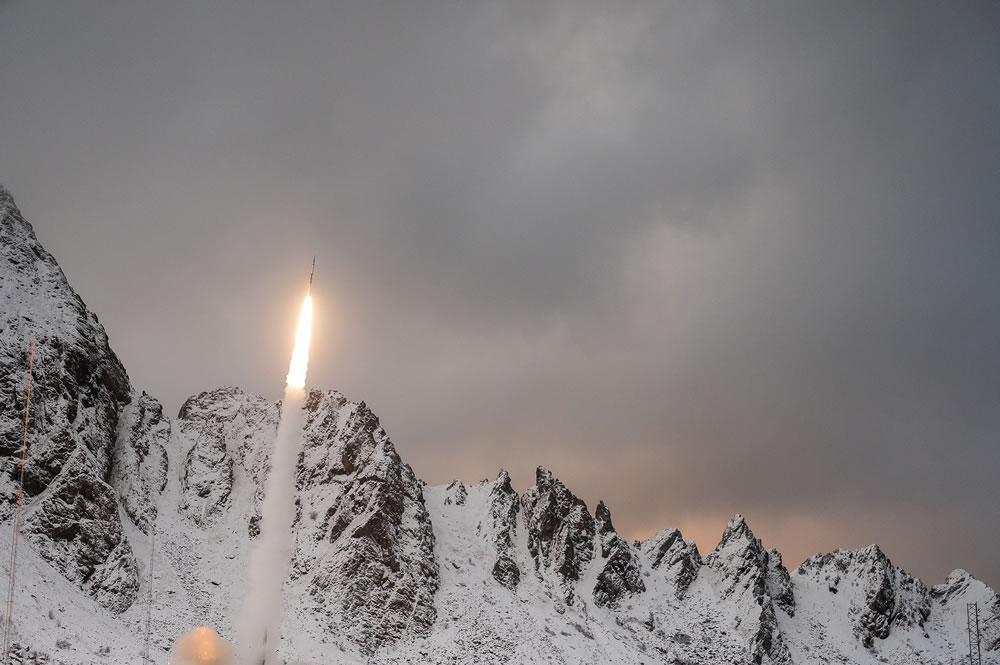
The Andøya Space Center is located in the Vesterålen archipelago, above the Arctic Circle, in northern Norway. In this far north, which attracts tourists for the midnight sun and the northern lights amid unspoiled nature, since the 1960s there has been a spaceport owned by the Norwegian Ministry of Trade and Industry (ten percent is owned by the private company Kongsberg Defence & Aerospace), from which approximately twelve hundred sounding rockets have been launched since 1962, and which became famous – infamous – in the mid-1990s when a rocket was launched into orbit for scientific purposes that Russian missile forces took as a possible nuclear attack by the United States. On January 25, 1995, a group of Norwegian and American scientists launched a Black Brant carrying equipment to study the aurora borealis over the Svalbard Islands: it was headed north, traveling along an air corridor that extends from the Minuteman-III launch sites in North Dakota to Moscow, reaching an altitude of 1,453 kilometers. The rocket was detected by Russian radars installed at Olenegorsk, and since it had a structure and speed very similar to those of nuclear missiles launched from submarines, the alarm was triggered. Russian missile forces would soon realize that the rocket was not heading toward their country but toward the sea, but in these situations – as we recently saw in “House of Dynamite” – the time to decide whether and how to react is very short: in that case it was about ten minutes. So the notification of the possible attack quickly reached then-President Boris Yeltsin who, according to what was later reported, received the Cheget, the nuclear briefcase, and for the first time since the dissolution of the Soviet Union activated the so-called nuclear keys and ordered submarines to assume combat readiness. The rocket fell to the ground near the island of Spitsbergen twenty-four minutes after launch, as planned from the beginning, and the alarm subsided. The Russian people were informed of that misunderstanding a week later: as we know from the explosion inside the Chernobyl power plant in Ukraine in 1986, Russian authorities have never had either haste or transparency in explaining themselves to their people.
The Satellite Race
On January 21, a satellite launch from the Andøya Space Center was scheduled: it was postponed for technical reasons, but it will happen because Europe desperately needs to enter the satellite race in which all other major powers are extraordinarily ahead. As the Economist recently wrote: “A look at the battlefield in Ukraine explains why this is urgent. Starlink, Elon Musk’s satellite constellation, has been fundamental to the Ukrainian Armed Forces. But relying on a company run by a Europe-hater for defense would be imprudent and is costly. Space autonomy is a geostrategic imperative for Europe.” To launch satellites with its own rockets, Europe currently transports them six thousand kilometers to French Guiana in South America. The European Space Agency (ESA) spaceport at Kourou is suitable because its low latitude takes advantage of the fact that the Earth rotates faster at the equator, giving rockets a boost toward orbital velocity and saving fuel and money. But a single spaceport is not enough: of the 324 orbital launches in 2025, only 8 were European. America handled 193, China 93 and Russia 17. For launches from European territory there are three centers in particular: Andøya in Norway, Esrange in Sweden and SaxaVord in the Shetland Islands, Scotland. High-latitude launches are more fuel-efficient for polar and sun-synchronous orbits that pass over the same points on Earth every day at the same local time: these SSO satellites maintain the same angle to the sun, so illumination remains constant in the images they transmit: they are perfect for monitoring troop movements, new construction or glacier retreat. Norway’s Andøya Space Center is currently the most developed, and an entire launch pad – the one that was ready on January 21 – is dedicated to satellites produced by a German startup, Isar Aerospace, founded in 2018 by a group of Bavarian students, which already attempted an orbital launch in March last year, which then failed. But studies and preparations continue: Europe must enter the satellite business, and Norway is a fundamental springboard. Not only for space, to tell the truth.
A sea of resources
Norwegian Prime Minister Jonas Gahr Støre, a Labour politician, millionaire and former military officer, ended up in Donald Trump’s crosshairs, and therefore on the front pages of newspapers in January because of a letter. The sender was precisely the American president who wrote to him: “Considering that your country has decided not to award me the Nobel Peace Prize for stopping 8 wars plus, I no longer feel obliged to think exclusively about Peace,” and therefore I can safely annex Greenland. This happened before the World Economic Forum in Davos, during which Trump said he would not use military force to conquer Greenland and withdrew the threat of tariffs on European NATO countries that had sent soldiers to Greenland to strengthen the Alliance’s presence (of which America is naturally also part), but Prime Minister Støre still found himself in the situation of having to explain to Trump that it is not he who decides who is awarded the Nobel Peace Prize, but an independent committee, and to strengthen his position he sent a message with Finnish President Alexander Stubb, who is in Trump’s good graces having played golf with him, saying that “we should all commit to ending this situation and easing tension: so many things are happening around us that we must stay united.” But Trump’s attack on Støre is not motivated solely by Trump’s whim about the Nobel: Norway, which is not part of the EU, is the largest gas supplier to the European bloc and represents about 30 percent of imports. With the Russian invasion of Ukraine, the EU had to redesign its energy supply chain (which it is still doing: dependence on Russia especially regarding gas still exists, albeit to an extraordinarily lesser extent than before 2022, and should end by 2027) and Norway proved crucial. If you look at liquefied gas and pipeline imports, you can see that in 2021 Europe imported 151 billion cubic meters of gas from Russia, 79 from Norway and 21 from the United States. In 2025 the situation is this: 37 billion cubic meters from Russia, 89 from Norway and 81 from the United States. In fact, dependence on Russia has been replaced by dependence on America, and while a year ago this seemed like a solid strategy (albeit costly), now that there is Trump it no longer seems so. Indeed, in Europe many are already worried – terrified – that Trump could transform his strong position in the oil and gas industry into a coercive commercial weapon against Europeans. In fact, it has already happened: in the tariff agreement signed last year by Trump and European Commission President Ursula von der Leyen (the one that is called into question every day, now even by the European Parliament), the United States provided for an increase in liquefied natural gas (LNG) exports to Europe. In 2025, LNG flows from the United States to EU countries increased by about 60 percent compared to the previous year. The terror derives from the fact that there are not many alternatives for the EU – the only one is Norway, and this explains, alongside the obsession with the missed Nobel, why this country has entered Trump’s hostile rhetoric.
Aid to Ukraine In mid-January, when it became clear that this winter is among the coldest ever in Ukraine and that Vladimir Putin decided to take advantage of the weather too to devastate the Ukrainian people with darkness, cold and lack of running water, the Oslo government allocated 340 million euros in emergency funds to support the Ukrainian energy sector and help Kyiv maintain essential services, as part of a broader aid program during 2026. At the end of last year, the Norwegian Parliament allocated 85 billion crowns (about 7.5 billion euros) in aid to Ukraine, of which 70 for military support and 15 for civilian and humanitarian aid, particularly for the energy sector, reconstruction and also entrepreneurial development. At the end of January, a group of employees from the Ukrainian Ministry of Defense arrived in Norway to participate in the “Train the trainer” program, a training course led by Norwegian and British defense industry experts: at the end of the course, participants will return to Kyiv and in turn will train others – it is a virtuous chain of knowledge. Recently, Norway has provided Ukraine with a significant number of missiles for Nasams air defense systems, within the PURL program, the initiative created by European NATO countries and the United States to guarantee military assistance to the Ukrainian army (European allies purchase weapons from America and send them to Kyiv). On January 22, Norwegian Defense Minister, Labour politician Tore Sandvik, met for the first time with the new Ukrainian Defense Minister, Mykhailo Fedorov, one of the most brilliant and visionary politicians, as well as very young (Fedorov perfectly embodies the Ukrainian spirit of always looking ahead and ingenuity: one does not stand still waiting for someone to come to help, one does not complain, one resists by inventing new ways to defend against Russian ferocity). In addition to discussing deliveries through PURL, Fedorov proposed to the Oslo government to participate in a large-scale project to support Ukrainian army units at the front with various types of drones and offering Norway access to Delta data, the software developed by Ukraine (also thanks to Fedorov himself in 2022, when he was Minister for Digital, together with American engineers) that integrates real-time data from drones, satellites, sensors, human intelligence and allows monitoring of Russian movements. This collaboration also allows Norway to strengthen its own defense systems: it is in fact the large and continuous modern warfare training course that Ukraine offers to NATO countries (this is why we often say that it will be Kyiv that will provide security guarantees to Europeans).
The pro-European push
Since the end of World War II, Norway’s foreign and security policy has been based on relations with the United States and NATO membership. But the Greenland issue has shown that even a country like Denmark, which is in NATO and also in the EU unlike Norway, can no longer feel safe only by trusting existing historical relations with Americans. Norway has chosen the closest possible integration with the EU: most of its regulation, trade and foreign policy is aligned with the EU, it adheres to sanctions introduced by the EU and participates in the European budget for the programs and agencies in which it is involved. But in January last year, a dispute over the adoption of EU energy regulations had led to the collapse of the Norwegian government, reigniting the European question within the country. Dependence on Norwegian gas provides the Oslo government with a very solid bargaining position, but it has been a year anyway that Norway has been trying to dodge the crossfire on tariffs between the EU and the United States. In the Norwegian Parliament the majority of parties are opposed to full membership in the European Union, but among Norwegians the mood is changing. In 2023, only 27 percent of citizens were in favor of a referendum on membership, while last year the percentage was over 40 percent. It is still a political gamble to side with the EU in Norway, but the Trumpian upheaval is changing – and in some way accelerating – this calculation too.
The Norwegian team will be among the most watched at the Winter Olympics in Milan and Cortina. Not only because for years the success model of this small country that amasses medals has been studied – they say the secret is: passion and discipline, together with a major investment in young people, indeed very young: Norwegians come out of their mother’s womb with skis on – but also because it has been at the center of a scandal about ski jumping suits, with suspensions of coaches and athletes. The campaign to restore Norwegian reputation has been underway for some time and, sporting competition aside, Europeans were the first to be reconquered: there is so much need for Norway, on our side.