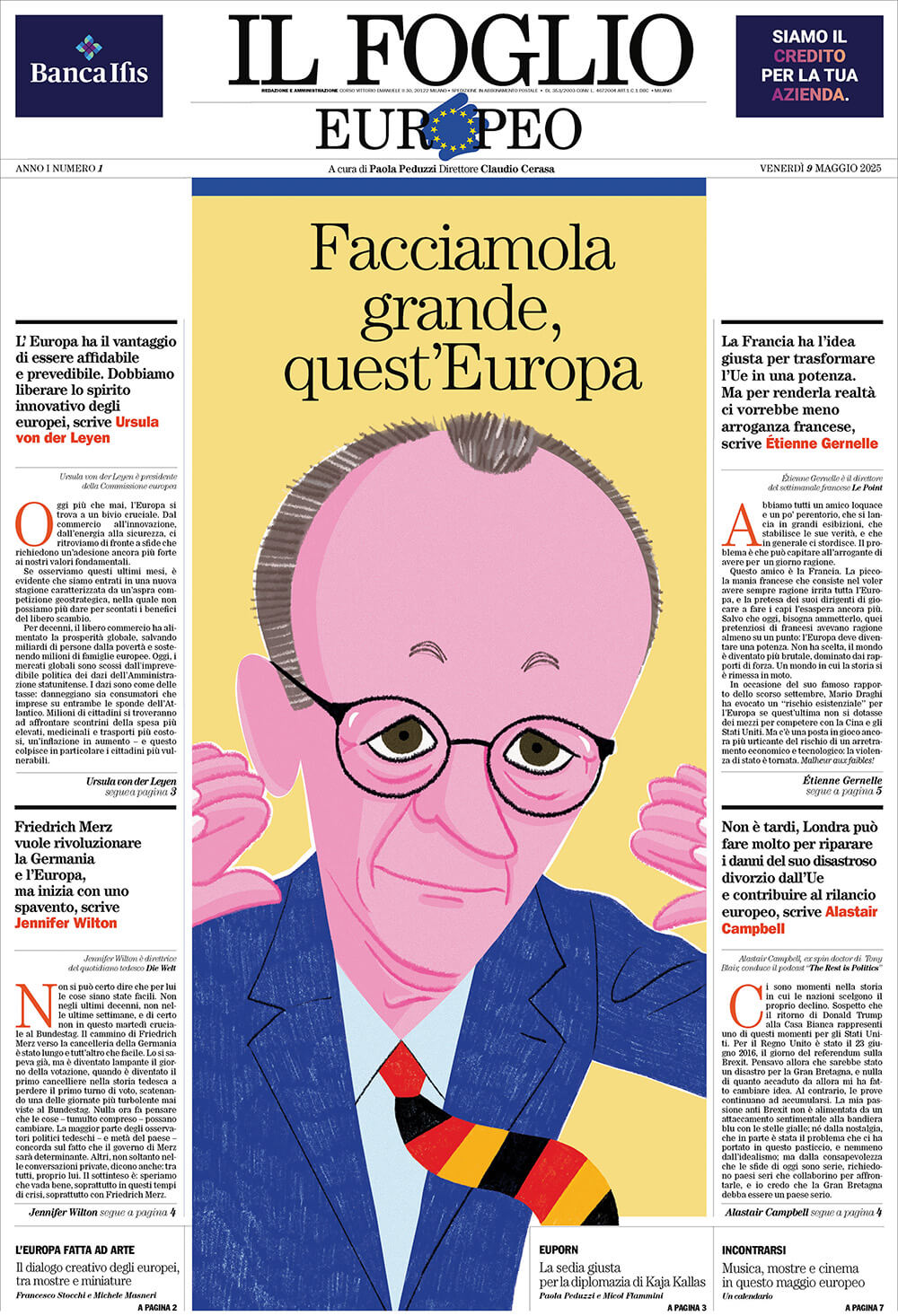
We all have that chatty and slightly overbearing friend who launches into grand explanations, asserts their truths, and, overall, wears us out. The problem is, sometimes the arrogant one might actually be right…
That friend is France. France’s little habit of always wanting to be right annoys all of Europe, and the arrogance of its leaders trying to play the boss is even more exasperating. Except today, we have to admit, those pretentious French were right at least on one point: Europe must become a power. It has no choice – the world has become more brutal, dominated by power dynamics. A world where history has started moving again.
In his much-discussed report last September, Mario Draghi spoke of an “existential risk” for Europe if it failed to equip itself to compete with China and the United States. But there is an even more pressing issue than the risk of economic and technological decline: state violence is back. Malheur aux faibles!
The most immediate threat, of course, comes from Russia. You’d have to be mad or ignorant to think Vladimir Putin will stop on his own, satisfied with the piece of Ukraine he has already bitten off. And today the world is full of autocrats emboldened by the example of their unpunished peers: In Beijing, Moscow, Ankara, Baku, and elsewhere, anything goes. This is not a century for the soft-hearted.
All the more so since our protector for the past 70 years, America, is looking elsewhere. It would be equally naïve to think this is just about Donald Trump, and that we simply need to wait for the bombastic Mr. MAGA to lose the midterms for everything to return to normal, so we can drift back into a peaceful slumber. The U.S. “Asia pivot” began under Barack Obama, continued under Joe Biden, and there’s no doubt Kamala Harris would have carried it on. All of it would certainly have been more polite, more courteous, at least less crude, but it is reality: Washington has its eyes fixed westward, toward the Pacific; it is turning its back on us, and it has good reasons for it—one of which is enough: China.
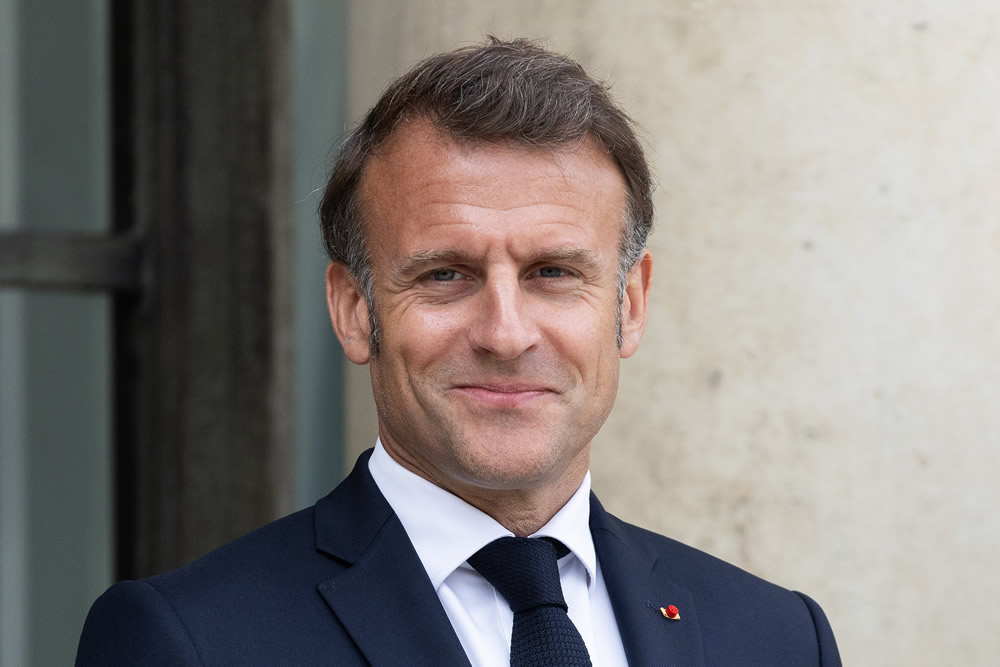
The prevailing vision of Europe on the continent until now was, if we exaggerate slightly, that of a large Swiss Confederation—an area of internal peace and quiet prosperity. That’s actually unfair to Switzerland, which has always taken care to know how to defend itself. In any case, it is now necessary to choose between self-assertion and submission. The idea of a Europe as a power, until now mainly championed in Paris—and probably even more so under Emmanuel Macron—is beginning to take hold. To his credit, the French president has always consistently advocated for “European sovereignty.” Even before his famous “Sorbonne speech,” he said it in the pages of Le Point, in August 2017: “I believe that Europe is the appropriate level to fully recover our sovereignty in areas that no longer fall solely under national control, because I want a Europe that is a continent on the scale of the American and Chinese powers.”
The observation is accurate; only the use of “I” in that sentence betrays a slight arrogance that undermines the achievement of his aim. No one will build Europe just to please him… In the years that followed, Macron hammered home his concept of “strategic autonomy.” Into a void, most of the time. Europe either didn’t believe or didn’t want to see that America was drifting away. And France was always suspected of envisioning Europe as a larger version of itself. History doesn’t exactly argue in its favor… Napoleon, his hands stained with the blood of European peoples, dared in 1807 to present his conquests to the Corps législatif—a kind of sub-parliament of the time—in these terms: “France is united with the peoples of Germany by the laws of the Confederation of the Rhine, and with those of Spain, Holland, Switzerland, and Italy by the laws of our federative system.”
Since then, Europe has forgiven France—other horrors have been committed—but it’s hard to stop Europeans from shuddering when a Frenchman speaks of a “federative system” or anything similar…
Another reason France hasn’t been heard is that Emmanuel Macron has consistently undermined his own declared ambitions by widening France’s public deficits to such a degree that many Union members suspected—and not without reason—that his federalist goals, if realized, would result in a wholesale siphoning of their finances. One trillion euros of additional debt in seven years: Emmanuel Macron’s financial record is damning. Who would want to entrust him with their savings? His predecessors, since François Mitterrand, didn’t do much better, but Macron has for now buried France’s financial reputation.
Macron, smooth talker about Europe, but small achiever. But what about the others? Are they ready to rise to the occasion? That’s the uncomfortable question. Capitulation is never far off on the “old continent.” The Romanian writer Emil Cioran, the “pope” of pessimism, who had—how convenient!—taken refuge in France, painted this defeatist mindset in particularly cruel terms in his 1956 essay The Temptation to Exist. Here’s what he wrote: “Amid its perplexities and cowardice, Europe still clings to one conviction, and one alone, which it would never abandon for anything in the world: the conviction that its future is to be a victim, a sacrificial offering.” A little further on, he added: “Resistant to any form of excess, to any form of life, it deliberates, and will always deliberate—even after it has ceased to exist: does it not already resemble a gathering of specters?”
Seen from Moscow, the “gathering of specters” is more than an opinion—it’s a statement of fact. What did we do in 2014, when Vladimir Putin annexed Crimea and invaded Donbas with his “hybrid” operation? More gatherings of specters… Until the 2022 invasion, Europe had not grasped the historic rupture that was reawakening in the East.
The great German philosopher Peter Sloterdijk, perhaps the most stimulating contemporary thinker, had already in 2003, in a book titled If Europe Awakens, explored the future of a continent marked by the translatio imperii, or “mechanism of empire transfer,” through which it regularly “replays” the Roman Empire. But can one be a power without being an empire? That same Sloterdijk, this time writing in Le Point in 2018, pointed out the scale of the challenge: “Let’s be honest: it’s a union of losing nations! A club that has only admitted humiliated empires, defeated nations! In 1945, it wasn’t just Germany that had to face its catastrophe: in truth, the entire ‘family’ of European nations was affected by failure in the years that followed. Let’s look from west to east: Portugal, Spain, France, Italy, Austria, Germany, Belgium, the Netherlands, Denmark, the United Kingdom—all empire-nations condemned to the loss of their colonies.”
Sloterdijk saw Europe as “a kind of rehab center, a place where 500 million losers learn how to live, exist, and recover in a post-imperial, post-heroic, post-idiotic world.” Except that the imperial world has since returned to claim its place.
Cioran wasn’t entirely right: Europe partially emerged from its “rehab center” in response to Putin in 2022, and more recently, faced with Trump’s trade harassment. The continent of “losers” is starting to regain a bit of self-respect. We even heard Friedrich Merz, once a staunch Atlanticist, declare after his election victory that “Europe must become independent from the United States.” Even Poland, once unwavering in its loyalty to America, is changing its tone—through the words of its Foreign Minister Radek Sikorski, who now refers to the Union as a “geopolitical entity.” And these are not just words—military spending is increasing almost everywhere on the continent.
In 1949, at the beginning of the Cold War, Raymond Aron had posed the issue very simply: “Europe will only truly regain confidence in itself the day it is once again capable of defending itself.” Today, in the heart of this new form of Cold War, or rather a lukewarm one, Aron’s wish may finally come true, 76 years later. But how to go further? Major developments on European institutions generally provoke stifled yawns. So let’s keep it brief, and limit the proposals to two: in the European Council, decisions by qualified majority should become the rule, those by unanimity the exception; and Parliament must – finally! – elect a significant portion of its members from transnational lists. This will (slightly) reduce the pollution of debate by domestic political issues. But politics, the real one, in the end, is about men and women, breaths, temperaments. Europe has plenty of them.
It’s certainly not always the most assertive characters who are chosen: in Paris and Berlin, in particular, they don’t much like the idea of seeing figures at the Commission or European Council who might overshadow them. Especially in Paris, where they don’t forget that Brussels was, from 1795 to 1815, the capital of the French department of the Dyle…
One thing is for sure: if we want Europe to lift its head, it’s better not to let France have too much control. Like the United Kingdom, it is a victim of an illusion: that it is still one of the great powers of this world.
The political genius of General de Gaulle allowed France to be counted among the victors of World War II, with even an occupation zone in Germany. A permanent seat on the United Nations Security Council, and a few years later, the development of the atomic bomb, allowed it to prolong this sweet dream. Valery Giscard d’Estaing had scandalized the country by stating that it was only a “great medium power,” which speaks volumes about this denial of reality.
This French tendency to see itself as greater than it is has of course been maintained by a monarchical tradition that the beheading of Louis XVI in 1793 did not erase. The protocol surrounding the President of the Republic is more impressive than that accompanying most European monarchs. One only needs to have flown once with a French president to know this. The author of these lines remembers a small trip taken with Emmanuel Macron to conduct an interview during the 2022 campaign. It all begins with a convoy of nine cars, all with flashing lights, and a swarm of motorcyclists, arriving at the military airport of Villacoublay, near Paris. On the Falcon 7X, a high-ranking military officer asks the president if he would like access to the wifi on the plane. Is that really why one reaches the rank of senior officer? During the flight, the last ten minutes are dedicated to deciding which local dignitary will have the honor of sitting in the presidential car between the airport and the meeting location. Aside from technological progress, Louis XIV would not have been out of place…
Emmanuel Macron, to his credit, is merely the heir to this monarchical Fifth Republic. In a brilliant book published in 1992, titled Ineffective Absolutism, Jean-François Revel mocked the authoritarian, centralizing, and sometimes ridiculous excesses of what he called “presidentocracy.” At the time of this book, the occupant of the Élysée was François Mitterrand. Revel did not have him in his heart, but he did grant some mitigating circumstances: it’s not really his fault, but that of the French “absolutism.” Mitterrand, a great critic of the Fifth Republic, which he had vituperated in a pamphlet, The Permanent Coup d’État, had very well adapted to the throne left by De Gaulle…
French hubris certainly doesn’t just come from protocol. France, unlike the rest of the continent – with the United Kingdom now separate – has maintained an army with projection capabilities, but also and most importantly, a nuclear strike force. This flatters national pride, but to be fair, it is also a major asset for Europe, especially since the American umbrella is wavering. Moreover, French deterrence has never been conceived as strictly national. As early as 1964, General de Gaulle had implied that if the security of Germany and Belgium were threatened, France’s vital interests would also be threatened.
A more formal extension of this guarantee to the East would obviously be useful, and Germany, for example, now says so. However, this is, pardon, one more reason not to give too much importance to France in the European construction processes in the coming years: it is not lacking in ego, no need to add more…
If Europe’s destiny requires a surge of pride, the best thing France could do to contribute would be to undergo a small cure of humility itself.