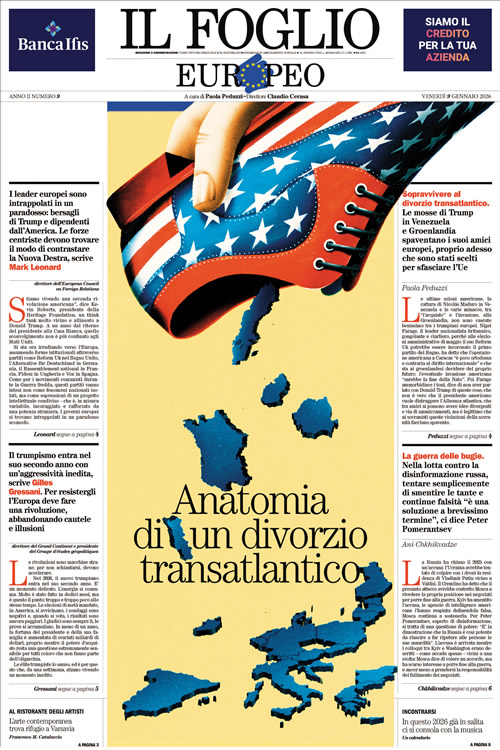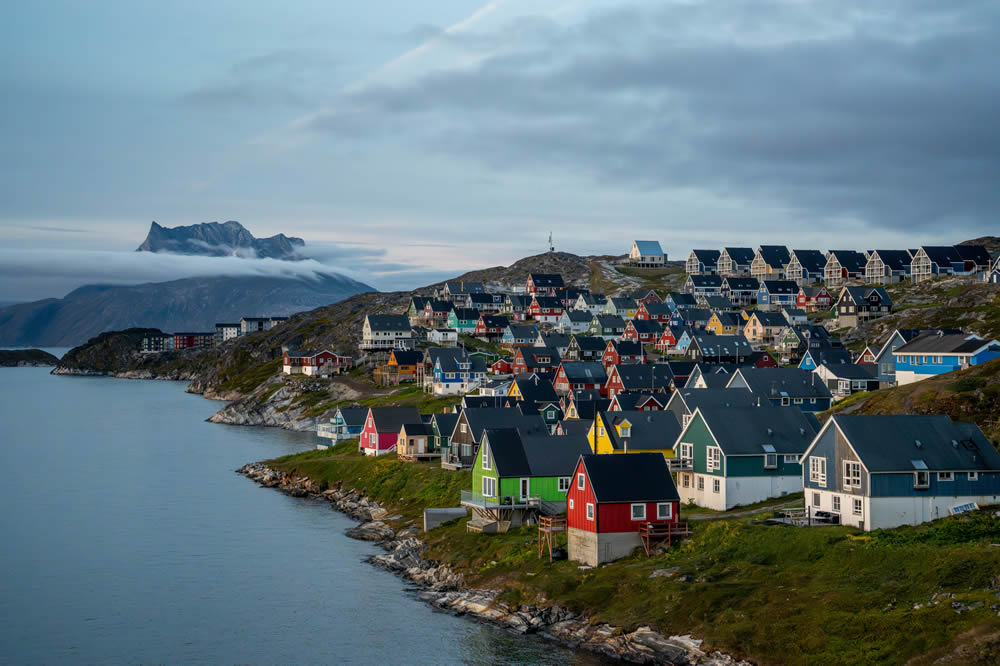
“We need Greenland,” said Donald Trump on the plane taking him back to Washington from his shadow White House in Mar-a-Lago, where the American president had done, during the Christmas holidays, some negotiations on Gaza and Ukraine, and where he had set up a situation room to follow the capture of Venezuelan dictator Nicolás Maduro. The blitz in Caracas had occurred less than 48 hours earlier when the American president, on January 4, speaking with journalists on Air Force One, set his sights back on Greenland, saying that in “about two months” he will deal with the northern island – an autonomous territory of Denmark, therefore of NATO – because America “needs” it for national security reasons, “it’s so strategic,” and in any case Trump doesn’t expect a firm reaction from Copenhagen, “you know what Denmark has done lately to increase Greenland’s security? – he asked and answered – It added a dog sled.” Two days later, Stephen Miller, one of the most prominent and increasingly present figures of the Trump Administration, formally the guru of anti-immigration but in reality much more, told CNN that “Greenland should be part of the United States, by what right does Denmark exercise its control over Greenland? The United States is the NATO power.” So is the military option on the table? “No one will militarily fight America over Greenland’s future,” Miller responded. In the Miller family there must be a special fixation with the island, because, just after Maduro’s capture, it was Miller’s wife, Katie, a podcaster with various roles in the Trumpian world of government and beyond, who put on X an image of Greenland with the colors of the American flag and the caption: soon.
A year of covetousness
During his first term, Trump talked about “purchasing” Greenland – 56,000 inhabitants on over two million square kilometers of land extremely rich in energy resources and highly coveted minerals that enjoys autonomy from Denmark but not regarding defense and security, for which it is under the Atlantic Alliance’s umbrella – but in this second, tragic term (which began less than a year ago) he moved directly to the idea of annexation: at Christmas 2024, his son Eric had put Greenland, along with Canada and the Panama Canal, in an Amazon shopping cart, his gift. Since then the threats have been repeated and intensified, so much so that in May, during an interview, Trump had not ruled out the possibility of using force to annex the island to the United States. In April, Vice President J.D. Vance had visited the Pituffik space base – a strategic monitoring center for NATO – and had said: Denmark has not done a good job for the Greenlandic people. In August, the American diplomat in Copenhagen had been summoned by the Danish government after news came out of three American citizens who were recruiting people in Greenland to create a secessionist movement. Meanwhile there had been very tense phone conversations between Trump and Danish Prime Minister Mette Frederiksen, Trumpian incursions into Greenland, European tours by Frederiksen to understand with allies what to do – quite a dilemma, given that the main ally is the one that wants to annex a piece of your territory – and the uninterrupted insistence of the Americans, who maintain that the island is geographically part of the American continent (and therefore of that Western Hemisphere which, according to the document for the National Security Strategy, is a priority for the Trump Administration) and that annexation is a security issue, even though the 150 people stationed at the space base are doing an excellent job. The Trumpians say “security” but mean resources to exploit and to take away from other countries circling like vultures in the resource-rich Arctic, namely Russia and China.
The envoy from Louisiana
A few days before Christmas, Trump appointed Jeff Landry as the American special envoy to Greenland. Landry, 55 years old and not aging well with a Southern Cajun accent that often makes him incomprehensible, has been governor of Louisiana since 2023, has no foreign policy expertise but about a year ago, when the Trump Administration was taking office and there was much talk of annexing independent states, he wrote on X: “President Trump is completely right! We must make sure Greenland comes into the United States. Great for them, great for us! Let’s do it!” This is certainly not the first time Trump has chosen envoys without experience, but in Landry’s curriculum Greenland never really appears, except in this post, which evidently was sufficient to be appointed to what will be a second job, somewhat inconvenient, for Landry who will continue to be governor. Very Trumpian, when he was attorney general (from 2016), the improbable envoy had fought vaccine mandates during the pandemic, environmental regulations and those to control disinformation on social media, and had defended the state’s abortion law, one of the most restrictive, telling protesters: you can just leave Louisiana. As governor, Landry has continued his conservative campaigns, put the Ten Commandments in every classroom of public schools and universities, requested the deployment of the National Guard to control immigrants and crime, and celebrated the arrival of Border Patrol guards deployed with the goal of arresting five thousand illegal immigrants (so far only a few hundred have been arrested). Nothing that has anything remotely to do with his mandate in Greenland, and perhaps that’s the point.
Kirill of the north
Trump’s interest in the Arctic has been picked up not only by his Trumpian admirers, but also by the historic rivals of the United States who, however, since the American president began his second term, behave as if they were friends not so much of the Americans, but of the president personally, for life. We’re talking about the Russians, for whom Trump’s return has been a blessing, since so far they have managed to push back every peace plan for Ukraine and indeed to sketch one out jointly with Trump’s emissaries, Steve Witkoff and Jared Kushner, sent so far to the Middle East and Russia, but kept out of Greenland. The Russians have understood how to entice Trump and his circle, and the one who has understood this best of all is Kirill Dmitriev, born in Kyiv, economist, Harvard student, knows how to play the American when needed, friend of one of Putin’s daughters, today head of the Russian Direct Investment Fund. Dmitriev began talking about the Arctic as soon as Trump set foot back in the White House, launching proposals for collaboration in the icy waters where the Russians move with a certain ease to the American president. Obviously the collaboration has a price and can only come true after the easing of sanctions imposed by the United States after Russia’s aggression against Ukraine. It has never yet happened, but Dmitriev is a patient, methodical, and above all ambitious man. He has found in Witkoff his access route, the way to be heard by Trump, already well disposed toward Moscow, and at every meeting whether in Mar-a-Lago or Moscow, he always manages to obsessively pronounce the magic word: “business.” The Arctic is the land of business, paradise. This is why Dmitriev has made it a banner, the symbol of collaboration between Americans and Russians, which so far remains only in the imagination, because the truth is different. If there is a collaboration underway in the northern waters, it is that between Russia and China, always with reluctance, but the joint projects are not few.
Russian and Chinese designs
Arctic means business, but it also means weapons, secrets, energy, and at the moment the collaboration between Moscow and Beijing is proceeding quite fruitfully. Russia is the veteran, China the newcomer, so much so that it defines itself a “near-Arctic power.” For Russia, the Arctic is an identity dimension, strategic, by geographical right. It has invested in military infrastructure, icebreakers, and the fulcrum of the vision is the “Northern Sea Route,” a commercial route shorter than the Suez Canal but which to be fully realized needs investments and technological cooperation. For Beijing, the Arctic is an integral part of its Polar Silk Road, of which it already completed an exploratory voyage in September. But the interest is not only a matter of commercial routes, but also of natural resources, and for this reason Russia and China have co-financed projects such as liquefied natural gas plants that Moscow was able to build by circumventing sanctions only thanks to China. It is an alliance of convenience, not welcome. But we have become increasingly accustomed to this collaboration since 2022, when Moscow launched the major aggression against Ukraine and found itself tightening ties with Beijing, increasing military, technological, space, and nuclear collaboration. And therefore also in the Arctic, where Russia has always had the ambition to be the dominant power, feels it is, studied to be so, but could find itself with roles reversed with Beijing. The United States watches this cooperation and also knows it is far behind in the Arctic. Dmitriev has understood this weak point, among the many of the Trump Administration. But when it comes to Greenland, the Kremlin repeats: “We are monitoring closely.”
“Enough now”
Jens Frederik Nielsen, 34 years old, was elected prime minister of Greenland in March of last year, when Trumpian threats had already begun and indeed had somewhat upended the island’s politics. Until that moment the line of demarcation between the various parties was defined by the relationship with Denmark – a complicated coexistence, with an unhappy past and a resentful present – but then everyone had to find themselves in many statements of national unity against the American threat. The words are always the same: Greenland wants to collaborate with its American ally but is not for sale; mutual trust needs respect; pressure, between friends, is not useful. After Trump said he “needs” the island for security reasons, and said it while the Venezuelan dictator was being transferred to a penitentiary in New York, Nielsen reacted: “Enough now,” he wrote on Facebook, “Enough with the pressure, enough with the insinuations, enough with the annexation fantasies.” But if Nielsen seems impatient to you, it’s because you haven’t yet heard the Danes.
The Danes
Danish Prime Minister Mette Frederiksen doesn’t know how to keep repeating to the Americans that allies don’t behave this way toward each other, Denmark is part of NATO, therefore so is Greenland, and if the United States needs greater collaboration in the Arctic, they just need to ask for it. European leaders have supported Denmark, expressed great concern about American threats, and among all of them there is one recurring expression: what’s the need? It’s true that Trump has no respect for Europeans, it’s true that he doesn’t intend to be part of their security, but if he cares so much about Greenland and talks about a threat to his own security, he should at least have the courage to say that the threat is not the Danes, the Greenlanders, the French, the Swedes, the Italians, or any of the Europeans. He never names the threat, but says he “needs” Greenland, against which he has also long since begun a small operation in an attempt to increase nationalist movements, to flush out sympathizers of the United States, almost as if it were a Russian-style operation.
The threat Trump alludes to is the same one his NATO allies feel, but it takes the form of chaos, which is the method of government of the American president who is overturning a world where you no longer know who you can trust.