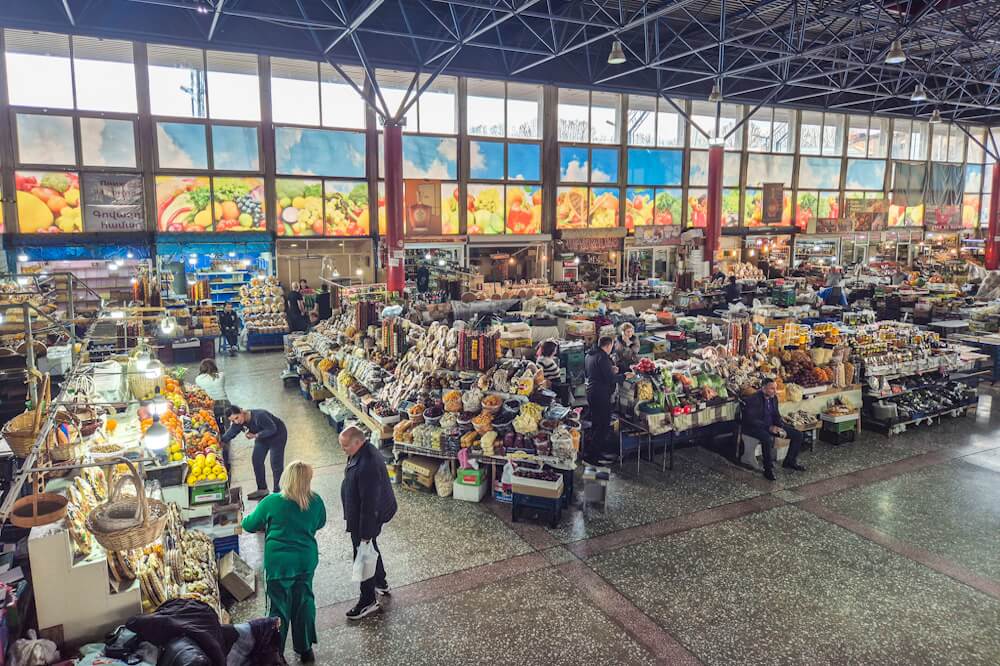
For the first time, Yerevan’s supermarkets are selling flowers. It strikes Armenia’s three million citizens as strange, since the main streets of their cities are already full of florists. Armenia, wedged into the mountains of the southern Caucasus between Turkey and Azerbaijan, has always had a flower-giving tradition: flowers are given as gifts, seen as good omens. The market is backed by highly efficient greenhouses that have, however, been struggling with sales lately. Robert Arutinov and Hovannes Ghukasyan, two flower growers, say almost in unison: “It’s not going badly, but it used to be better.” A year ago, one of their bouquets was worth about ten euros; today, seven. “Most recently I was left with seven thousand unsold flowers,” says Robert. To compensate, the government guarantees a subsidy of about 9 cents per unsold flower.
Flower-growing is one of the sectors hit by Russian sanctions. Shortly before the June 7 elections, won by outgoing Prime Minister Nikol Pashinyan, Moscow suspended imports of Armenian goods such as foodstuffs, flowers, spirits, and mineral water. Russian authorities cited alleged food-safety concerns. But many observers believe it is punishment for Pashinyan’s pro-Western stance. The bone of contention dates to early May, when the EU-Armenia summit marked a decisive turning point for Yerevan’s European integration. A broad strategic partnership would unlock up to 2.5 billion euros for Armenian transport, energy, and digital infrastructure, laying the groundwork for eventual visa liberalization.
These European aspirations have soured relations with Moscow. When the Kremlin’s deputy foreign minister warned Yerevan not to “dance at two weddings” — referring to the EU and the Eurasian Economic Union (EAEU, founded by Vladimir Putin to facilitate trade across the post-Soviet space) — Armenia’s economy minister shot back: “We cannot trade national sovereignty for tomatoes.” Besides subsidizing producers, the Armenian government is diversifying its export market. The goal is to eliminate the vulnerability tied to dependence on Russia within a year. A spokesperson for the Ministry of Economy tells Il Foglio that integration into the EU market, begun in 2024, is not a temporary measure but a deliberate policy that strengthens the country’s economic sovereignty. Davit Davtyan, a farmer who exports abroad, takes the opposite view. In his opinion, these measures are a stopgap that doesn’t address the root problem: for too long the Armenian economy has depended on Russia, the destination for a full 35 percent of its exports. Within a year, he argues, only large producers would be helped, not the small businesses brought to their knees by the blockade. Already today, some street vendors in Yerevan are selling cherries for little more than a euro a kilo. Fish farmers can’t cut electricity or feed to their animals just because revenue has dried up. Flower exporters now face costs four times higher when turning to EU markets.
So much so that the impact on the economy is significant. According to the governor of the Armenian Central Bank, the Russian blockade could shrink GDP by 2 percent. This has prompted the EU to shore up its support against Moscow even further. In an unexpected visit to Yerevan in early July, European Commission President Ursula von der Leyen said that “if Russia closes its doors to Armenian products, the EU will open the doors of its market of 450 million consumers.” Where tomatoes and flowers were once subject to tariffs of 8 to 15 percent, the Commission has now liberalized 80 percent of exports to the EU with zero duties. Still, according to Armenia’s economy minister, logistics and transport costs remain issues to be resolved. As a result, the EU’s initial 200-million-euro tranche for Armenian mobility could grow to as much as 2 billion. In the immediate term, another 38 million euros will go toward creating “an export promotion agency” and supporting local businesses.
Even so, the bureaucratic machine is dragging its feet on operational details. The ministry shifts responsibility for creating this agency onto the central government. There is also great reticence about how effective European aid will be in offsetting lost Russian exports: quantifying the impact is still premature. One person who can offer an estimate is Benjamin Poghosyan, a researcher at the Applied Policy Research Institute of Armenia (APRI), a Yerevan-based think tank. In his view, it’s unrealistic to think the EU could fully counterbalance trade between Armenia and Russia: on a scale of 1 to 20, “I’d say the EU can reduce the intensity of the problem by four points.” And on this front, Georgia’s history is instructive. After the 2003 Rose Revolution brought the pro-Western government of Mikheil Saakashvili to power, Russia imposed restrictions on Georgian imports, citing — much as now — food-safety concerns. This brought Georgia’s fragile economy to its knees. Armenia’s situation doesn’t map onto Georgia’s exactly, if only because its increasingly pro-Western leader came to power through a popular uprising — Pashinyan became prime minister after the Velvet Revolution in 2018. But two other factors do align the country with Georgia twenty years ago: dependence on gas from Moscow, and the tens of thousands of workers sending remittances home from Russia. At the heart of Yerevan’s economic vulnerability is the fact that Gazprom, the Russian energy giant, controls 100 percent of the country’s gas network — and Putin did not hesitate to bring up discounted gas prices as a point of leverage during his most recent meeting with Pashinyan. Add to that the 3.37 billion dollars in remittances (equal to a full 12 percent of GDP) sent home in 2025 by the 70,000 Armenians working in Russia under visas facilitated by the EAEU, and it’s no surprise that Pashinyan struck a conciliatory tone during his first visit to the Russian Federation after the elections: “Several problematic issues have recently come up, and I hope we will discuss and resolve them.”
Russian sanctions on gas and the forced repatriation of Georgians — which cut into GDP and burdened the administration with thousands of unemployed — brought down Saakashvili’s government. Since 2012, the Georgian Dream party, with a far more pro-Moscow outlook, has governed the country. Looking at this history, Armenia’s situation worries analysts like Poghosyan: “What Russia is doing now represents about 20 percent of its economic arsenal, and it’s already causing blowback. If it decided to use 90 percent of it, the consequences would be extremely serious.”