Martin Scorsese often imparts on younger generations of would-be filmmakers a simple lesson: “Study the masters.” The masters of cinema, perhaps more often than not, were filmmakers who came of age and into creative fruition in the remaking of post-WWII Europe. The Italian neorealist period evolved in real time through Fellini, Antonioni, Lina Wertmüller, and the maestro of terror Dario Argento. In France it was Agnès Varda, Godard, Truffaut, Jacques Rivette and the nouvelle vague whose eldest member – Eric Rohmer – created a body of work that brightens our social media pages and continues to find new audiences over half a century since these films released. The exactitude of Hitchcock and the creative madness of Ken Russell. In the West we had Bergman, Fassbinder, Herzog, and Almodovar while from the East we found the rebellious undercurrents of Věra Chytilová, Dušan Makavejev, the genius of Andrei Tarkovsky. This broad range of European auteurs, our artistic elders – no strangers to ego – often insulted or demeaned one another (some viscously), but they at least for a time all seemed to be chasing something ephemeral, drawing some a transcendent source of inspiration common to all great works of art. In those pursuits they left us with a body of work that will likely sustain for centuries (assuming we can avoid the path of self annihilation).
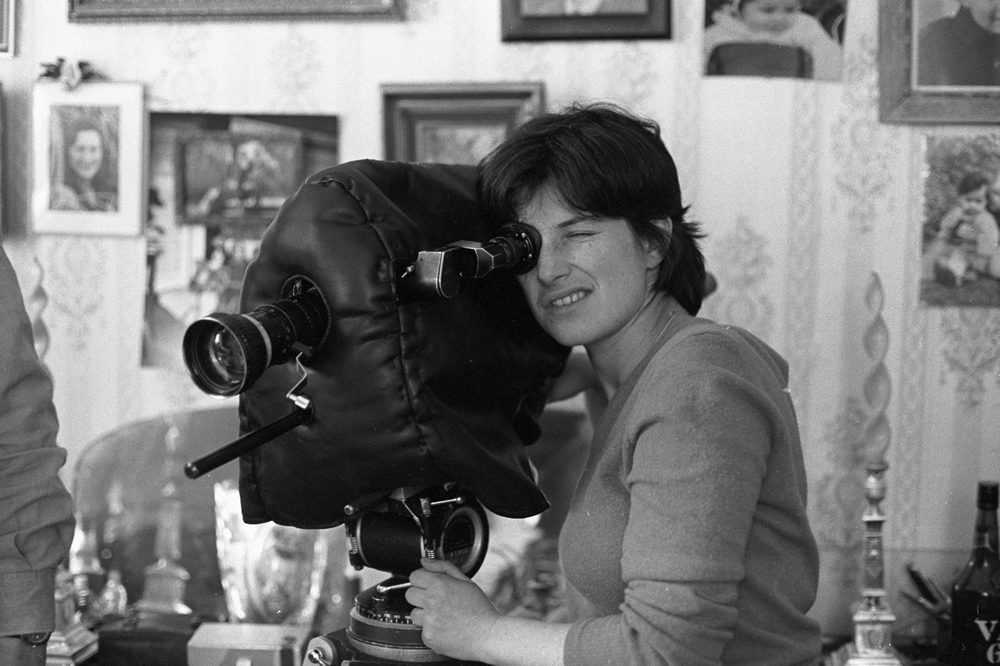
Just a few years ago Sight and Sound magazine made a list of masters far longer than this and at the top was Chantal Akerman’s “Jeanne Dielman, 23 Commerce Quay, 1080 Brussels“ – I first encountered a strong endorsement of Chantal Akerman back in the spring of 2020, from a film scholar who joined us as a volunteer in the production of the first campaign video for a little-known local politician named Zohran Mamdani. This fellow cinephile shared their recent interest in the filmmakers alleged to be the largest inspirations on David Lynch: The French masters Jacques Rivette and Chantal Akerman top of the list. There we were – a small crew of independent filmmakers, students of the masters – making small talk about the greats while setting out to make the very first campaign video for an especially charismatic young man who has today inspired the world.
When I finally sat with “Jeanne Dielman” I recalled the words of a much older Leftist New York professor who described the radicalism of “slow cinema” and the impact in its time – “You’d sit and watch a woman vacuum the floor for twenty minutes. It was revolutionary.” The decisive slowness of this film is perhaps more revolutionary by the year (at least from the perspective of the United States) as technology and culture seem to be allies in an accelerationist war against time. Capitalism by its nature always demands more for less – the internal logic of the system as it attempts to scale to infinity – and currently this systemic imperative is spiralling into an AI-run technofeudal economy that will leave the world split between a class of transnational overlords who own and profit from this technology, and a new digital serfdom for the great many – billions who will “own nothing and be happy,” endlessly surveilled from cradle to grave and subject to an algorithmically policed spectrum of acceptable thought.
Rebellion against this future stretches across the world, from the insistence of the tradition the month of August set aside for vacanza, to an insistence of maintaining siestas, festivals, time for non-capitalist pursuits. Having just spent a month in Italy for a film project, I saw a sign outside of a restaurant in Procida reading “riposare è il più piccolo atto di resistenza” (to rest is the smallest act of resistance). Much to the dismay of those whose minds are consumed by an eternal productivity, the slow life of the Italian Ferragosto presents an alternative – a social assumption that all deserve extended time to do as they please, to travel, to adapt to the rhythm of the sea – one rebellion among many against the march to a digital dystopia.
Speaking out against the domination of algorithmic capitalism on our collective consciousness, in his November 2025 address in defense of cinema Pope Leo XIV warned: “Not everything has to be immediate or predictable. Defend slowness when it serves a purpose, silence when it speaks and difference when evocative. Beauty is not just a means of escape; it is above all an invocation. When cinema is authentic, it does not merely console, but challenges. It articulates the questions that dwell within us, and sometimes, even provokes tears that we did not know we needed to express.”
Film – a medium of sight and sound – crosses borders by its very nature. One of the world cinema attendees of Leo’s address was avant-garde provocateur Gaspar Noé, who gifted the Pope a copy of his film “Vortex”. Unbeknownst to him this same film had already gifted a once lost New York filmmaker in Paris the creative framework to make his first film.
Last December in Manhattan’s Manhattan East Village Cinema, I sat in front of a crowded theater watching “Love New York” for the first time as someone in the audience posed a question, “How do you reconcile your political life with your filmmaking?” After a long pause I answered at the time, “Well, I wake up…I say “The world is a horrible place,’ and then I do my best to change that.” Nearly a year later, I think there’s an even more important question to add: “Where does politics end and filmmaking begin?”
The various modes of reckoning with the hells in our midst – political, cultural, arts, our legal framework – these lines seem more porous than one may expect. Wim Wenders recently referred to filmmakers as “the antidote” to politics. It was not reflections of Pier Paolo Pasolini’s “Salò, or the 120 Days of Sodom” that force our polite, dissociative society into an encounter with the mirror we often work to avoid at any cost.
We in the West are increasingly inundated with video – our reels, our streams, and the bright and endlessly positive commercials that sustain them. So much of our media in the West – and much of the consumerist real-world we inhabit – increasingly looks like the Kendall Jenner Pepsi commercial – a bright pallet of colors, a feel-good sense of performative civic duty, a false sense that we’ve opposed authority, while on the other hand the oligarchs of our day are running modern and globe-spanning networks of violent exploitation that make Pasolini’s work seem gentle. We’ve seen the bankrolling of war and genocide, torture dungeons, and – when it comes to the Epstein network, quite literally a reproduction of the imagined horrors of Saló. Much of our modern civilization is the dance between these realms – the brightly colored, neatly packaged, consumer – and the horrors kept at the perimeter. The disconnect between the falsehood of corporate culture and the realities our media buries in a flurry of bright colors and desirable consumer products is perhaps best articulated in the meme: “Do people on LinkedIn realize they’re going to die?”
Facing the weight of nihilism, where do we go from here? Again, we can look to the Holy See, who warns: “It is wonderful to see that when the magic light of cinema illuminates the darkness, it simultaneously ignites the eyes of the soul.” It is cinema which “helps audiences consider their own lives, look at the complexity of their experiences with new eyes and examine the world as if for the first time. In doing so, they rediscover a portion of the hope that is essential for humanity to live to the fullest. I find comfort in the thought that cinema is not just moving pictures; it sets hope in motion!”
Just a short time ago we saw the short-form motion pictures of hope add great fuel to the fire of the political revolution in New York City. Here, the mass production of short-form, joyous political media was a tool in our country’s most lively rebellion against a decade-long descent into political darkness. It is now, with the success of a growing democratic socialist movement in the U.S. that Europe, home of “the masters,” are now looking to us. I can safely say that the world is not going to be saved by TikToks and a chronic rollout of clever Instagram reels, but it may just be saved by allowing ourselves to once again begin at the beginning and ask how it is that a political message of life against death can be communicated – and how every communications tool at our disposal could be used to uplift that message. The problems of the world may often seem overwhelming, accelerative and worsening in their destruction and alienation, but the responsibility lies with us – all people of conscience – to face these problems head on, or as Leo XIV implores, “there is a need for witnesses of hope, beauty and truth.” We have the opportunity to meet the despair of the descent into a renewed fascism with a message of a joyous Left populism. In New York coalescing a movement around this democratic spirit was something that soon blossomed beyond our wildest imaginations – a swell of creative and cooperative politics that engulfed the City of New York, inspired nearly 100,000 volunteers, and has now affected much of the world.
As the contemporary master documentarian Gianfranco Rosi puts it, “cinema has always been a way of crossing borders, invisible borders often.” It was in Europe that we once saw the birth of the liberatory philosophies that once shook the world, and once more today we desperately see the need for a liberatory movement that inspires, rather than forfeiting the spirit of political vitality to our hypernationalists, oligarchs, and the radical right. More than ever we must reject the tendencies toward dissociation, for the passivity of consumerism, and the nihilism that turns money into our modern god. Across the world, we need creativity, experimentation, and a solidarity that transcends borders. Now, once more in the time of monsters, billions are desperate for a renaissance of our consciousness, and a renewed politics of life against death. If we’re lucky, a new cinema that sets hope in motion may be our first step.
Anthony DiMieri is a filmmaker, writer and producer. He worked on the videos for the campaign of New York City mayor Zohran Mamdani.