I invite you on a journey through time. The Europe of the future: what will it look like, how will it be organised? Of course we want a democratic Europe, but what kind? It is high time we discussed European democracy: its obvious shortcomings, its contradictions, the need to develop it further. Why, you ask? Europe is democratic, after all; the country you live in is a democracy. All the member states of the Union are democracies. What is there to change? So democracy is simply what you are used to, what you know? From time to time you go and vote, and afterwards either the familiar elites are back in political charge, or elites who present themselves as anti-elites. That is, either populists who are not very popular, or populists whom the unpopular populists denounce as populists. Being used to this, and being allowed to get angry now and then without consequence: is that democracy for you? And because it is democracy, it must not be questioned? Seriously? Does Article 1 of the Basic Law read “All power derives from habit”? The principle of democracy is immutable?
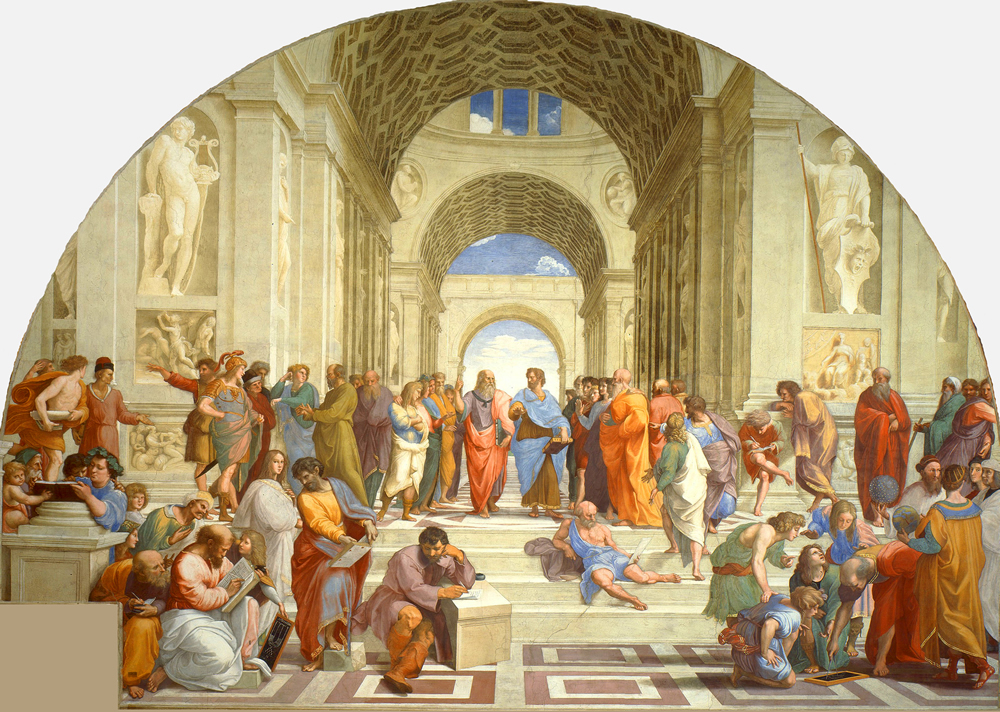
If we are talking about principle, then let us go back to the beginning, to the root of the idea, to the “cradle of democracy”, the foundation of European values. So first, let us travel back in time to ancient Greece! We want to talk to the wise people who brought the idea of democracy into the European world and first put it into practice. I will take you there now, and since I attended a humanistic Gymnasium and therefore learned Ancient Greek, there should be no communication problem. We climb out of our time-travel capsule and run into Plato. We haven’t set the destination date very precisely, for Plato turns out to be highly sceptical about democracy. That his teacher Socrates had been forced to take his own life by a democratic verdict, reached by majority decision, was for him proof that a popular vote contradicts higher reason.
Transposed to our own time, that would make for an interesting discussion too, but it is not the question we set out to pursue. We set the clock more precisely and fly to the very beginning of the golden age of Athenian democracy to meet Cleisthenes, who at the end of the sixth century had driven the tyrants out of Athens and, building on the Solonian constitution, laid the foundations of the democracy we mean when we speak of the “cradle of European democracy”. And there he is, Cleisthenes, in debate on the agora, a free man among free citizens.
Σε χαιρετώ, ω Κλεισθένη, I greet him politely, accept his invitation to follow him into the γυμνάσιον, where handsome naked men discuss questions of the common good, and finally I ask him: Esteemed Cleisthenes, can you imagine a democracy without slaves, but with women?
He bursts out laughing. No, he says, I am famous for my political imagination, and it has led our society into the future. But democracy without our slaves? He laughs. How could that possibly work? And with women, you mean they would have a say? He chokes with laughter. No, he says, I cannot imagine that, it will never happen! It is impossible!
And now I ask you, having returned with me from the cradle of democracy to the present, quite innocently: is what was unimaginable at the beginning of democracy not taken for granted today? And shouldn’t we already be trying today to imagine what will reasonably be taken for granted tomorrow? In solemn speeches on public holidays we are told again and again that democracy cannot be taken for granted, that it is an achievement we must defend over and over. But what does “defending democracy” mean? That it should stay as it is? It is banal, but readily forgotten: democracy is a process. We must remember this when we look to the future: tomorrow democracy will be (will have to be) something different from what it was the day before yesterday or is today.
So what might it be, the unimaginable that will be taken for granted tomorrow, or should be? The answer, too, can be found in the history of Europe. Let us take another trip, a shorter one this time, back to the postwar years. We want to talk to the men who set in motion the European unification project that led to today’s EU. We land in a landscape of rubble, where people, with growing euphoria, are building a new life, peacefully and with growing prosperity. We meet a generation who in a single lifetime experienced the following wars or their consequences: the Franco-German war, the Balkan wars, the First World War, the Polish march on the Ukrainian capital Kyiv and the Polish-Soviet war that followed, civil wars, and the Second World War. The founding fathers of the European unification project, men like Jean Monnet, drew a lesson from it, named the aggressor clearly and developed a vision.
Monnet is a courteous, clever man. He pours us cognac, we talk, and we understand: the aggressor that committed the most brutal crimes against humanity was nationalism. A Europe that is pacified, and lastingly peaceful, must therefore overcome nationalism and interweave the nations so tightly that none can undertake anything against the others without harming itself. We must therefore develop common institutions and common law. And of course a common democracy.
Back in the present we look around and ask ourselves: where is it, European democracy? Is a continent with a common market, a common currency, a common area without internal borders, with common institutions and the claim of a post-national union, really democratic when its 27 member states have twenty-seven different systems of democracy? Europe has democratic republics and constitutional monarchies, centralised and federal democracies, systems with two votes or with only one or with the possibility of a preference vote, with plebiscitary elements or with strictly representative democracy, with majoritarian or proportional voting, with a parliament that exercises real control or with a merely formal parliamentarism that does no more than rubber-stamp government decisions. And the national electoral arithmetic alone produces results that, under the electoral arithmetic of another European state, would have turned out completely differently. So what is, objectively, the “democratic majority”? How important are principles such as the separation of powers, how independent are constitutional courts? Here we see in the European states, to put it cautiously, dramatic differences. In short: what is democracy? The democratic system? And with regard to common European policy, what is now truly democratically legitimated?
If we take the idea seriously and want to develop Europe as a political union, then the EU cannot remain a club of nation states. If we acknowledge the reasonableness of the vision, then the vision has a name: post-national democracy. However different the national systems of democracy may be, in a post-national Europe they must be merged into a common system.
You can’t imagine it?
Do you hear Cleisthenes laughing?
Perhaps this reminder will help: Charles de Gaulle coined the phrase “Europe of the fatherlands”. He did not say “Europe of nations”. I interpret “fatherland” as homeland. That I understand: homeland is a human right. Nation is a fiction. Homeland endures even when it dissolves into fraternity within a larger whole; nation, by contrast, defends itself against others. François Mitterrand left Europe with these words to remember: “Nationalism means war!”
Who wants to tear this page out of the European book and crumple it up? All the great crises we face are long since transnational; no nation state can solve them alone in defence of its sovereignty or stop them at national borders. Nationalists can promise it, but they cannot deliver. What they can do is produce anger.
How democratic, then, is the EU’s current system really?
We can elect a European representative body, which is a great advance in the history of democracy. But for now we can only do so on the basis of national lists and twenty-seven different national electoral systems. Is the common Europe, with its common challenges, really represented by national deputies in a supranational parliament? Is the defence of national sovereignty and so-called national interests really the end of the history of democracy? What are national interests, apart from the interests of national elites? What is in the interest of the Dutch, for example, must surely also be good for the Portuguese, Poles, Italians and so on. Does a German teacher not have more in common with a Greek teacher than with the German wife of a corporate executive?
Then there is the Commission. Its task is to develop common policy and to launch initiatives for common law. But the governments of the nation states send the commissioners, the “ministers” for European policy. Not only that: they nominate them without knowing which portfolio they will get. The portfolio is assigned only later by the Commission President, once the national heads of state and government have agreed on one. In other words, professional qualification is evidently a secondary matter. What counts is that every nation has a representative at the top level of the Commission, and that the President of the European Commission is acceptable to the national heads of state and government.
When the Commission then launches an initiative and drafts a directive, it goes to Parliament. If it finds a majority there, it is still a long way from being law. This is unique among all known models of parliamentary democracy: a parliamentary majority is not enough to turn a legislative initiative into law. For now the whole thing goes on to the Council of national heads of state and government, the circled wagons for the defence of the sovereignty of nation states. The “trilogue” begins, in which Commission and Parliament must deal with the Council’s objections. This involves papers that in Commission parlance are called “martyr papers”, because they are simply torn up in the Council.
In short: we elect the European Parliament via national lists; it works with the European Commission, into whose top ranks national representatives are pushed, in order then to seek a compromise with the national heads of government in the Council. All nationally democratically elected and delegated, and so, in European-policy terms, democratically legitimated only at several removes?! One could also say “broken” instead of “mediated”. European policy, broken three times over by the national.
And this system is supposed to be immutable, because we are used to it?
Do we really want, today, to look on without imagination as nationalists in this system block common European policy and, for all the transnational crises they cannot solve nationally, offer scapegoats and stoke aggression? We should know the consequences from history. Or do we at least want to begin discussing what that could be: a post-national democracy? A democracy that finally redeems in Europe a promise of the French Revolution, namely the principle of equality: that all Europeans live under equal legal conditions and have equal opportunities for political participation, no matter how large and politically influential the country whose passport they hold.
Another time trip! Come with me into the future! Hold tight! It won’t take long! We climb out of our time capsule in the year 2040 and see misery and wretchedness. Crises. Climate catastrophes. The nationalists have, as once before, blown the common Europe sky-high, blocked all common policy, been unable to offer any solutions themselves, only stirred up hatred and… No! We cannot change the past, but we can still shape the future. We must fulfil what we have inherited as an obligation, namely the overcoming of nationalism, and to shape the future we need what we must finally discuss now: a post-national European democracy.
What should it look like? That is the question I am asking. We must finally begin to develop a vision that answers it.
Was it about the sovereignty of people or the sovereignty of nations? Was it about liberty, equality and fraternity, or really only about this: freedom of the market, equality of labour as a commodity, and hopefully fraternity in pricing?
Robert Menasse is an Austrian writer, essayist and translator. Among his best-known books are “The Capital” (2018), “Enraged Citizens, European Peace and Democratic Deficits” (2019) and “Die Erweiterung”, his novelistic portrait of the state of European politics in the twenty-first century.