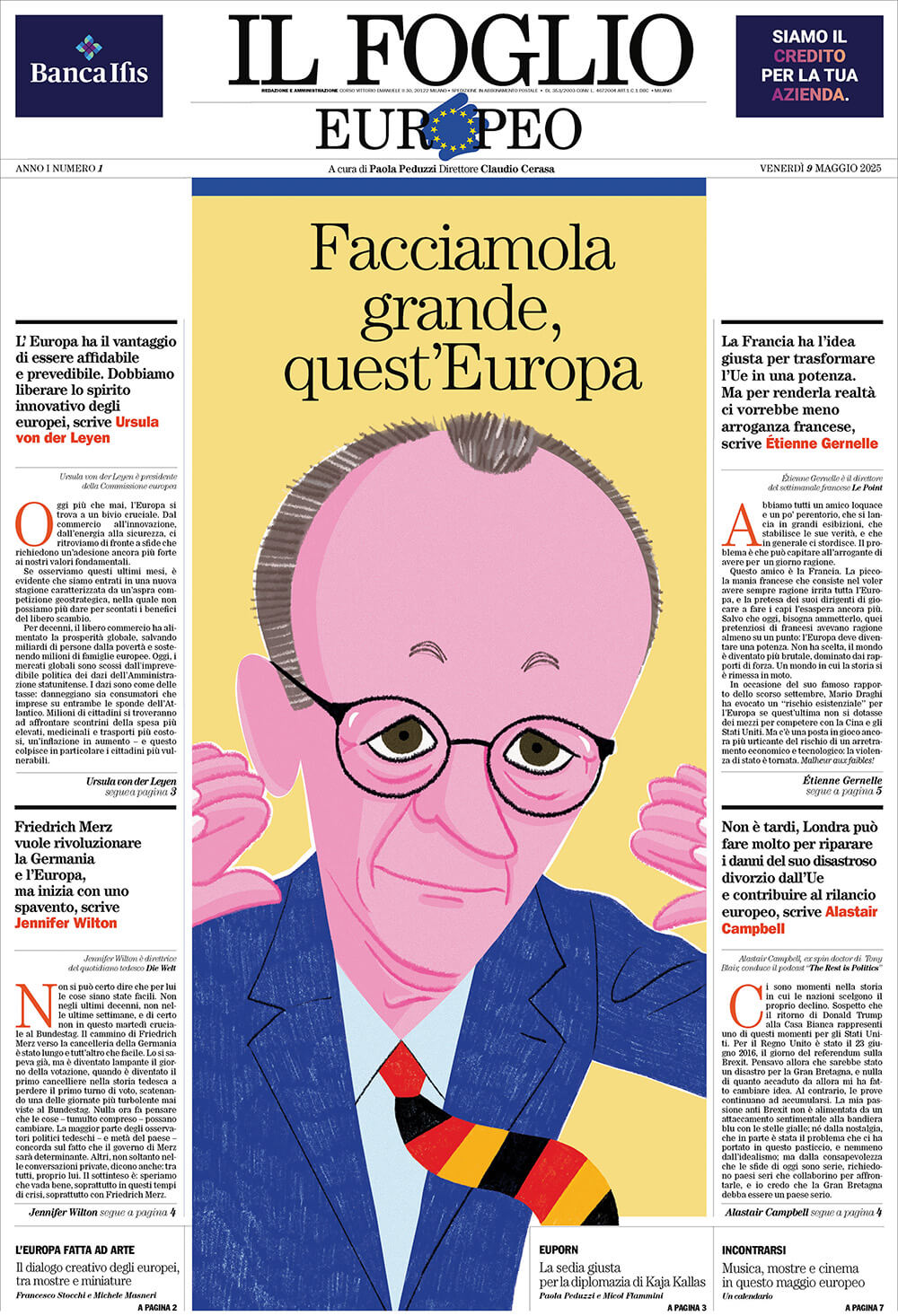
The EU in Lviv to celebrate Europe with Ukraine
After an informal meeting in Warsaw, the foreign ministers of the European Union will move to Lviv on Friday, May 9 on the occasion of Europe Day, as a demonstration of solidarity with Ukraine on the day when Red Square in Moscow sees soldiers and tanks parade for the eightieth anniversary of the victory in the Great Patriotic War. Eight decades after the end of the Second World War, Russia has brought war back to the Old Continent. Ongoing for more than three years, Vladimir Putin’s special military operation has not achieved any of its objectives. On the contrary: it has shown the ineffectiveness and weakness of what was supposed to be the second most powerful army in the world. But, at the moment when Donald Trump threatens to withdraw the support of the United States to Ukraine, the EU finds itself facing a decisive moment. The twenty-seven must decide whether and how to fill the American void. The multiple vetoes of Hungary make the task more difficult for the EU. The foreign ministers must discuss what to do if Budapest vetoes the extension of the sectoral sanctions against Russia (including the 200 billion in frozen sovereign assets) expiring on July 31. Another meeting of the foreign ministers is scheduled for May 19 in Brussels, followed by a meeting of the EU defense ministers. But the problems are deeper than Viktor Orbán’s pro-Russian line: the EU seems to have reached the limits of what it can do for Ukraine. The coalitions of the willing are taking over. The number of ministers present in Lviv will give an indication of which member states are ready to support Ukraine no matter the cost.
An Ecofin on Defense: in search of new billions for rearmament
The EU finance ministers are meeting on Friday, May 9 in Brussels to discuss how to finance the continent’s rearmament. The Polish presidency of the EU Council hopes to reach an agreement on the “Sure” instrument proposed by the Commission to provide 150 billion in loans to member states to purchase military equipment. The ministers must also make a first assessment of Ursula von der Leyen’s decision to suspend the rules of the Stability and Growth Pact through the “national safeguard clause” to create 650 billion in fiscal space for rearmament. The initiative has not generated great enthusiasm. Germany was the first country to officially announce the activation of the clause. The large highly indebted countries – like Italy and France – are much more cautious.
Rome is thinking about it, while Paris has already said that it will not make use of this exception. The member states geographically furthest from Russia – like Italy and Spain – have a different perception of the threat. The Polish presidency, supported by several member states, would like to open the discussion for a new common EU debt instrument that provides grants instead of loans, following the model of NextGenerationEU. But Ursula von der Leyen has so far always refused to consider the option. Today’s Ecofin is a good opportunity to relaunch. The NATO summit of heads of state and government in June should set a new target for defense spending above 3 percent of GDP.
The Commission dives into preparing the 2028–34 budget
On Wednesday, May 14, the College of Commissioners will hold an orientation debate on the Multiannual Financial Framework. Behind the acronyms Qfp (in Italian) or Mff (in English) hides the EU’s multiannual budget, which establishes which financial resources go to which policies and who pays. The next one should cover the period 2028–2034, seven years that promise to be very complicated and under pressure for the EU and its financial resources. In addition to the need to rearm in the face of the threat represented by Russia and the disengagement of the United States from Europe’s security, the EU must deal with the promised enlargement to Ukraine, Moldova, and the Western Balkan countries. Also weighing on the next multiannual budget is the debt of NextGenerationEU and the need to repay 20 billion euros a year – according to the Commission’s estimates – in capital and interest. The blanket is short and the needs are multiplying.
The Commission has already presented some ideas that are proving to be very controversial, such as the merger of the Common Agricultural Policy and the Cohesion Policy into a single national check that should be disbursed based on a series of commitments in terms of reforms and investments. The model is that of the Recovery and Resilience Plans of NextGenerationEU.
But it is not liked by the countries that benefit most from the agriculture and cohesion funds. The Commission’s formal proposal is expected before the summer. Then the negotiations between governments and with the European Parliament will begin. Unanimity among the twenty-seven member states is required. Looking at previous examples, the negotiation could last until summer 2026.
Simplifying the EU
The word “Omnibus” in the EU has become synonymous with “simplification.” In her policy speech, von der Leyen had promised a package to reduce bureaucracy for businesses. It was supposed to be a single “Omnibus” measure that included amendments to legislation in different sectors. Then the packages became two: one on “reporting” obligations, the other on rules related to investments. Six months after the start of the second term, the Commission is preparing to present a string of Omnibus packages. On May 14 the Omnibus on agriculture, on May 21 on medium-sized enterprises, on June 17 on defense. The Omnibus on small midcap companies (medium-sized enterprises) will be particularly interesting. The Commission could decide to apply to companies with fewer than 500 employees the same exemptions currently guaranteed to Small and Medium Enterprises. The 250-employee threshold of SMEs becomes a barrier to their growth if exceeding that number of employees means having to bear all the European bureaucracy.
The summit of the European Political Community
The heads of state and government of the EU and of about twenty other countries will meet on May 16 in Tirana for the summit of the European Political Community (EPC). The creation of Emmanuel Macron, who launched the EPC after the beginning of Russia’s war of aggression against Ukraine to discuss strategic issues affecting both EU and non-EU countries, is becoming increasingly relevant. In addition to the Russian threat, it is Trump who is forcing all of Europe to unite around essential common interests, even in the form of coalitions of the willing. The EPC had allowed a first rapprochement between the EU and the United Kingdom after Brexit. At the Tirana summit, the architecture of European security should be the dominant theme. It will also be the first major European meeting attended by the new German chancellor, Friedrich Merz. The president of the European Council, António Costa, is thinking of organizing another informal summit limited to the twenty-seven. In Brussels as in many capitals, starting with Paris, the need to reactivate the Franco-German engine is increasingly felt. During his two terms, Emmanuel Macron has not found in either Angela Merkel or Olaf Scholz a partner up to his ambitions for the EU.
The reset after Brexit
Keir Starmer on one side, Ursula von der Leyen and Antonio Costa on the other. On Monday, May 19, the United Kingdom and the EU should announce the great “reset” of their relations after Brexit. It has been almost nine years since the referendum of June 23, 2016 that narrowly decided the exit from the EU. A chaotic period in relations followed, and some red lines have remained.
Labour Prime Minister Starmer, during the electoral campaign, promised not to re-enter the EU, nor its single market nor the customs union. Only in case of a second mandate could Starmer pursue a deep rapprochement. But the United Kingdom’s economic difficulties and the international upheavals caused by Russia’s war in Ukraine and Trump’s return to the White House make the “reset” necessary. At the May 19 summit a partnership on defense and security should be signed, which will allow the British to open the door to EU rearmament programs. Starmer is willing to make other concessions unimaginable for the brexiters: a fishing agreement, a youth mobility agreement, an agreement on sanitary and phytosanitary controls to facilitate the circulation of goods.
The United Kingdom will have to align itself with EU legislation and accept the jurisdiction of the EU Court of Justice. In London, von der Leyen said: “We are friends and we are Europeans, and we think the same way. We share the same interests and the same values. We face the same challenges, but we are also complementary in defending our democracies.”