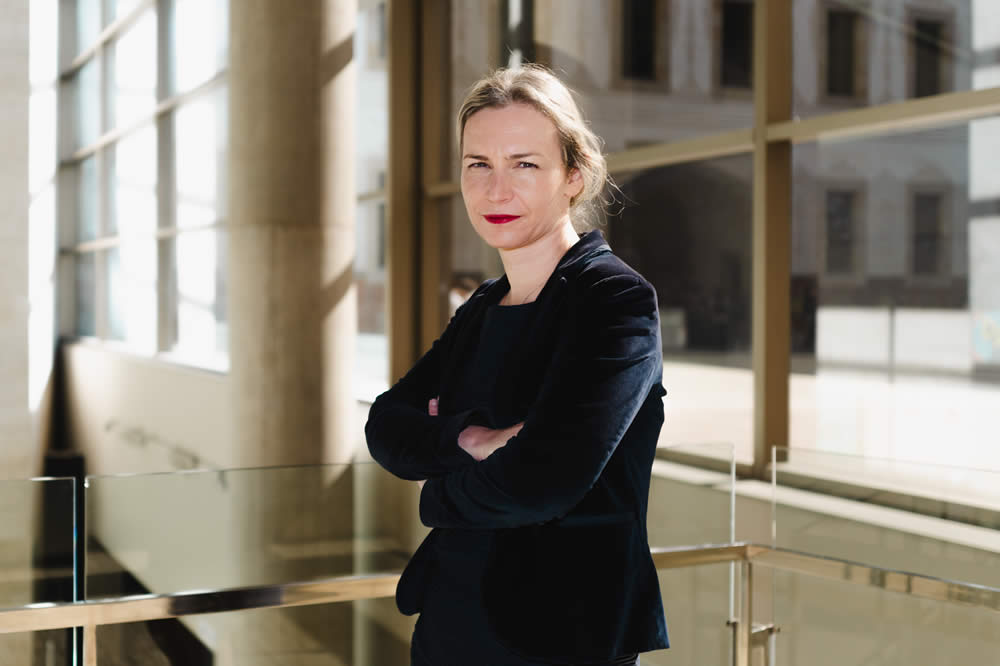
I had been living in London since 2010, says Lea Ypi, but in 2016 “I wasn’t yet a British citizen, I wasn’t a European citizen, I was only an Albanian citizen, and for the first time my ambition to simply be a citizen of the world was shattered: I have to apply for citizenship here before it’s too late, I told myself”. Ypi teaches at the London School of Economics and writes books that blend her personal story with that of parts of Europe.
A work permit, in the UK as it was before Brexit, was sufficient, but then between 2015 and 2016 the ‘take back control’ rhetoric began, the vote to leave the EU won in the referendum and foreigners no longer felt safe. “In those months, the regularisation procedures had begun and I took advantage of them,” says Lea Ypi, “with that resurgence of sovereignty, all my cosmopolitanism was no longer of any use.” She smiles when she says there were bizarre moments, for her, an Albanian from a country that would do anything to join the European Union (membership is no longer a distant prospect): “Others have also discovered that European citizenship can mean exclusion. The British used to say to me: now we’ll have to queue outside the EU one, and I’d think: Welcome to my world,” she says with a twinkle that flashes across her eyes so often it seems to live there. “We’ve always been in the other queue! And even the Europeans living in the UK would say to me: now we’ll be excluded, and I’d say again: welcome to my world. Many, like us Albanians, have experienced this exclusion for decades, and with the referendum, the British and Europeans have also entered the reality in which we have always lived.” Ypi is convinced that democratic citizenship is not synonymous with inclusion; she pays more attention to those who have been overlooked, left out, or left behind than to those who wield power, because the system either works for everyone or it doesn’t; the wrong queues shouldn’t exist at all.
It is human capital that interests me: for ten years we have been assessing the costs of Brexit for the British and for Europeans; it is always a calculation with a minus sign in front. Perhaps there has been some compensation, but this divorce has not been a good deal for anyone. But how do you measure the fact that we socialise less, work together less, exchange fewer ideas – in short, that we no longer live in the same chaotic family? There is no precise answer; one can gather up decades of anecdotes about the loss of familiarity – which is ultimately a lack of communication, of meetings, of chance chats – but nostalgia mingles with the ability to get used to everything, even silly separations. Lea Ypi finds a measure of it: the impoverishment of universities. “Not mine,” she says, “which is well-funded, like Oxford or Cambridge; here, students arrive and we keep our jobs. But elsewhere, over the last two or three years, there have been many redundancies.” I’m thinking of the University of Essex, which is public and renowned, a centre of excellence: in one department, eight out of twelve lecturers were recently made redundant. This means dismantling not only the lives of individuals, but a social fabric that will be difficult to rebuild.” So that’s how it went: Brexit was meant to shake off the bureaucratic ballast typical of Brussels and ended up doing the exact opposite – all we hear about are forms to fill in at customs, requests for special treatment for certain products, and exceptions on stamped paper; it wanted to give a voice to the people against the elites, a major shake-up of the establishment, and it ends up with “the ruling class consisting mainly of the economic elite in power,” says Ypi. “There is no longer the social mobility that existed before: those living in the peripheries in the broadest sense are increasingly condemned to remain in the peripheries, and those who already had means and access have even more.” In short, we are importing America’s flaws, and yet Trump’s excesses towards foreigners, including Europeans, should have created a new space for freedom and knowledge in Europe, but the UK had started early, and sooner, with its nationalist isolationism, “There was a massive brain drain, especially of Europeans who went back home,” says Ypi, “because until the referendum very few Europeans had applied for British citizenship: they didn’t need it, they were all European anyway. Then, however, it became necessary and many preferred to leave, to the extent that huge gaps were created in the labour market: ‘the little things, the symbols, matter’—if you no longer feel welcome, you leave. Thus British society has frayed: ‘the knowledge needed to transform a country is no longer being generated’ and differences, disagreements and divisions are growing.
That must be why Nigel Farage, ten years after the referendum, is even aspiring to become Prime Minister of the UK: “Farage is anti-establishment,” says Ypi, “even when he himself is the establishment, because his movement is based on finding someone to blame, a scapegoat. First it was Europe’s fault, then nothing was resolved so it was the illegal immigrants’ fault, then we built walls and detention centres and nothing new was resolved so it’s the fault of those who aren’t yet citizens or those who are half-English and half-foreign, and so on, from one blame to the next: we’ve seen this before during the Second World War, from the Jews stealing our jobs to Auschwitz”. We need to change everything, says Ypi, “we need to change our analysis of reality, offer a genuine alternative to this hegemonic discourse, not simply tweak it, adapt it, or tone it down: we need to overturn it”. So what will the UK be like in five years’ time, closer to or further from Europe? “For a start, I don’t know if the European Union will even still exist,” concludes Lea Ypi. “If anti-establishment parties keep winning across Europe, they’ll end up dismantling the EU, because they want to ‘make their countries great’ and couldn’t care less about the rest. Viktor Orbán has been trying this for a long time in Hungary, but he’s certainly not the only one. If all European states think only of themselves, if nationalism prevails, the European project cannot survive: to stay in this, you have to make some sacrifices.” There you have it: the sacrifices, the ones the British no longer wanted to make, ending up giving up even the benefits, the trade, the ideas: alone, yes, but certainly not happy.