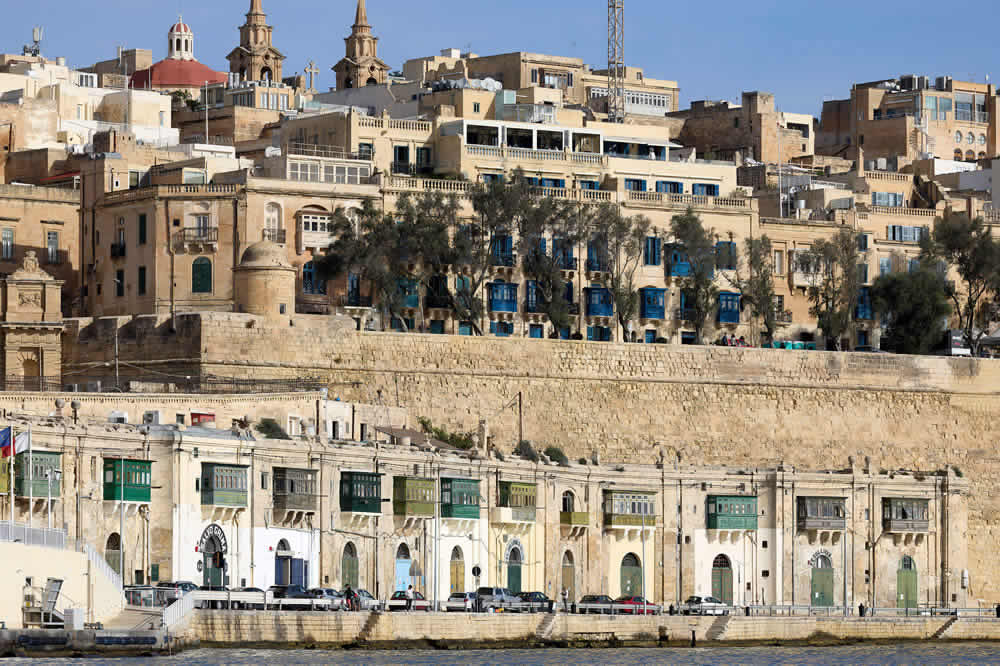
Valletta, Malta
Mdina makes no noise even in August, despite the pressure and crowds of tourists, many of them Italian. It’s been called the “Silent City” ever since the 18th century, when the nobility moved to Valletta and left behind these golden limestone alleyways. Across the Grand Harbour, the Three Cities answer with names the Knights of St. John chose to intimidate: Vittoriosa, Cospicua, and Senglea, which still carries the title “City Unconquered,” coined after the Great Siege of 1565. Prickly pears and capers grow among the limestone, plants that survive on this great rock where fresh water has always been a luxury. The country’s other main island, besides the natural paradise of the Comino reserve, is Gozo, which, according to tradition and philologists, is said to be Calypso’s island from the Odyssey — a detail that confirms an idea Malta has always cultivated: staying hidden from the world while sitting right in the middle of its trade routes.
The language tells the same story of layered history. Maltese is still spoken by nearly the entire population, with English close behind, but until the 1930s the role of third official language belonged to Italian, used by the educated elite in the courts and administration. Today, in the bars of Sliema, you hear a hybrid English, halfway between the British variety inherited from colonialism and certain cadences that, to an Italian ear, sound almost Sicilian. The Maltese seem to view their own language — which still carries traces of the Norman Arabic extinct everywhere except here — as the last bastion of identity on an island that, in every other respect, has learned to bend to whoever passed through: Phoenicians, Arabs, Knights, the British.
The economy obeys the same logic of permanent adaptation. The services sector generates 80.6 percent of Malta’s GDP and employs 81.3 percent of the workforce, with finance as the leading segment: assets worth more than 500 percent of GDP, and a contribution of roughly 15 percent to public revenue. The real estate market reflects the same vocation: average prices around €3,300 per square meter nationally, rising to €7,500 in the Valletta-Sliema-Saint Julian’s belt, with 2026 growth estimated between 4 and 7 percent in nominal terms. There is no annual property wealth tax; the registration tax stands at 5 percent, and tax on rental income remains flat at 15 percent.
No sector embodies this rule better than iGaming. More than three hundred companies are based on the island, between consumer-facing operators and technology providers. Betsson Group, legally headquartered in Ta’ Xbiex and listed in Stockholm, generated around €1.1 billion in revenue in Malta in 2024. Kindred Group, which owns brands like Unibet and 32Red, closed 2025 at the top of the local ranking with $1.6 billion, followed by Betsson with $1 billion and Tipico with $950 million. Alongside the operators, a whole technology supply chain has grown up, made up of companies like Softswiss, EveryMatrix, Evolution Gaming, and Playtech, which found favorable tax rates and an already-mature professional ecosystem in Malta.
I meet Marek one evening in Saint Julian’s, the neighborhood most in vogue among the local young expat crowd. He’s sitting on a low wall near Spinola Bay with a beer in hand, waiting for a colleague for a game of padel. Twenty-eight years old, from Košice, Slovakia, he’s worked for three years for a sports betting operator with an MGA license, where he handles retention — the part of the business that studies player behavior to figure out when and how to nudge them into coming back to play. He tells his story with a casual, slightly cocky confidence. “In Košice I earned half as much, working more,” Marek says. “The income tax rate is lower, rent is expensive but manageable if you share, and above all, there’s an actual career path here.” He started in customer support, he explains: after a year he moved into client management (CRM), and the next step might be a key-account-manager role somewhere else — without even having to change neighborhoods. Mobility between competing operators is so high that some job interviews happen in the very same bar, between people who might end up as colleagues within a few months. Financially, Marek has no doubts: iGaming gave him in three years what would have taken a decade in Slovakia — a salary that lets him save, travel, and think of Malta as a stable base rather than a stopover. Ethically, the question sits less comfortably with him. He admits that in his first months he considered quitting after reading certain reports on gambling addiction: “My job is figuring out who’s at risk of quitting and sending them an offer so they don’t. Put that way, it sounds awful.” He adds, though, that he genuinely applies, every day, the limits required by the license: self-exclusion thresholds, deposit checks, daily time caps, and automatic alerts. MGA (Malta Gaming Authority) regulation imposes stricter responsible-gambling requirements than he expected, though he remains convinced their effectiveness depends on the good faith of whoever applies them, company by company.
I ask him whether he feels part of an industry that exports a social problem to the countries its players live in while pocketing the profits in Malta. He thinks about it for a moment. “It’s a fair point, and I don’t have a comfortable answer. Most of our customers are in Germany and Sweden, and the gaming tax we pay here only applies to Malta residents — an irrelevant minority compared to total revenue. The value is created elsewhere; the taxation stays here.” On the outlook ahead, he’s less pessimistic than you might expect from someone working under mounting regulatory pressure: he believes Malta will keep attracting companies even if Germany and Austria tighten their rules, because the MGA license remains a recognized standard, and because, he says with a smile, as long as people keep betting, someone has to be headquartered somewhere.
The backstory that makes Marek’s story possible was built over a quarter-century. Malta was among the first European jurisdictions to regulate remote gambling, as early as the 2000s, when the rest of the continent still treated online gambling as a gray area. The dedicated authority — today the Malta Gaming Authority — was founded in 2001, and over two decades it has built up an edge made of specialized magistrates and banks accustomed to handling flows that elsewhere struggled to even find a bank account. The license, which since 2018 lasts ten years without annual renewal, has become a standard recognized by those who manage international payments — decisive in a sector where the real bottleneck remains payment infrastructure. On the tax side, the nominal rate stays high, but the dividend refund mechanism allows properly structured operators to bring it down close to single digits, while the actual gaming tax — 5 percent — only hits revenue from players resident on the island. On top of all this comes the European passport guaranteed by the license.
The flip side is the tension with Brussels. In 2025 the European Commission opened infringement proceedings against Malta, accused of shielding its own operators from rulings by German and Austrian courts, which had been asked to rule on refunds sought by players complaining of unfair practices. The very same rules that make the island attractive create friction every time a citizen of another member state seeks justice at home.
Behind the regulatory showcase of finance and iGaming, Malta still carries the weight of a wound that has never healed. On October 16, 2017, journalist Daphne Caruana Galizia died in a car-bomb explosion, just hours after publishing the last post on her blog Running Commentary, where for years she had documented the murky ties between political power and the offshore companies that surfaced in the Panama Papers, implicating the inner circle of then-Prime Minister Joseph Muscat. The murder sparked mass protests and led, months later, to Muscat’s own resignation. A public inquiry in 2021 found that the Maltese state had created a climate of impunity that made the assassination possible, exposing the journalist for years to personal attacks from the political class without offering her protection.
Since then, justice has moved slowly. The men who physically planted and detonated the device, from the Degiorgio brothers to Vince Muscat, have been convicted and are serving their sentences. In June 2025, life sentences also came down for those who supplied the explosives. What remains open is the chapter everyone is waiting for: that of the alleged mastermind, Yorgen Fenech, a businessman whose companies were among the subjects of Caruana Galizia’s investigations, arrested in November 2019 as he tried to leave the island by boat. His trial, postponed multiple times, including over appeals to the Constitutional Court, finally opened on July 1, 2026, in Valletta — nearly nine years after the murder. Fenech maintains his innocence and faces a life sentence. The trial carries the weight of a country that, for a decade, has been waiting to find out just how far the chain of responsibility really reaches.
Then there’s another pillar of the country’s economy, less visible but growing even more steeply: semiconductors, which revolve almost entirely around a single name, the Italian-French company STMicroelectronics. The Kirkop plant, operating since 1981, is today the largest packaging and testing facility of its kind in Europe (packaging and testing being a crucial stage in the delicate process of chip production), employing between 1,600 and 1,800 people. It handles the final stage of production, encapsulating and testing more than 1,200 products destined mainly for the automotive and telecom sectors, without including wafer fabrication. To think that seven years ago the plant was slated for closure. Then came Project KKO, and in 2025 it was recognized as Europe’s first advanced backend manufacturing facility, among the most productive in the entire group worldwide. Over 2025-2026, investment accelerated, with €250 million going toward a new plant in Ħal Kirkop dedicated to satellite and aerospace components — the largest foreign direct investment in the country’s history. At the 2025 Global Semiconductor Conference Malta, ST also unveiled its first humanoid robot deployed in production, a sign that even the island’s heavy industry follows the same logic as the rest of the Maltese economy.
This isn’t the first time Malta has gotten ahead of an emerging technology. In spring 2026, the government signed the first agreement of its kind ever concluded between OpenAI and a national government, guaranteeing a year of free ChatGPT Plus to anyone who completes a literacy course developed by the University of Malta. It’s the same ambition that in 2018 made the island the first European jurisdiction to regulate blockchain by law, and that twenty years earlier had created the remote-gambling authority when no one else in Europe yet knew what to call it. It is on that regulatory speed, more than on inventing the technologies themselves, that Malta has built its edge for twenty years.
And yet the same island that regulates blockchain, gambling, offshore finance, and now artificial intelligence with near-cynical pragmatism remains one of the most conservative states in Europe on issues like abortion and civil rights, where the Catholic Church retains a degree of public influence now rare in the rest of Western Europe. These are two axes that, in Maltese public debate, remain almost entirely disconnected: on one side, what Maltese people can do in their own private lives, firmly guarded by religious tradition; on the other, what a foreign company registered on the island can do in international markets, managed with the cold logic of tax attractiveness.
The precedent, in the end, is an old one. The Knights of St. John, who gave the Three Cities their honorific names after the Great Siege, were a religious-military order whose extremely strict theology coexisted without apparent contradiction with a wartime economy built on corsairing — legalized piracy against Ottoman ships that funded a good part of the Order’s coffers. Since then, Malta has learned to hold its identity core firmly in place while letting its external economy do whatever it takes to survive on a rock thirty-two kilometers by twenty-seven, wedged between Sicily and North Africa, with no natural resources of its own beyond its geographic position, a fair dose of corruption swept, English-style, under the rug, and a particular talent for sensing, ahead of everyone else, which way the world is heading.