Let’s talk about young European cinema, yes – but first, let’s set what the average age is to be considered a young European filmmaker. In Italy, if we take the David di Donatello award for Best Directorial Debut as a reference, this year it was deservedly won by Margherita Vicario, who is 37. “Gloria!” is a passionate and timeless debut, ageless in essence, but the age of its author seems to be about average, I’d say, for Italian first-time directors.
In Europe, where there are stronger protections for young filmmakers (young how young? – I’ll get to that), especially in some countries with more supportive film industries, people might debut slightly earlier, but not by much – at least if we use local film awards as a benchmark. Here are some of the main ones.
France: the César for Best First Film this year went to the lovely “Vingt dieux” (released in Italy in late June as “Tutto in un’estate!” – yes, with an exclamation point, even though it’s a bittersweet coming-of-age story). Its talented director, Louise Courvoisier, is 31. Spain: the 2025 Goya for Best Debut went to Javier Macipe Costa, age 37, for “La estrella azul”, which has yet to be released in Italy. And then there’s the European Film Award (EFA), which is meant to represent the entire continent. Last December, the award for Best Debut – called “revelation” in that context – went to the intriguing “Armand”, which was also released in Italian cinemas. It was directed by Halfdan Ullmann Tøndel, who happens to be the grandson of Ingmar Bergman and Liv Ullmann. He’s 35.
So, this isn’t exactly a continent for the young – or at least not for the very young. So where do the new voices come from, where do we find them? I’ll pick one, and go back to Spain, a country rich in fresh perspectives, female directors, and new gazes – in both writing and directing. Leaving aside Pedro (a national and global treasure), my personal favorite – and arguably the best currently active – is Rodrigo Sorogoyen, with a stunning filmography that spans both cinema (“God Save Us”, “The Realm”, “Mother”, and especially “The Beasts”) and TV series (“Antidisturbios – Riot Police”, and the recent “The New Years”). He makes proudly popular entertainment that still weaves in politics, economics, and the cultural and social differences that are both Europe’s joy and, more than ever, its burden (take the clash between native Spaniards and eco-conscious French newcomers in The Beasts’ Galician countryside—it’s practically a thesis that should be studied by Brussels committees). But Sorogoyen is 43, so he’s outside the scope of our discussion.
Another prodigious Spanish filmmaker is Carla Simón, now 38, but she debuted at age 30, so I’m choosing her – retroactively. Her first film, “Summer 1993”, released in 2017, is a story of childhood, family, place, and memory. A beautiful, small film that signaled a new voice. With “Alcarràs” (2022), she won the Golden Bear in Berlin – something that usually doesn’t happen to young directors (she was 36 at the time).
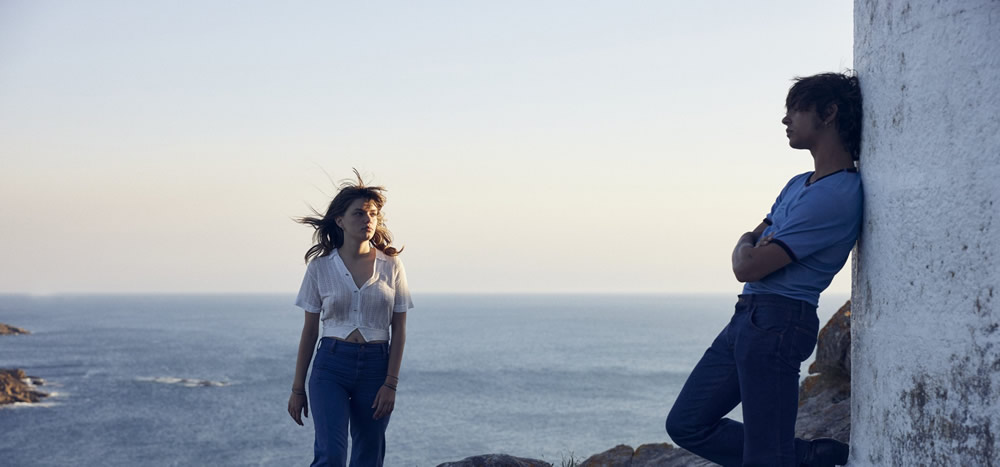
She reminds one of Sorogoyen for her focus on agriculture and its decline, on class difference – but while he focuses on society, she keeps the family at the center (or perhaps treats the family as a stand-in for society as a whole). “Alcarràs” is a great film with Catalan roots but a communal spirit – if we’re to draw a link with European identity and belonging. Her third film, “Romería”, was in competition this year at Cannes: another story set on the margins, of both place and people. A young woman returns to her provincial hometown to investigate the death of her father from AIDS when she was a child. Seek out her films.
I choose Spain because, among the many films and countries I encounter (and they are truly many), it seems to me the national cinema with the strongest sense of community. It feels compelled to tell its stories within History, and wherever possible, to frame them in the broader tableau of the world’s many provinces – each with its own stories, all different and all the same. Europe, after all, has now become a province of global cinema, a micro-macro industry made of a thousand smaller industries. And its only response to the mainstream is its art – or rather, its craftsmanship, without any rhetoric – like that of Simón’s farmers.
I interview many directors, including young ones, but never quite young enough to make me say: everything has changed, cinema has awakened, and it knows it must start from scratch. And in the end, those who best tell the story of Europe – and its ever-possible, ever-thwarted spirit of community – are still the old masters. One film comes to mind, magnificent and from quite a few years ago now, in 2003: “A Talking Picture” by Manoel de Oliveira, then 95 (!) years old, and forever the youngest of them all. On a cruise ship, several passengers gather around a table: Catherine Deneuve speaks in French, Stefania Sandrelli in Italian, Irene Papas in Greek, the captain – John Malkovich – in English. Everyone understands each other. Including the Portuguese director, who directed them in all those different languages.
I interview many directors, including young ones – and about a year ago, I met one who seemed noticeably younger than the rest. The film was “Toni, en famille” (released in Italy as “Ricomincio da me”), and I was talking with lead actress Camille Cottin, the radiant Andrea from “Call My Agent!”, and the director, Nathan Ambrosioni. He struck me as especially young, and indeed, he was just 25 at the time. A 25-year-old directing a film about a woman in her 40s, a former pop hopeful who gave up her career to raise five children on her own. Now that the kids are grown, what will she do “as an adult”? The fact that such a question comes from someone so young, about a woman much older than him, is telling: beautiful things can still happen in Europe – and in European cinema. And then you think: sure, but it’s easier in France. Cinema is more supported, and so are young auteurs. And watching the great films made elsewhere, you come back to being a localist – and maybe, in that sense, truly European.