September has arrived cruel in Ceuta, with the cleanup of the schools that, over the summer, served as shelter for the migrants stranded in the Spanish exclave in North Africa — above all unaccompanied minors, so many, so many girls: the schools are needed by Ceuta’s own students, who rightly have to go back to their desks to build their future. No one is talking about the right to education of the Moroccan minors who arrived in Ceuta; the entire conversation is about how to move them out, how to clean up, how to erase the traces of this wave of migrants that swept over Ceuta in the middle of summer and then receded, leaving behind roughly three thousand people — the niños and niñas, many of whom arrived with their parents, who have since left again. The children did not. The children stayed, following the harsh and ruthless logic that it’s better to grow up far from home, without affection, without care, but in a land of opportunity. Except that Ceuta, and Spain, and in the end all of Europe, have become inhospitable, and this journey — often fatal — from Morocco to Ceuta has revealed a further distortion: xenophobic rhetoric is no longer confined to talk shows or ugly corners of social media, it has become ordinary conversation about immigration — from America all the way here, in our countries of first arrival, in the countries of second arrival, where the actual numbers matter little and what counts is “perception,” the scourge of times that, indeed, haven’t been this bleak in a long while.
In Ceuta, the lack of hospitality is a physical fact: there is no room for the boys and girls who remain, and a solution has to be found. The government in Madrid is considering a gradual relocation of unaccompanied minors to various regions, but people in the exclave are exhausted and furious — there isn’t a single interview in the Spanish media where someone doesn’t shout that they should all go back home. There’s an understandable exhaustion behind these complaints, and Ceuta’s authorities took it into account when they decided not to postpone the reopening of schools — set for September 8 — as had seemed inevitable in the preceding weeks. Yet their statements also betray a wish not to hand ammunition to those who decry an “invasion”: there could be no better talking point than Spanish students’ return to school being ruined because of these — can we call them that? — foreign students, who arrived desperate and undocumented.
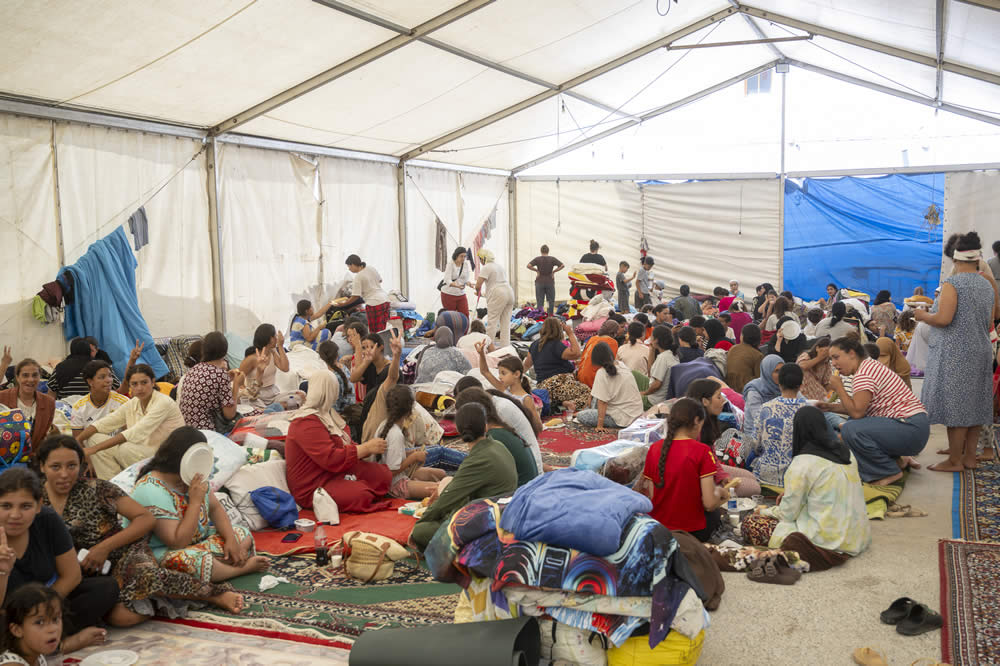
In the Príncipe Alfonso neighborhood — in southern Ceuta, along the N-352, which links the city center to the border with Morocco, and the setting for a well-known TV series, “El Príncipe,” which tells a story of terrorism, illegal trafficking, and moments of grace not far removed from reality — the two schools named after Queen Sofía and Prince Felipe were turned into makeshift shelters, mostly in the outdoor areas, where huts made of bedsheets, like something out of a children’s game, have served as migrants’ refuges for over a month. Refuges, yes, because outside those sheets — barely stirring in the hottest summer on record — the young people could not stay, especially the girls. Assaults and sexual violence have marked these weeks; the numbers aren’t confirmed, but they’re enough to terrify girls who no longer want to go outside, even as food runs short, even as they suffer in the heat — and enough, too, to fuel complaints from Ceuta’s residents, who are also afraid to go out, because the migrants are dangerous. Just as with the right to education, no one ever raises the fact that if reception conditions were decent, there would be no need for people to wander the city hungry and exhausted — though it’s also true that the existing facilities were designed, for emergencies, to hold 500 people, and now six times that number are needed.
The life of Ceuta and its uninvited guests has become tangled in the web of xenophobic propaganda and the slow pace of the Madrid government; September has arrived loaded with its promises, and the migrant children who don’t know where they’ll be tomorrow — who know only that their makeshift shelters are now needed by other children, for school — have nothing left but to tell their own stories, or draw them. Ishan is 17. She draws a soccer field; she’d like to become a footballer in Spain, and on her team are other girls she met under the sheets. On the other side of the page is the sea, and the rocks, and many heads emerging from the water, stylized bodies, surfboards, small bottles, T-shirts, and a few crosses: “This is the people who died,” she says. Nada has drawn a green circle — it’s her heart, she says, and it’s full of hope; around it are lines that look like barbed wire — that’s the pain, she says. Fatima draws clothes; she wants to be a fashion designer. Salma has drawn a uniform; she’s on a video call with her mother: I’m here for you, her mother tells her, and she smiles and cries.