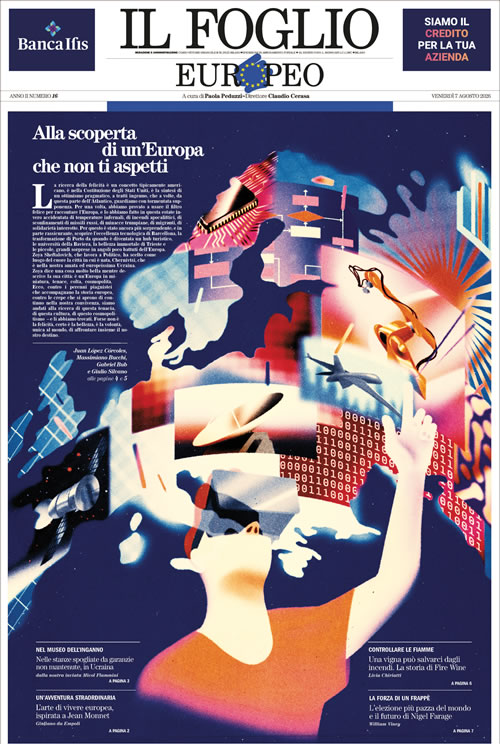
The Ukrainian city that is like a miniature Europe: cultured, tenacious, cosmopolitan. The British Orkney Islands, Bertolt Brecht’s home and the magnificent Trieste. A round-up of opinions on the places where the European spirit resides.
What makes a city European? Each of us has in mind a place – both real and ideal – that represents the very essence of Europeanism, of the European identity. We asked leading figures from the European media landscape to tell us which place, for them, best embodies this European spirit – bridging the past and the future, and offering a broad vision of our shared space.
My pick is Chernivtsi, which just happens to be my hometown in western Ukraine. It’s a lively, beautiful city where Ukrainian, Romanian, Jewish, Polish and Austro-Hungarian influences all come together in its Habsburg architecture, bustling pedestrian boulevards and spectacular UNESCO-listed university. To me, it feels like Europe in miniature: cultured, resilient and cosmopolitan.
Zoya Sheftalovich – POLITICO’s Chief EU Correspondent and host of the Brussels Playbook Podcast.
Tucked into a narrow strip of land between the Adriatic Sea and the Slovenian border is a city that is fiercely, beautifully, and uniquely European. It’s called Trieste, and it has a fair claim to being Europe’s ultimate geopolitical and cultural crossroads: the point where the Latin, Slavic, and Germanic worlds collide.
For centuries, Trieste served as the primary seaport for the Austro-Hungarian Empire. That heritage gifted it the grand, sweeping architecture of Vienna, the intellectual café culture of Central Europe, and a rich, multilingual culture and identity where Italian is the primary tongue, Slovenian is widely spoken, and the ghost of German lingers in its heritage.
Trieste doesn’t look like Florence or Rome; it looks like Austria went on a particularly enjoyable Mediterranean holiday. Its crown jewel, the magnificent Piazza Unità d’Italia, is Europe’s largest sea-facing square, flanked on three sides by monumental, illuminated Habsburg palaces.
The great literary minds of Europe – James Joyce, Italo Svevo, Rainer Maria Rilke – all fell under its spell. That diversity extends to its skyline, too, marked by a striking mix of Catholic cathedrals, one of Europe’s largest synagogues, a beautiful Serbian Orthodox temple, and historic Greek Orthodox churches.
And perhaps best of all, in an era of low-cost flights and overtourism, Trieste remains largely off the beaten track. If you want to breathe in the deep and complex history of Europe without pushing through crowds to do it, this is your place.
Jon Henley, The Guardian correspondent based in Paris
Orkney is British by accident; the island just off the tip of mainland Scotland’s most northern point was pawned in 1468 by the Danish king Christian the First as security against his daughter’s dowry. He never settled the bill.
Place names are Old Norse. Each May 17, Norwegian flags celebrate another nation’s Constitution Day. Local loyalties will have been split between Scotland and Norway this World Cup, though happily united against Team England.
Viking runes scar neolithic tombs at Maeshowe. Beneath Scapa Flow, the Kaiser’s scuttled fleet rusts. One world war later, Italian prisoners of war converted two camp huts into a baroque chapel; the glorious spirit of Bernini lives in this rugged, majestic landscape.
In the capital, Kirkwall, a red sandstone cathedral is named for the Norwegian saint Magnus. But for the real magic of Orkney, arrive on the 90-minute ferry from Scrabster to Stromness, and make the short walk from the pier to the foot of the town’s ancient and winding main street to the Stromness Hotel. Find a place at the bar and order a pint of Orkney Brewery’s Dark Island. It is, and I do not say this lightly, Europe’s finest beer. Small wonder the Danes are keen to have Orkney back after all these years.
Matt Kelly, founder and editor-in-chief of The New European
What makes a city particularly European? I define this quality historically. That is why, for me, we can consider only a place located on the border of cultural regions that have shaped Europe in the long term. Augsburg was founded by the Romans. Here met the Roman roads that connected Paris with Constantinople, and Northern Italy with Southern Germany. Even today, in some places, you could think that you are in Italy. European history was often written in Augsburg: Emperor Otto defeated the Hungarians outside the city—a relief for the entire continent. Jakob Fugger, the richest man of all time, from here financed emperors and kings. Gutenberg’s invention was, in the best sense, commercialized here. The Welsers, super-rich rivals of the Fuggers, founded the short-lived first German colony from here: Venezuela. It was here in 1555 that the Peace of Augsburg was signed between Catholics and Protestants. Their conflicts also played a role in the work of the city’s famous son, Bertolt Brecht. His father worked in a paper mill, whose existence was made possible by the many small canals that run through the city. Today, they are a UNESCO World Heritage site. The ability to manage water—from aqueducts to flush toilets—has always been a core European competence. Another typically European aspect of Augsburg is that, like the continent itself, its best days are behind it. Although the city where Rudolf Diesel invented his engine is still a technology hub, global politics is no longer conducted here as it was in the time of the Fuggers and Welsers, and a new Brecht is nowhere in sight.
Matthias Heine, writer and culture editor for the newspaper Die Welt.