One day in February 1997, Bulgarians woke up to discover that their savings were worthless. Overnight, hyperinflation had accelerated to 242 percent per month. The lev, Bulgaria’s currency, had plummeted from 70 to the dollar in the fall of 1996 to over three thousand by the new year. Nine Bulgarian banks had collapsed the previous September, and scenes reminiscent of the American Black Friday had unfolded: savers wanting to withdraw their money were forcibly kept out of financial institutions. Within a few days, gas stations had empty tanks and supermarkets had become luxury stores: people could no longer afford anything. In January, as monthly inflation reached levels unseen in Europe since Weimar Germany, protesters stormed the Parliament building in Sofia, the government fell, and the nation was on the brink of dissolution. In memory, Bulgarians consider 1997 their year zero: there had been 1989, of course, and the fall of communism, but in 1997 the choice was between chaos and national discipline, a test of responsibility. Bulgaria chose the latter, and on July 1, 1997, Ivan Kostov’s government pegged the lev to the German mark and removed the Bulgarian Central Bank’s ability to print money to save struggling banks. These were not temporary measures, but as Bulgarians proudly say, it was like preparing for the euro when the euro didn’t yet exist. That’s why they await January 1st, when Bulgaria will become the 21st country of the Eurozone, as the finish line of a thirty-year marathon, waving economic data that many other European countries with the euro would envy, such as debt at 23 percent of GDP. But they know perfectly well that in recent years Bulgaria has been famous for very different reasons: because it is the second poorest country in the EU (the first is Moldova) and because over the last four years it has descended into chaos.
Four years of instability
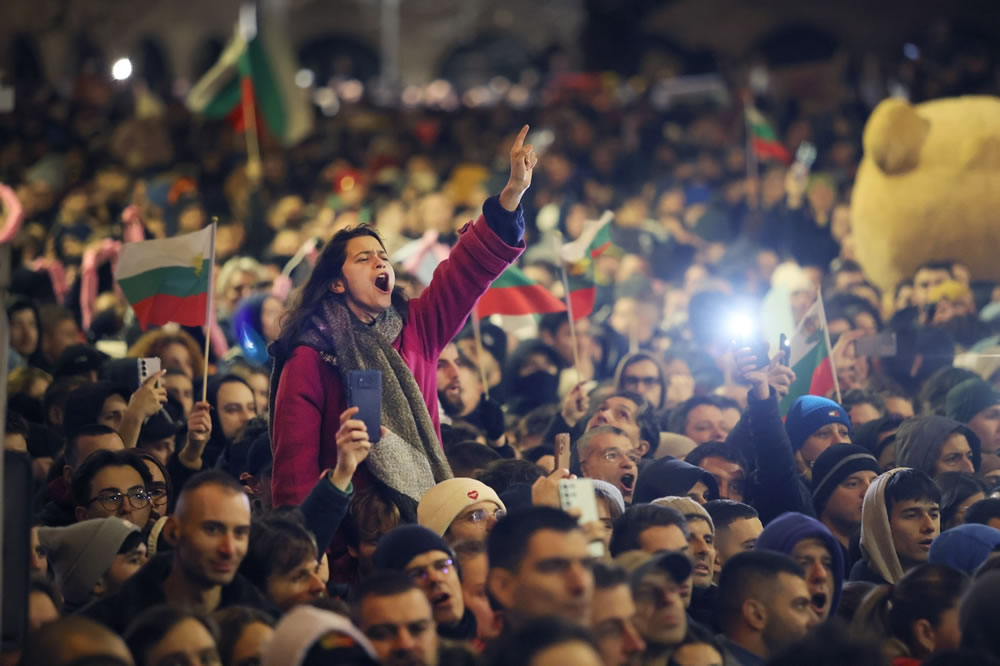
Bulgaria’s political crisis began in 2021, when a series of mass protests against corruption led to the end of Boyko Borisov’s third government. Borisov is the leader of GERB (acronym for Citizens for European Development of Bulgaria), a center-right party that is part of the European People’s Party. A karate enthusiast—he was also the national team coach—Borisov worked for a long time at the Ministry of the Interior, served as mayor of Sofia, and led the country from 2009 to 2013 and then again from 2017 until the fateful 2021. Corruption allegations marked his premiership and then erupted when his term ended, and in 2022 he was accused of extortion and misappropriation of European funds. Photos of Borisov half-naked in bed with his nightstand full of 500-euro banknotes, gold bars and a gun led to a wave of demonstrations demanding the prime minister’s resignation and new leaders capable of dismantling the control Borisov exercised over the legislative and judicial system. But these leaders didn’t exist or lacked the strength to assert themselves, so over four years Bulgarians went to vote seven times: that’s how long it took to reckon with Borisov. The latest round, in October 2024, led in January of this year to the appointment as prime minister of Rosen Zhelyazkov, who belongs to Borisov’s party and worked in his governments as Minister of Transport but also as Secretary of Ministerial Affairs, a position that is at the root of much criticism against him, because it’s linked to the functioning—and therefore the funds—of government administration. These are very difficult days for him: following the presentation of the new budget on November 27, protests resumed. That evening, demonstrators formed a human chain around Parliament, and chanting “Continue changing Bulgaria” and “Democratic Bulgaria,” they clashed with police. With this budget law, public spending will reach 46 percent of GDP and will be financed by raising taxes on companies and individuals, with a swelling of debt that deeply worries economists and those who until now have been so proud of the steps taken to present themselves at the entrance to the Eurozone with their homework done.
The Arms Man
With so much political instability, Bulgaria has often been under special scrutiny. Election after election, there were fears that Sofia could become one of Putin’s tunnels to reach the heart of Europe and neutralize support for Ukraine. Instead, the country has continued to do its work—with a shaky politics and the distrust of its citizens who most recently took to the streets against the budget law—supplying arms to Ukraine, often in secret, partly because it has a substantial defense industry and a man who, while not admitting it, began helping Kyiv well before February 24, 2022, the day of the start of Russia’s large-scale invasion. Emilian Gebrev is a Bulgarian arms dealer, known for several reasons, and although he would have preferred to continue doing his work without too much fanfare, it was Russia that made him famous. Gebrev survived a poisoning attempt: it was 2015, the businessman was dining at a luxury hotel in Sofia when he began having hallucinations, vomiting, pain, and ended up in a coma. These were the same symptoms that a few years later afflicted former GRU spy (Russian military intelligence) Sergei Skripal and Kremlin opponent Alexei Navalny: all had come into contact with a powerful nerve agent, Novichok, produced in Moscow laboratories. Gebrev survived; his son and the director of his company were also poisoned, all three in different places—Russian agents had followed them and managed to strike. The motive for these murder attempts was not related to the GRU spy agency, as in Skripal’s case, nor was it related to opposition to Putin’s regime, as in Navalny’s case, but was linked to Ukraine and Gebrev’s activity in supplying Kyiv to resist the invasion that had already begun in 2014. Gebrev was a man Moscow needed to stop; the men of GRU Unit 29155 who carried Novichok around Europe had already tried to hit him in another way, by blowing up an arms depot in the Czech Republic, in Vrbětice. The depot contained a shipment of ammunition already paid for by Gebrev that could have had two destinations: Ukraine or Syrian groups fighting against dictator Bashar al-Assad. In 2022, when Putin’s invasion had become total, an arms depot exploded in Karnobat, Bulgaria. The facility was also owned by Gebrev.
The Shared Sea
If the Russian threat is such a close subject for Bulgarians, it’s also a matter of position and that enclosed sea shared by six nations that for twelve years have felt war drawing ever closer. Bulgaria’s coast faces the Black Sea; the war is not just reported, it is felt. Sofia has had to change its approach to security while relying on limited and outdated naval capabilities. The bulk of support comes from the Atlantic Alliance, which has facilitated the creation of a Regional Command of Bulgarian and Romanian forces—Bulgaria and Romania face the same threat and share the same sea. A multinational NATO contingent led by Italy is stationed in Bulgaria, and for the country the issue is not only military but also economic. Sofia looks at the war and where it once had a sea that provided trade and energy possibilities, it now increasingly has a wall. Despite political difficulties, it is committed to increasing defense spending, aware that Moscow has not stopped considering it among the most penetrable members of the European Union, euro or no euro.