The research center at Yale University that has been monitoring for years the forced removals and deportations of Ukrainian children by Russia could shut down any day now, “unless we receive further individual donations or Europe finally steps up,” Nathaniel Raymond, executive director of Yale’s Humanitarian Research Lab (HRL), tells Foglio Europeo.
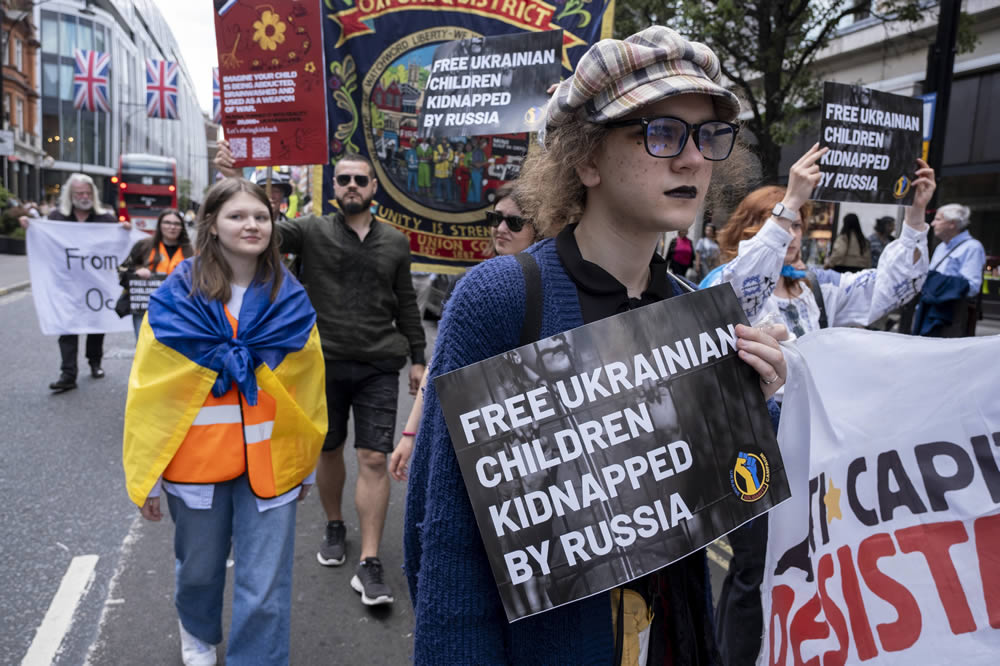
In February 2025, the Trump Administration cut funding for this research program that documents what is happening to thousands of Ukrainian children, forcibly removed from their country and their families, subjected to re-education programs and in some cases to military training. The data collected by the research center directed by Raymond serves to prove a crime for which, since March 2023, the International Criminal Court has issued arrest warrants for Vladimir Putin and for the Russian Commissioner for Children’s Rights Maria Lvova-Belova. Should the center close, its substantial archive could be transferred to Europol, the European agency for investigative activities.
Only estimates can be made regarding how many minors have been forcibly removed from Ukraine. The most recent estimate from the Yale center is approximately 35,000 minors, which nearly doubles the number, about 19,000, that Kyiv authorities had previously released. To increase the degree of certainty regarding this figure – or an even higher one – the Humanitarian Research Lab would need to continue operating. Since they are no longer funded by the American government, they have carried on with online donations from private citizens – sometimes elderly ladies of Ukrainian origin – which however do not cover the costs necessary to remain open. So they turned to Europe. Last November, the European Parliament approved a document in which it “regrets the suspension of U.S. federal funding for the renowned investigation by the Yale Humanitarian Research Lab” and calls on the EU and member states to “ensure that this crucial research and data collection continue,” but it was a motion, not a legally binding text. Raymond reiterates that what is at stake is not a research laboratory at Yale but “Ukraine’s ability to know how many of its children have been taken away, where they are, who they are, and to facilitate their return.”
At the request of the U.S. State Department, since the summer of 2022 the Humanitarian Research Lab has begun investigating with open source means – primarily very high-resolution satellite imagery and cross-confirmations from at least five independent sources – the existence in Russia and in occupied territories of facilities where Ukrainian minors have been taken. According to their latest report, at least 210 facilities are involved, including hospitals, orphanages, churches, monasteries, summer camps, military bases, and others. In more than half of the facilities, cultural, patriotic, or military re-education programs are conducted aligned with the Russian narrative of events and the war. In 18.6 percent of the total facilities examined, military training programs are carried out, in which young Ukrainians are indoctrinated and also initiated into activities such as the production of war equipment, the assembly of drones, or instructed for ceremonial parades. Many facilities have expanded or are expanding – for example, two new cadet schools have recently been built – and the Russian government directly manages at least half of these places, probably even more. “The Humanitarian Research Lab can conclude,” the report reads, “that Russia is operating a potentially unprecedented system of large-scale re-education, military training, and residential facilities capable of housing tens of thousands of Ukrainian children for long periods of time.”
The Yale expert explains that Ukrainian minors inserted into this network of facilities can be analyzed by distinguishing four groups. The first group consists of children deported to summer camps for pro-Russian re-education, in some cases returned home after a certain period of time. The second consists of minors without parents or guardians, taken from Ukrainian institutions, and among them there also appear to be some with physical disabilities. “They constitute the majority if not all of the children who ended up in adoption and foster care programs,” adds Raymond. In the third case, these are children forcibly separated from their parents in areas where the first fighting took place in 2022; finally, the fourth group is formed by children taken from families that same year in the so-called Russian filtration camps established in Mariupol.
One of the significant aspects of this forced Russification program concerns the presence of psychologists. Although Raymond clarifies that it is not currently possible to establish the extent to which Russia has used its mental health professionals for the indoctrination of children and young people, he adds that based on an official Russian document they examined, the government provides “advice to psychologists affiliated with the Ministry of Education to engage in mental health interventions” with these children, using as a pretext the very fact that they had been separated from their homes and communities of origin. This would be a further branch for the Humanitarian Research Lab’s investigations, if only time and money weren’t about to run out. On the part of European institutions and countries, “the reluctance to fund us is due to fear of retaliation from the Trump Administration,” Raymond emphasizes, concluding: “Europe’s inability to act in this case is an indictment of its willingness to defend its own values precisely now that they are under siege.”